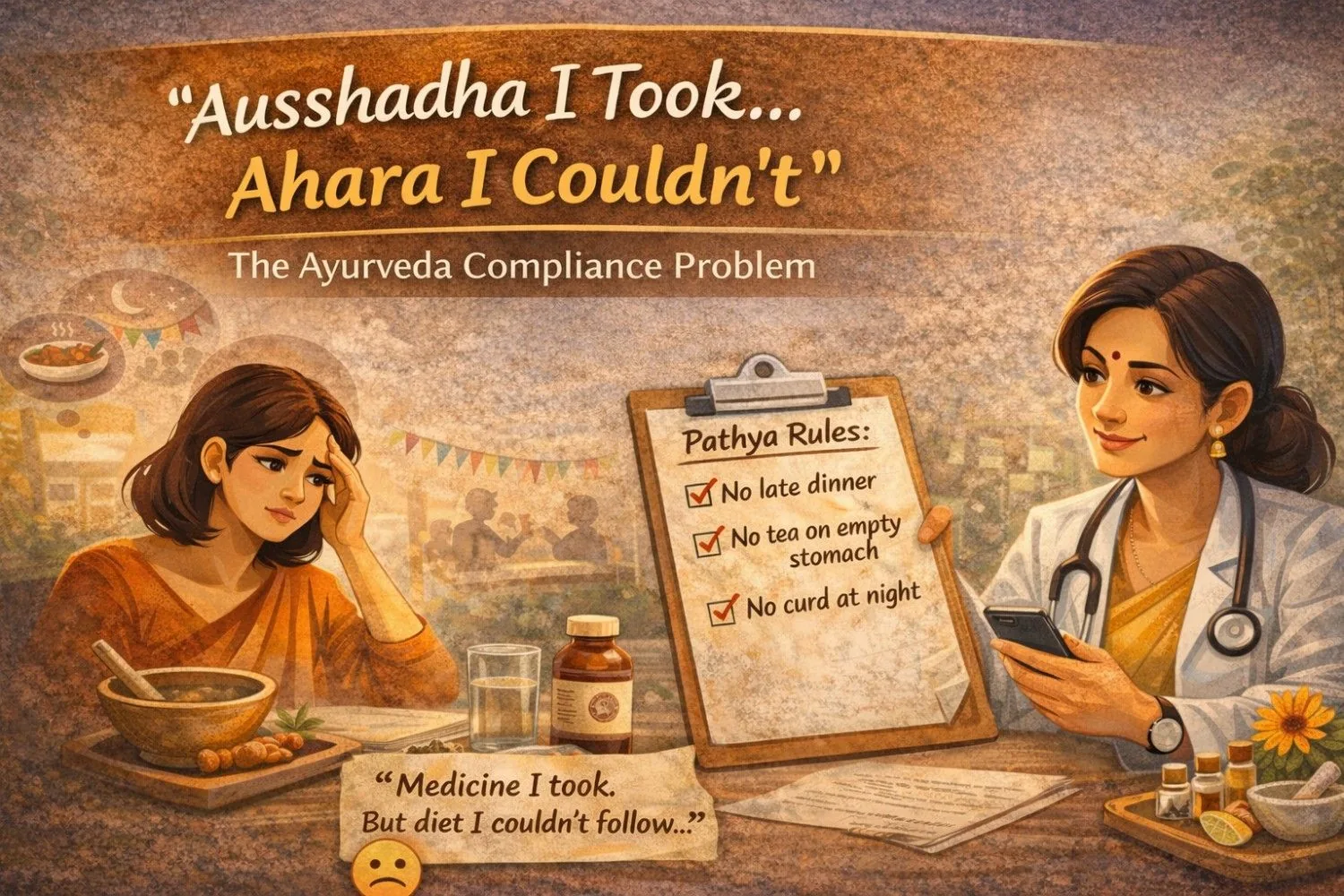
In Ayurveda, we say Ahara (diet) is not optional. It is part of the treatment—just like Aushadha (medicine).
Many of us have seen it:
A patient takes the kashayam and tablets properly… but still comes back with the same complaint.
And when we ask gently, the answer is usually the same: “Doctor… medicine I took. But diet I couldn’t follow.”
Not because they don’t care. Because life happens.
Why This Happens in Real Ayurveda Practice
Ayurvedic treatment works best when Ahara + Vihara (daily routine) + Aushadha stay together.
But diet advice fails in day-to-day life because:
- Patients remember the medicine name, but forget the food rules
- Family meals are shared, so separate diet feels difficult
- They feel better in 2–3 days and become relaxed
- Festivals, travel, office stress, late nights break routine
- Many diet instructions are long, and patients keep only one or two in mind
- Some feel shy to admit they didn’t follow the pathyam (diet restrictions)
So the follow-up becomes confusing: Is the medicine not working? Or is the Pathya-Apathya not followed?

Try Dr. Notes on Mobile
- Secure On-Device Data
- Instant Voice Notes
- Simple Patient Management


A Small Moment in the Clinic
Dr. Anjali Nair, an Ayurvedic physician (BAMS), runs a small clinic. One evening, Meenakshi (32) comes back with watery eyes and a tired face.
“Doctor, I felt light for one week… then the acidity and burning came back.”
Last time, Meenakshi had classic Amlapitta symptoms:
- burning in chest
- sour belching
- heaviness after food
- worsening after tea and spicy items
Dr. Anjali remembers the case… but she doesn’t rely on memory. She opens the patient notes and sees the last visit clearly.
Last visit (10 days ago):
- Diagnosis: Amlapitta (Pitta aggravation)
- Plan: Avipattikar Churna + a kashayam
- Pathya: early dinner, warm water, simple food
- Apathya: tea on empty stomach, spicy/fried, curd at night
- Follow-up: 2 weeks
Dr. Anjali doesn’t blame her. She asks in a calm tone: “Tell me honestly… how many days you followed the Pathya?”
Meenakshi pauses. Her eyes become watery again—not from acidity this time.
“First 3 days I followed everything, doctor. I even felt proud.”
Then she smiles sadly and adds: “But my mother-in-law made curd rice at night… and I didn’t want to say no. Office stress was high. I drank tea without thinking. And two days ago, we attended a function. Late dinner happened.”
This is the real Ayurveda problem. Not a failure of medicine. A breakdown of routine.
Dr. Anjali nods and says something simple that makes Meenakshi relax:
“It’s okay. We don’t need perfection. We need awareness.”
She updates the plan and adds one small line in the notes:
Today: flare after apathya (late dinner + curd at night + tea); reinforce pathya; set small goals; review in 10 days.
Meenakshi leaves lighter—not just in the stomach, but in the heart. Because she wasn’t judged. She was understood.
The Hidden Truth: Patients Forget Diet Advice Because It’s Too Big
When we say 10 rules, patients remember 2.
So instead of long diet lectures, the best approach is:
The “Top 3 Pathya Rules” Method
Pick just 3 rules that matter most for that case.
Example for Amlapitta:
- No late dinner
- No tea on empty stomach
- No curd at night
These 3 alone can improve many cases.
How to Track Compliance Without Making Patients Feel Guilty
1) Ask Yes/No Questions (Patients Answer Honestly)
Instead of “Did you follow diet?”, ask:
- “Late dinner happened this week?” Yes/No
- “Curd at night happened?” Yes/No
- “Tea empty stomach happened?” Yes/No
This removes shame and saves time.
2) Track Triggers, Not Mistakes
Tell patients: “Just note what triggered the flare. That’s enough.”
This turns follow-up into learning, not scolding.
3) Use a Simple Compliance Label
In your notes:
- Pathya compliance: Good / Partial / Not followed
- Reason: function / stress / family food / travel
Over 2–3 visits, you will see patterns clearly.
The 1-Minute Ayurveda Follow-Up Checklist
Condition: Amlapitta / Vata-kapha cough / Sandhivata etc.
Top 3 Pathya rules: 1) ___ 2) ___ 3) ___
This week:
- Rule 1 followed: Yes/No
- Rule 2 followed: Yes/No
- Rule 3 followed: Yes/No
Result: better / same / worse
Trigger noticed: ________
Next plan: ________
Follow-up: ___ days
Why This Matters
Ayurveda is not only about symptom control. It’s about changing the pattern.
When patients don’t follow pathya, they feel:
- “Maybe I’m not disciplined”
- “Maybe my body is weak”
- “Maybe treatment is not working”
But when we track compliance gently, they feel:
- “Now I know my trigger.”
- “I can do better next week.”
- “My doctor understands my life.”
That trust itself becomes medicine.
Final Thoughts
Patients don’t forget diet advice because they don’t care. They forget because life is messy.
In Ayurveda, Pathya is powerful—but only when it is simple and trackable. The best plan is not the longest plan. It’s the one the patient can actually follow—without fear or guilt.
“Aushadha works best when Ahara becomes doable.”
Try Dr. Notes on Mobile
- Secure On-Device Data
- Instant Voice Notes
- Simple Patient Management
Comments