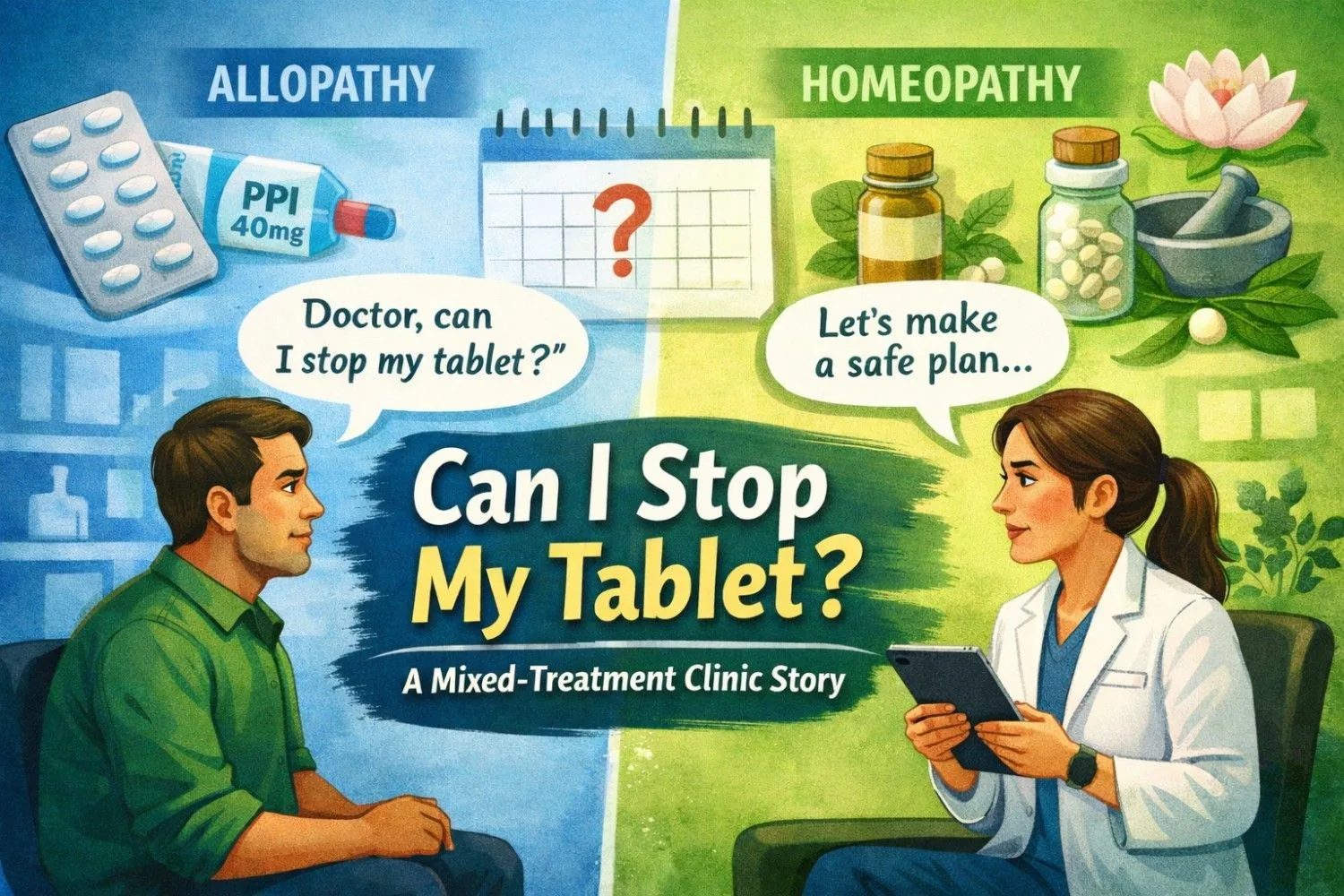
A 42-year-old patient walks into a homeopathy clinic with a familiar story.
“Doctor, I’m taking allopathy tablets daily… but the problem keeps coming back. I want homeopathy also.”
He has acidity and bloating for months. He’s already on a PPI (pantoprazole), prescribed elsewhere. Now he wants a long-term solution, but he’s nervous about stopping the tablet.
Then comes the question that every clinic hears: “Can I stop it if I start homeopathy?”
This is where mixed-treatment cases get risky—not because the case is complicated, but because continuity is fragile.
Patients forget medicine names. They change brands. They add a painkiller or antibiotic from a pharmacy. They stop tablets suddenly when they feel slightly better. And on the next visit, they remember only one line: “I was taking something… I don’t know the name.”
Day 1: The plan is clear, but memory is not reliable
You explain carefully:
- Don’t stop suddenly
- Continue the PPI for now
- Follow the homeopathy plan
- Review in 7 days
- We’ll taper only if symptoms improve
But the clinic is busy. Two more patients are waiting. Phone is ringing. Assistant is asking for next appointment slots.
This is where doctors usually depend on one of two things:
- Memory
- Paper notes that are hard to search later
And both fail when the OPD is fast.
How Dr. Notes helps immediately
Right after the consultation, you open Dr. Notes and record a clean, structured entry in seconds:
- Current allopathy medicine: Pantoprazole 40 mg, once daily (morning)
- Since when: 3 months
- Symptoms: burning after meals, bloating, sour belching
- Triggers: late dinner, spicy food, tea
- Homeopathy plan: remedy + diet advice
- Clear instruction: “Continue PPI for 7 days. Do not stop suddenly. Review and taper only if burning reduces.”
If you’re rushed, you add a 10–15 second voice note instead:
“Patient on PPI daily. Continue one week. If improvement, taper stepwise. Ask them to update if any new medicine is added.”
Now your thinking is captured. Not in your head. Not in a scattered notebook. In one place.
Follow-up visit: where mixed-treatment cases usually break
One week later, the patient returns and says: “I feel about 40% better. I also took another tablet two days… I forgot the name.”
This is the exact moment where trust is either protected or lost.
If you don’t remember what you told him last week, your response becomes unsure. The patient senses it immediately.
But with Dr. Notes, you open the patient history and see the last plan instantly:
- What medicine they were already on
- What you advised
- What taper plan you intended
- What symptoms you were tracking
So you can confidently guide: “Good improvement. Reduce the PPI to alternate days for one week. If burning returns, don’t self-change the medicine. Message and come earlier.”
The patient relaxes—not because you gave a big lecture, but because your guidance is consistent across visits.
The emotional win
Mixed-treatment patients don’t just want treatment. They want safety.
They want to feel:
- “My doctor knows my case.”
- “My plan is being monitored.”
- “I’m not experimenting on myself.”
Dr. Notes helps you deliver that feeling with zero extra workload.
How Dr. Notes is better than EMR/EHR for this exact clinic reality
Most EMR/EHR systems are built for large setups: billing-heavy workflows, multi-department records, complex forms, and many screens.
For a homeopathy clinic handling mixed-treatment patients, the pain points are different: speed, follow-up continuity, and quick recall.
1) Faster than EMR/EHR for real OPD flow
In EMR/EHR, capturing a mixed-treatment note often means:
- multiple tabs
- long forms
- structured fields that don’t match homeopathy thinking
- slower retrieval during follow-up
Dr. Notes is designed for fast clinical capture:
- quick structured points
- minimal steps
- easy to repeat daily
2) Voice notes
In reality, doctors remember the “why” behind a decision: “Continue PPI for one week, then taper only if burning reduces.”
EMR/EHR rarely supports voice-based quick capture smoothly. Dr. Notes makes voice notes natural when you’re busy, and that saves your reasoning for the next visit.

Try Dr. Notes on Mobile
- Secure On-Device Data
- Instant Voice Notes
- Simple Patient Management


3) Follow-up history is immediate
Mixed-treatment cases need instant answers:
- What were they taking before?
- What did I advise about stopping?
- What changes did we observe?
- What was the taper plan?
Dr. Notes keeps the entire journey in chronological order, so the doctor doesn’t waste time searching.
4) Works even when internet fails
Many clinics struggle with network issues. EMR/EHR often becomes slow or unusable when the connection drops.
Dr. Notes being offline-friendly means your workflow doesn’t break mid-consultation.
5) Less complexity, more clinical focus
EMR/EHR is powerful, but can feel heavy for a solo or small clinic. Dr. Notes keeps it simple: capture, track, follow up—without extra admin load.
Mixed-treatment patients need a clear, safe plan, not guesswork. When a patient uses allopathy along with homeopathy, small details can get missed—medicine name, dose, what to continue, and when to taper. If those details aren’t recorded, follow-ups become confusing and trust drops.
Dr. Notes helps by letting you save quick notes or a short voice note, keep a clear visit timeline, and review the last plan instantly at the next visit—even without internet. Compared to heavy EMR/EHR systems, Dr. Notes stays simple and fast, so you can focus on care and keep follow-ups consistent.
Try Dr. Notes on Mobile
- Secure On-Device Data
- Instant Voice Notes
- Simple Patient Management
Comments