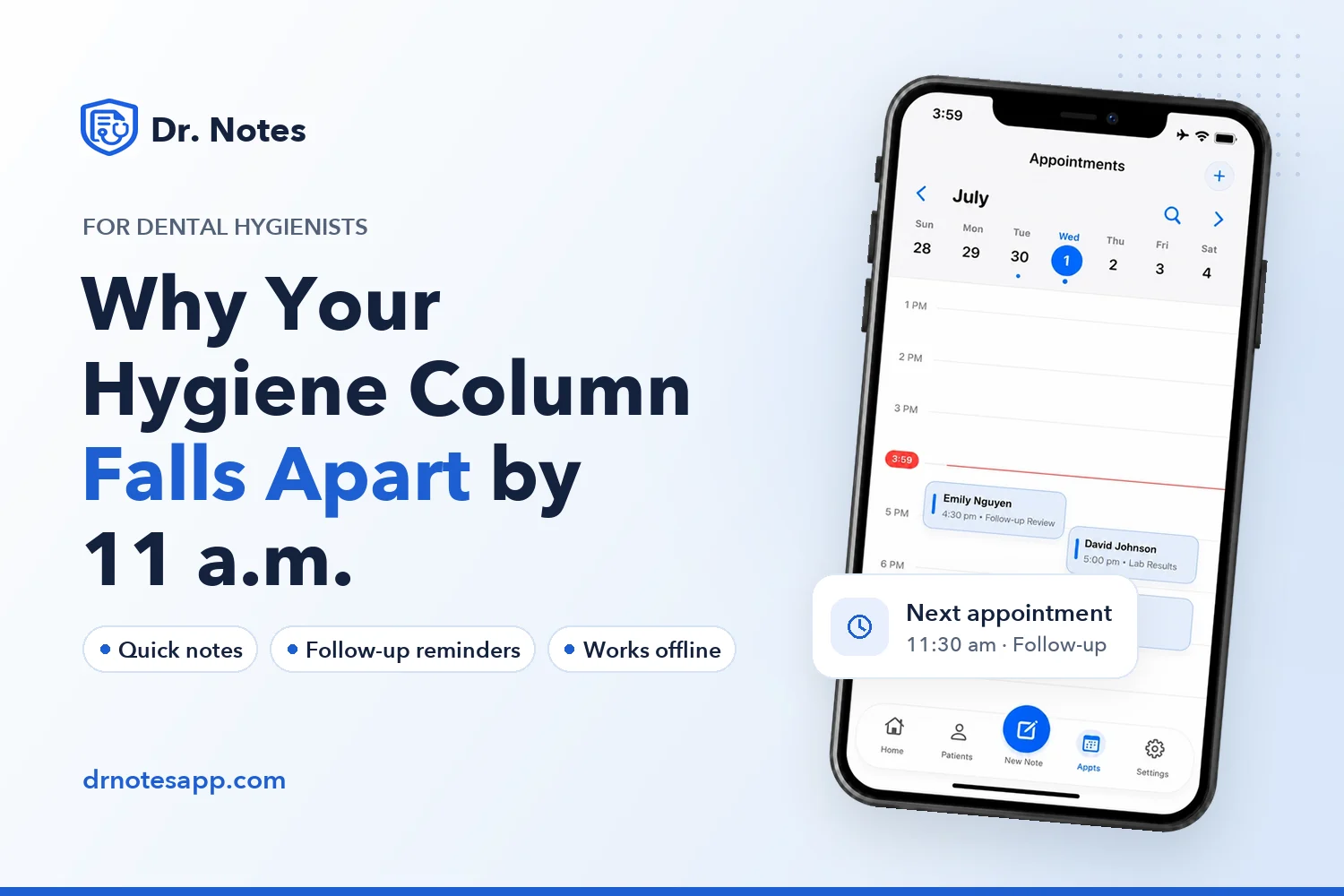
It's 11:08 a.m. Maya, RDH, is in op two with a 50-year-old recall patient whose pocket depths have crept up since last December. She's three minutes into a full-mouth six-point probing and the next patient is already on the schedule for 11:00.
The morning started clean. 8:00 prophy, on time. 8:50 recall, on time. 9:40 a child with a stained occlusal and a parent who wanted to talk about thumb-sucking — six minutes over. 10:30 perio maintenance with a heavy calculus build-up; she stopped charting to actually finish the scaling. Now Maya is twenty-eight minutes behind. She still hasn't entered the morning's perio numbers into the chart, the doctor is waiting for an exam in op three, and her lunch was supposed to start at 12:10.
Maya is good at this. She has been an RDH for eight years. The schedule is the part that isn't.
What's Actually Happening
This isn't a "Maya needs to be faster" problem. The math of a modern hygiene column doesn't add up, and the documentation has to fit in the time that's left over.
Every recall hygiene visit is expected to carry:
- Health history update — meds reconciled, BP taken, ASA classification considered. The ADA's Council on Scientific Affairs guidance says med rec is contemporaneous, not retroactive.
- Periodontal assessment — six-point probing (per the AAP's Comprehensive Periodontal Evaluation), bleeding on probing, recession, mobility, furcations. Six points per tooth, twenty-eight teeth.
- Hard and soft tissue exam — caries chart, restorations chart, oral cancer screen.
- Prophy or SRP — the actual clinical service the patient was scheduled for.
- Note — contemporaneous, defensible, in language a chart auditor (or the state board, or a malpractice carrier) would accept. The ADA Principles of Ethics 5.A and most state practice acts use the word "contemporaneous" specifically.
In a 60-minute recall slot, after seating, BP, health history, intraoral photos and radiographs, a hygienist is left with roughly thirty to thirty-five minutes of actual clinical time. The six-point probe alone takes about twelve minutes solo. The documentation gets squeezed last — and often happens at lunch, or after the last patient walks out.
Other Hygienists Saying The Same Thing
This is not a niche complaint. Sara Brooks, RDH, BS, wrote about it for Today's RDH in 2021 in a piece called "Career Satisfaction: Could Accelerated Hygiene Equal Accelerated Burnout?" describing the accelerated-hygiene model she worked under:
"All four rooms, all four patients, in 45 minutes. On average, I was given about eight minutes per patient."
— Sara Brooks, RDH, BS, Today's RDH, June 28, 2021
Eight minutes per patient leaves no time for documentation in the room. Sara goes on to describe what gets cut when time disappears:
"I was told to leave calculus behind and blame them next time for not flossing."
— Sara Brooks, RDH, BS, Today's RDH, June 28, 2021
And the part that lasts the longest:
"My body was screaming in pain. I had so much guilt from not doing a good job for my patients."
— Sara Brooks, RDH, BS, Today's RDH, June 28, 2021
Fifteen years earlier, Dianne D. Glasscoe, RDH, BS, was already writing the same story for RDH Magazine in an article bluntly titled "Always Running Behind". The number she landed on is still the one most hygienists quote today:
"It takes the average solo hygienist 12 minutes to do a six-point probing and recording with a written system. It takes about three minutes with someone else recording."
— Dianne D. Glasscoe, RDH, BS, RDH Magazine, September 2006
Nine minutes of recovered time, three patients deep, is twenty-seven minutes. That is the difference between leaving on time and writing notes at 6:15 p.m.
Why The Note Loses
When the schedule is the constraint and the clinical work is in front of you, the note is what gets deferred. Hygienists know this isn't safe. The state board doesn't accept "I'll write it later" as a defence. Most malpractice carriers say the same. But with the patient still in the chair and the doctor knocking for an exam, there is no realistic alternative inside the appointment.
The blocker is the tool. If charting means walking to the workstation, logging back in, finding the patient, clicking through three screens, and typing — that doesn't happen between patients. It happens at lunch or after work, from memory, which is exactly the documentation pattern every regulator warns against.
Where Dr. Notes Fits
Dr. Notes won't fix the eight-minute appointment. Nothing will, short of management changing the schedule. But it changes when the note gets written, so it stops following you home.
Three things matter for a hygiene column:
1. Voice notes while you're already saying it out loud. Maya is already calling out probe depths to a non-existent assistant — "3, 2, 4, BOP distal, 5 with bleeding, 3, 2." Dr. Notes captures that as a voice note on her phone, on-device, with no cloud round-trip. By the time the patient stands up, the numbers are recorded as plain text she can paste into the chart. Forty seconds of dictation instead of twelve minutes of solo probing-and-writing.
"Adult recall, perio maintenance. Probings: UR 3-2-4, 3-2-3, 4-3-5BOP, 3-2-3, 4-3-4, 3-2-3, 4-3-4. Generalised marginal inflammation upper right quadrant. Calculus moderate lingual lower anteriors. Two units SRP completed, ultrasonic and hand instrumentation. OHI: interdental brush size 2 reviewed. Recall three months for re-eval."
2. Patient history in one tap. Before the next recall walks in, Maya can open the patient's card and see the last three visits — probing trend, calculus notes, BP, what was discussed about home care, what was deferred. The thirty seconds before the patient sits down is enough to actually be ready.
3. Works fully offline. Practice broadband drops at 3 p.m. The mobile clinic at the community centre has one bar of signal. The basement op with two inches of concrete between you and the router. None of it stops the app. Notes are written to the device and stay there until Maya explicitly exports them.
Combined, that's the documentation pattern the ADA and AAP actually want — contemporaneous, complete, in the language the hygienist is already using out loud — without giving up the twelve minutes that the solo six-point probe normally costs.

Try Dr. Notes on Mobile
- Voice notes, on-device
- Patient history in one tap
- Works offline


A Realistic First Week
Nothing solves an eight-year charting habit in one Monday. A realistic first week with Dr. Notes for a solo hygienist looks like this:
- Day 1. Pick five recall patients on tomorrow's column — your most predictable ones. Voice-note the probing depths while you're already calling them out loud. Don't try to change the rest of the workflow yet.
- Day 2-3. Add the subjective ("patient reports sensitivity LR posterior", "patient declined fluoride varnish") and the OHI you actually gave. Review and clean up the note in the doorway gap before the next patient.
- Day 4. Try it on a heavier case — a new patient with a 28-tooth probe, or an SRP quadrant. See whether the structured voice note still holds up.
- Day 5. Notice what time you left this Friday compared to last. For most solo hygienists, this is the first week in a long time the perio numbers didn't follow them to lunch.
If the pattern works for the first five patients, it works for the rest of the column. The reason it works is unglamorous: write the note while the visit is fresh, in the room, in the language you already use to the assistant who isn't there.
One Last Thing
Hygienists don't burn out because they stopped caring about patients. Most still do, even after the bad weeks. They burn out because eight minutes is not enough, and the documentation that was supposed to fit in the leftover time follows them home instead.
Sara Brooks and Dianne Glasscoe wrote about this fifteen years apart and the math hasn't moved. The schedule is unlikely to change tomorrow. But the tool you reach for at 11:08 a.m. — when you're three minutes into a probe and twenty-eight behind — can.
Dr. Notes is on the App Store and Google Play. Try it for a week of real hygiene columns and see what time you leave on Friday.
Comments
Have a question, or a way you handle this in your own practice? Share it below.