It's 8:30 pm. The last patient walked out at 7. The nurse left at 7:15. The lights in the waiting room are off. Aaron is still at the desk in surgery two with his loupes pushed up onto his forehead, writing notes for the molar endo he started at 4:30.
He's been a dentist for six years. He likes the clinical work. The obturation looked clean on the post-op radiograph and the patient said her face felt numb in exactly the right places. But the note isn't written yet. Neither are the notes from the four restorations he did between 11 and 2, or the new-patient exam at 3, or the kid he had to send home in tears at 3:45 because the parent had already pre-decided about the extraction. He tells himself he'll do the urgent ones tonight and catch up on the rest at the weekend. He won't. Saturday morning he'll be at the desk again, with cold coffee, trying to reconstruct what a patient he saw 48 hours ago said about their TMJ.
From the outside, dentistry looks comfortable. People assume dentists earn well, work in clean rooms, leave at six and play golf on Wednesdays. Most dentists know what that picture actually leaves out: the body wear, the documentation that compounds across the week, the way one upset patient can sit in your chest for a month, and a quiet, unglamorous tiredness that doesn't lift on weekends.
A Video That Made A Lot Of Dentists Pause
Last year a UK dentist named Dr. James Martin posted a video called "UK Dentist: This Is Why I QUIT" on YouTube and a longer podcast version on Dentists Who Invest. He graduated from Leeds in 2016 and walked away from clinical practice at 29. Not because he was bad at it. He liked the patients and the cases were interesting. He just got honest about what staying in the chair was costing him.
"You can literally just do one filling or have one bad patient interaction. You have one off moment and it cost you so much."
— Dr. James Martin, Dentists Who Invest, Episode 402
In the same episode he talks about the gap between how dentistry looks from the outside and how it feels at the end of the week:
"I used to come home every weekend… and there was always part of me that was just like, do I just do this forever?"
— Dr. James Martin, Dentists Who Invest, Episode 402 · YouTube version
Martin's specific exit wasn't about paperwork. It was about no longer wanting the asymmetric stakes of clinical work — one bad outcome carrying so much weight when ninety-nine others went well. But the wider thing he describes, the sense that the work follows you home and won't let go, is the thing more dentists than quit silently live with.
It's Rarely the Drilling That Wears You Down
Ask most dentists what's hardest about a clinic day, and very few will say the actual dentistry. The procedures are the part they trained for. The hand skills feel good. A clean Class II is still satisfying after ten thousand of them.
What grinds people down is what sits on either side of the procedure. The fifteen seconds before the LA where the patient decides whether to trust you. The conversation about the crown they can't quite afford. The note that has to be detailed enough to defend if a complaint lands on it eighteen months from now. The follow-up call you remembered to make at 9 pm because nobody else was going to. None of that is on the appointment book.
The Body Wears In Specific Ways
Most non-dentists picture posture pain as a generic thing. It isn't. There's a pattern. The neck flexes 25–40° for hours. The shoulder on the working side carries the weight of the loupes plus the slow micro-tension of holding a handpiece steady at sub-mm precision. The lumbar spine takes the rotation. By year five most dentists can name their own version of it: a left trapezius that doesn't release, a thumb that locks at 5 pm, a lower back that stings on the drive home.
Dentists keep going. Patients are in the chair. The clinic schedule is full. You smile through the next exam because that's the job. The body files it for later.
The Emotional Load Is Quieter And Larger
A dentist can do a textbook composite — flawless margins, correct shade, occlusion checked — and the patient still calls a week later to say it feels weird. That's not a clinical failure. Sometimes the body just doesn't agree right away. But the dentist remembers. They replay the conversation. They wonder if the patient will leave a one-star review. They wonder if the practice manager will pull them aside. They wonder if the GDC, or the state board, or the indemnity carrier, will hear about it.
Most of the time none of that happens. But the rehearsal in the head still costs something. Multiply it by the number of patients you've ever felt unsure about, and that's the quiet tax.
Documentation Is The Glue, And The Burden
Good notes are how dentists protect themselves and their patients. Treatment options discussed. Risks and benefits. The exact pain history. The shade and the matrix. The medical history flags. The consent. The post-op instructions. The follow-up plan.
Every regulator says broadly the same thing: contemporaneous, accurate, legible, complete. The GDC's Standards for the Dental Team (4.1) says records should be made "at the time you treat the patient or as soon as practicable afterwards." The ADA's Principles of Ethics and Code of Professional Conduct expects the same. Indemnity providers like Dental Protection and MDDUS publish near-identical guidance. None of them say "write your notes on Saturday from memory" because nobody's memory of Wednesday's patient is good enough.
The problem isn't that dentists don't want to chart well. It's that between patients there are three minutes, two of which are spent greeting the next person at the door. There is no fifteen-minute block to type out a full note that would satisfy a defence union letter. So the note gets compressed, or shelved, or saved-as-draft. Then it follows the dentist home.
Where Dr. Notes Fits
Dr. Notes won't fix the asymmetric stakes Martin describes. Nothing will. But it does something narrower: it changes when the note gets written, so it stops following you home.
Three things make that possible:
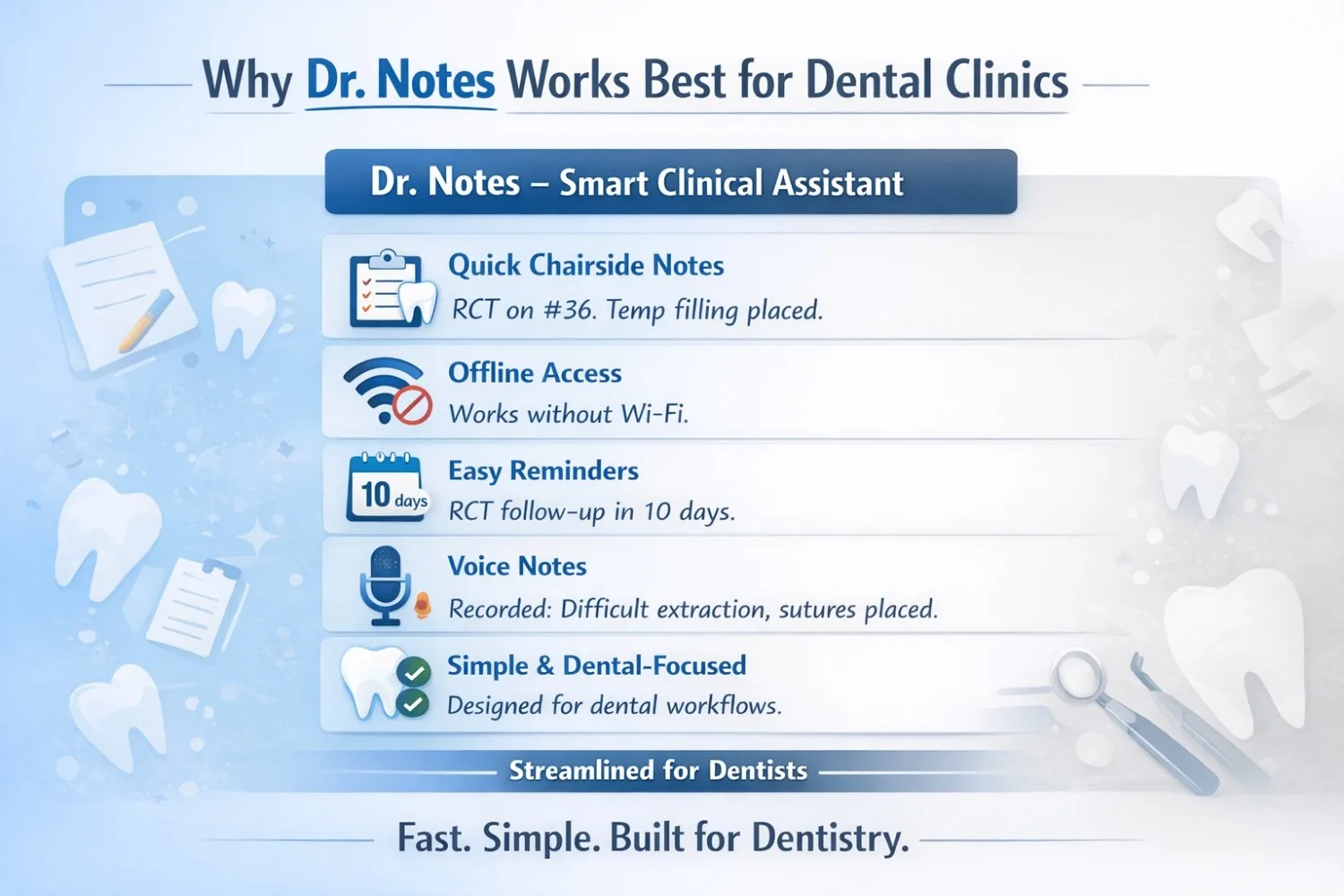
1. Voice capture during the procedure. While Aaron is dictating LA volumes and bur sequences to his nurse anyway, he can dictate the note at the same time. Dr. Notes runs on-device — there's no waiting for a server, no "uploading" while the next patient sits down. By the time he pulls his gloves off the structured note is already there to review.
"Tooth 36, irreversible pulpitis. Rubber dam. Endodontic access. Working length 21 mm with EAL confirmation, PA confirms. Hand files to 20.04, then Reciproc Blue R25. NaOCl irrigation, EDTA final rinse. Single visit obturation, BC sealer, GP. Cavit temporary. Patient tolerated well, advised analgesia, review two weeks for crown discussion."
Twenty-five seconds spoken, instead of ten minutes typed at 9 pm.
2. Patient history in one tap. Before each patient comes through the door, you can see the last three visits — radiographs noted, treatments completed, medications given, what was discussed, what was deferred. No flipping through paper files or scrolling a spreadsheet. The thirty seconds before the patient sits down is enough to actually be ready.
3. Offline-first. Mobile units, domiciliary visits, the hospital community clinic with one bar of signal, the busy practice where the broadband drops at 3 pm — none of it stops the app. Patient data lives on the device. Nothing hangs on a sync. Nothing leaves the phone unless you explicitly export it.
Together those three things let dentists do what every regulator asks for in the first place: contemporaneous, complete notes, written while the visit is still fresh. Not on Saturday morning.

Try Dr. Notes on Mobile
- Voice notes, on-device
- Patient history in one tap
- Works offline


A Realistic First Week
No tool fixes a six-year charting habit in one Monday. A realistic first week with Dr. Notes for an associate or solo dentist looks like this:
- Day 1. Pick five patients on the morning list — your most predictable cases. Voice-note the subjective while you're already saying it out loud to the nurse. Don't try to change everything yet.
- Day 2-3. Add the objective findings to the voice note as you go: shade taken, occlusion checked, bleeding on probing scores, anything you'd normally hold in your head until you sat down later. Review and clean up the note in the thirty-second window between patients.
- Day 4. Try it on a slightly messier case — the new patient with a long medical history, or the anxious one you usually struggle to chart for. See whether the structured note still holds up.
- Day 5. Notice what time you left on Friday compared to last Friday. For most dentists, this is the first week in a long time the notes haven't followed them home.
If it works for five patients, it works for the rest of the caseload. The reason it works is unglamorous: write the note while the visit is fresh, in the room, with the patient still there, in the language you already use out loud.
One Last Thing
Dentists don't burn out because they don't love the work. Most of them still do, even after the bad weeks. They burn out because the work doesn't end when the patient leaves — and one of the parts that follows them home is something a phone in their pocket can actually help with.
James Martin's reasons for leaving were bigger than any tool can solve. But the dentists who stay deserve a small win in the meantime: their evening back, and the kid's homework, and dinner while it's still warm.
Dr. Notes is on the App Store and Google Play. Try it for a week of real clinic days and see what time you leave on Friday.
Comments
Have a question, or a way you handle this in your own practice? Share it below.