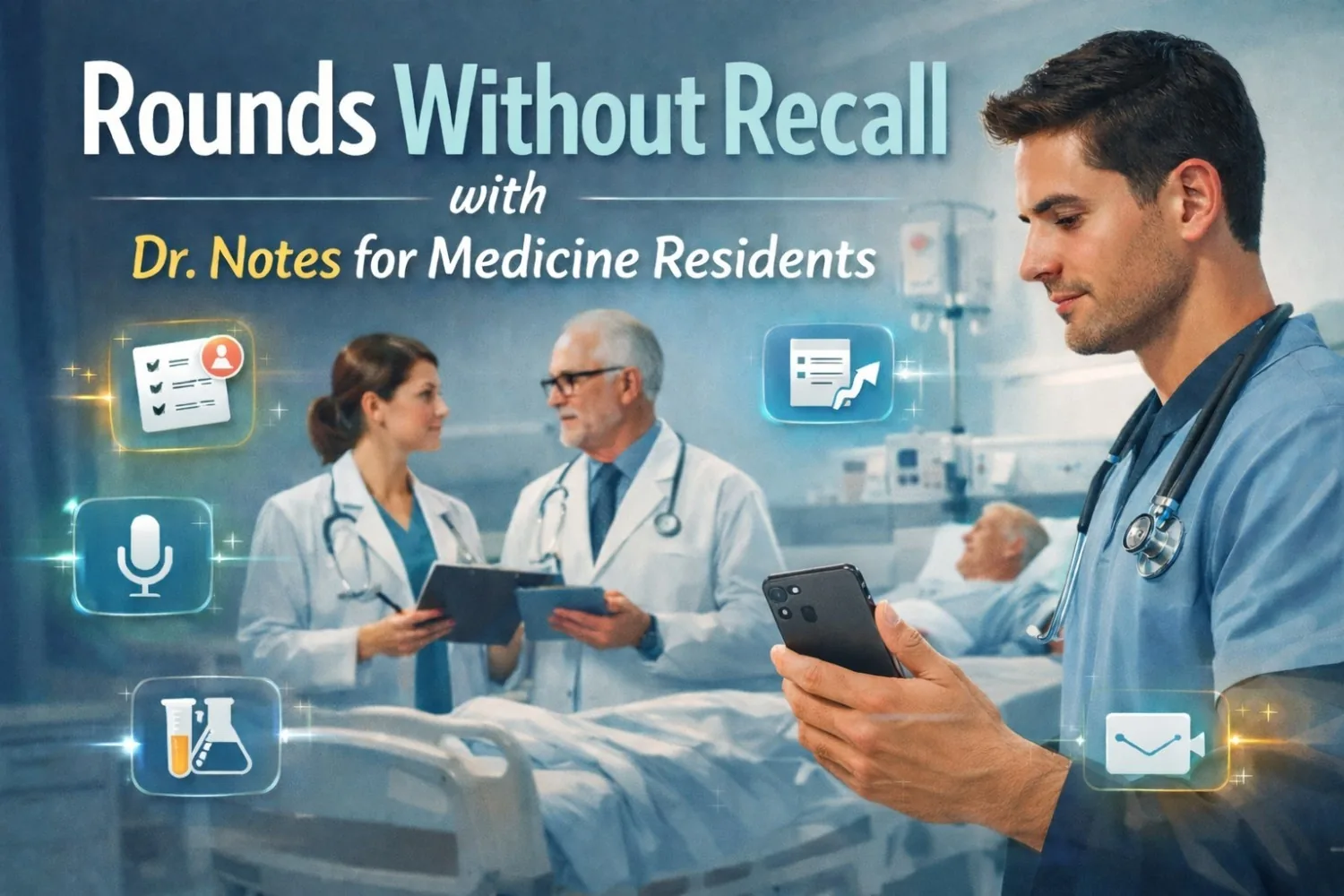
Rounds Without Recall with Dr. Notes for Medicine Residents
Medicine residency isn’t just about knowing diagnoses. It’s about managing multiple patients, constant changes, and endless follow-ups—while rounds keep moving.
On a typical day, a medicine resident handles:
- Morning rounds + evening rounds
- Admissions and transfers
- Labs, imaging, cultures, consults
- Nurses’ calls, family questions, discharge planning
- Shift handovers where one missed detail creates confusion
And documentation becomes the pain point—not because residents don’t write, but because there’s rarely time to write everything clearly, in one place.
That’s where Dr. Notes fits: a fast, offline-first notes app that helps medicine residents capture key details quickly, review patient progress clearly, and avoid missed follow-ups.
The Real Medicine-Ward Problem Is Continuity
In medicine wards, these issues happen daily:
- Notes are written later after rounds (details get forgotten)
- Patient updates get scattered (paper notes, WhatsApp, memory, screenshots)
- Labs and reports are missed (CBC trend, electrolytes, culture updates)
- Plans change daily (antibiotics, fluids, O2 support, insulin scale)
- Handovers are rushed, so the next shift repeats work
- Internet/hospital systems slow down at the worst times
Medicine residents don’t need a complicated system. They need fast capture + a clear timeline + reliable follow-up.
Try Dr. Notes on Mobile
- Secure On-Device Data
- Instant Voice Notes
- Simple Patient Management


In Practice: Fever with Sepsis Workup (Where Follow-Up Is Everything)
It’s 9:30 AM. Ward rounds are moving fast.
Patient: Fever, Suspected Sepsis (Day 2)
A 58-year-old man is admitted with fever, low BP episodes, and weakness.
The senior asks rapid questions:
- “What was yesterday’s TLC and today’s trend?”
- “Blood cultures sent? When?”
- “What antibiotics started and at what time?”
- “How’s urine output?”
- “Any new symptoms overnight?”
- “What’s today’s plan?”
In reality, this information is often split across:
- A scribbled rounds sheet
- Nursing updates
- Lab report photos
- The case file
- Your memory from night duty
With Dr. Notes, This Becomes Quick and Clean
You open the patient note and see a simple timeline.
Day 1
- Fever + hypotension episode
- Sepsis workup: blood culture sent, urine R/M, CBC, CRP
- Antibiotic started at 6 PM
- Fluids started, monitor urine output
Day 2 (today)
- TLC: 18k → 14k
- BP stable overnight
- Fever spike at 2 AM
- Culture pending
- Plan: continue antibiotic, repeat CBC/CRP, review culture, consider escalation if fever persists
During rounds, you add short updates in seconds:
- “TLC improving, fever spike persists”
- “Culture pending”
- “Continue antibiotic, reassess evening”
Instead of searching through notes and photos, you answer quickly and move on with confidence.
Two More Ward Moments Where Dr. Notes Saves You
These are everyday medicine-ward cases where residents don’t struggle with knowledge—they struggle with tracking and follow-ups.
COPD Exacerbation (Where Small Misses Become Big Problems)
It’s evening rounds. The ward is busy. You’re covering multiple patients.
Patient: COPD exacerbation (Day 1)
A 67-year-old with COPD is admitted with breathlessness and wheeze. He’s on nebulizations, oxygen, steroids, and antibiotics.
The senior asks:
- “What was his SpO2, on room air vs oxygen?”
- “How many nebulizations did he take today?”
- “ABG done? Any CO2 retention risk?”
- “What’s the oxygen target?”
- “When are we reviewing again?”
With Dr. Notes, you keep a quick snapshot:
- SpO2: 84% room air → 92% on 2 L O2
- Target: keep SpO2 88–92%
- Nebs: q4h, steroids + antibiotic started
- ABG: done/pending (add values when available)
- Review: reassess in 4 hours
Reminders:
- “Check ABG report”
- “Review in 4 hours: SpO2 + RR + wheeze”
Result: fewer mistakes on oxygen targets, fewer missed reviews, safer handovers.
DKA (Where Follow-Up Is the Treatment)
DKA care is not “one-time orders.” It’s continuous monitoring—exactly what becomes hard on busy shifts.
Patient: DKA (Day 1)
A 24-year-old comes with vomiting, dehydration, and high sugars. DKA is confirmed.
The senior asks:
- “Initial RBS and ketones?”
- “Fluids started and when?”
- “What’s the potassium now?”
- “Insulin rate and adjustments?”
- “Is the anion gap closing?”
With Dr. Notes, you record baseline in one place:
- RBS: ___
- Ketones: ___
- pH/ABG: ___
- K+ / Na+: ___
- Anion gap: ___
- Fluids started: time + rate
- Insulin started: time + rate
Reminders:
- “Electrolytes/K+ recheck at __”
- “ABG/anion gap review at __”
- “Plan transition once gap closes + oral intake starts”
Result: fewer missed lab checks, smoother insulin adjustments, safer transitions, cleaner handovers.
What Dr. Notes Changes for Medicine Residents
-
Faster progress notes during rounds
Write short, structured points instead of long paragraphs. -
Clear day-by-day case timeline
See how the case evolved: symptoms → investigations → treatment → response. -
Offline reliability
Works even if hospital network is slow or the system is down. -
Voice notes for busy moments
Capture quick reminders and clean them up later. -
Follow-up reminders
Never miss labs, cultures, imaging reports, consult follow-ups, or discharge tasks. -
Better handover clarity
The next shift can instantly see: what happened, what’s pending, and what’s planned.
Why This Feels Better Than Scattered Notes
Hospitals may have systems, but residents still need a personal workflow tool for:
- Quick capture
- Quick review
- Quick follow-up
Dr. Notes helps close that gap—without extra complexity.
The Results Medicine Residents Actually Feel
- Fewer missed labs and pending reports
- Smoother rounds with quicker updates
- Less repeated questioning during handover
- Lower mental load on busy shifts
- More confidence that nothing slipped
Try Dr. Notes on Mobile
- Secure On-Device Data
- Instant Voice Notes
- Simple Patient Management
Comments