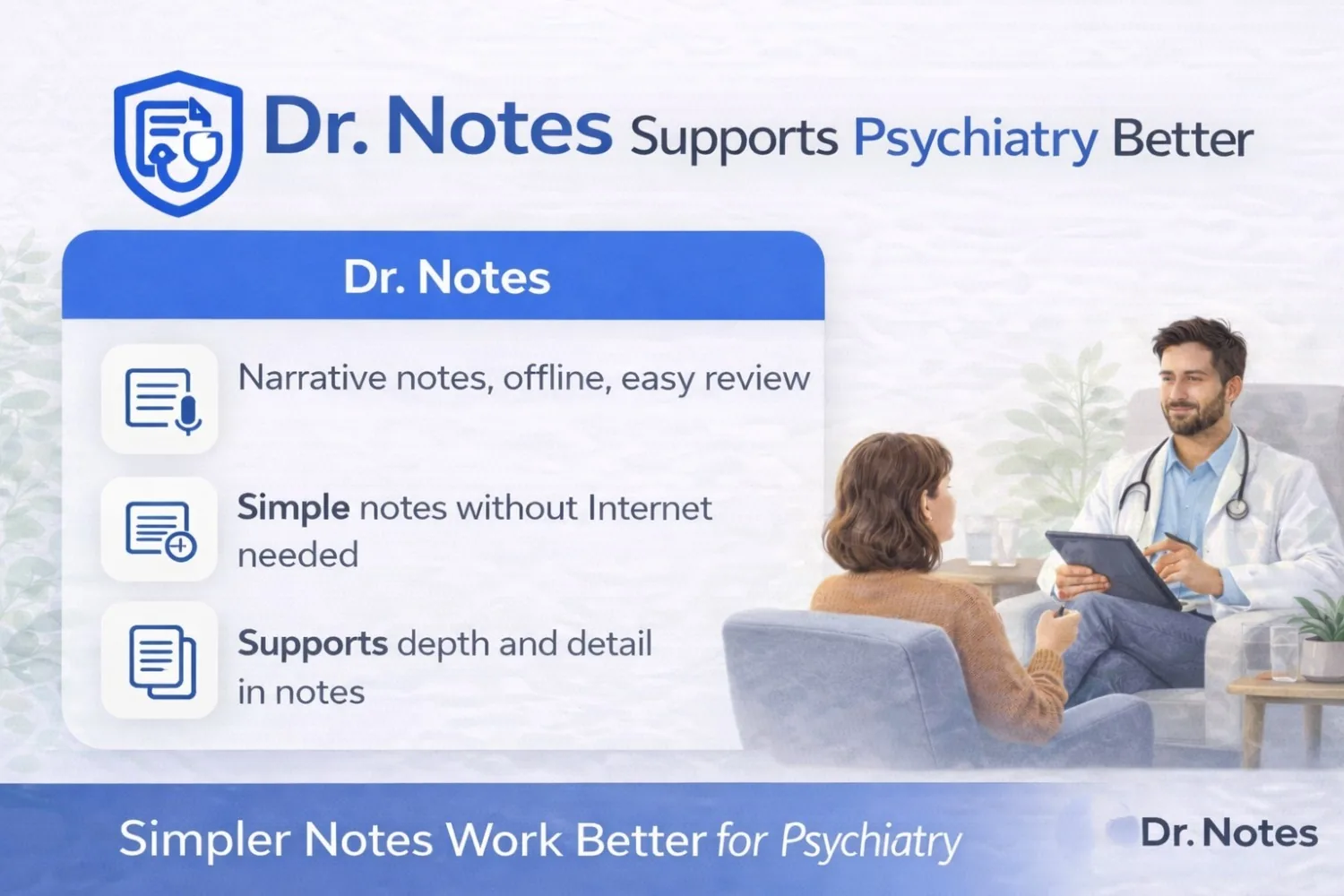
Psychiatry is not about checklists. It is about listening.
Every session carries a story—spoken and unspoken. A pause before an answer. A shift in tone. A detail that seems small today but matters deeply over time. For psychiatrists, care lives in these moments. Yet many digital systems are not built for this reality.
The Quiet Challenge in Psychiatric Practice
Psychiatrists spend hours in deep conversation, holding space for emotions, memories, and experiences that patients may be sharing for the first time. But when the session ends, another challenge begins: documentation.
Many EMR and EHR systems demand structured entries, endless clicks, and internet-dependent workflows. Instead of supporting reflection, they often pull attention away from it.
Over time, this creates fatigue—not from patient care, but from the tools meant to support it.
When Documentation Interrupts Care
In psychiatry, documentation should never interrupt:
- The flow of a session
- The emotional safety of the room
- The clinician’s ability to reflect clearly afterward
Yet heavy systems often force clinicians to:
- Break concentration to type
- Fit complex experiences into rigid fields
- Spend late hours rewriting what should have been captured naturally
Care becomes fragmented—not because of the patient, but because of the system.
Why Dr. Notes Feels Different in Psychiatry
Dr. Notes was designed with a different mindset—one that aligns closely with psychiatric care.
It does not ask psychiatrists to think in templates. It allows them to think in narratives.
Capturing Thoughts, Not Just Data
Psychiatry relies on:
- Long-term patterns
- Emotional shifts across visits
- Responses that cannot be measured in numbers
With Dr. Notes, clinicians can freely record:
- Observations in their own words
- Session reflections immediately after the visit
- Subtle changes that matter later
There is no pressure to compress complex experiences into predefined boxes.
Try Dr. Notes on Mobile
- Secure On-Device Data
- Instant Voice Notes
- Simple Patient Management


Voice Notes: When Words Matter More Than Typing
After an intense session, typing can feel heavy. Speaking feels natural.
Voice notes allow psychiatrists to:
- Record impressions while they are still fresh
- Preserve emotional nuance and clinical reasoning
- Reduce mental fatigue after long sessions
It becomes an extension of clinical thinking—not an extra task.
Offline Access Protects the Therapeutic Space
Psychiatric care should never depend on internet stability.
Dr. Notes works offline, allowing clinicians to:
- Document without interruption
- Review past sessions anytime
- Maintain focus and presence
The session remains sacred. The system stays in the background.
Continuity That Builds Confidence
Psychiatry is about looking back to move forward.
Having clear, organized visit history helps psychiatrists:
- Recall past discussions accurately
- Track progress across weeks or months
- Make decisions with confidence and clarity
Patients feel this too. They feel remembered. They feel heard.
Less Administration. More Care.
Dr. Notes intentionally avoids:
- Insurance-heavy workflows
- Coding complexity
- Hospital-scale dashboards
This keeps documentation light—so care can stay deep.
In the End, Psychiatry Is Human Work
Psychiatry is built on trust, time, and understanding. The tools used should respect that.
For many psychiatrists, simpler systems like Dr. Notes don’t just save time—they protect the quality of care itself.
When documentation supports reflection instead of replacing it, clinicians can return their full attention to where it belongs: the patient sitting in front of them.
Sometimes, simpler notes truly work better—especially in psychiatry.
Try Dr. Notes on Mobile
- Secure On-Device Data
- Instant Voice Notes
- Simple Patient Management
Comments