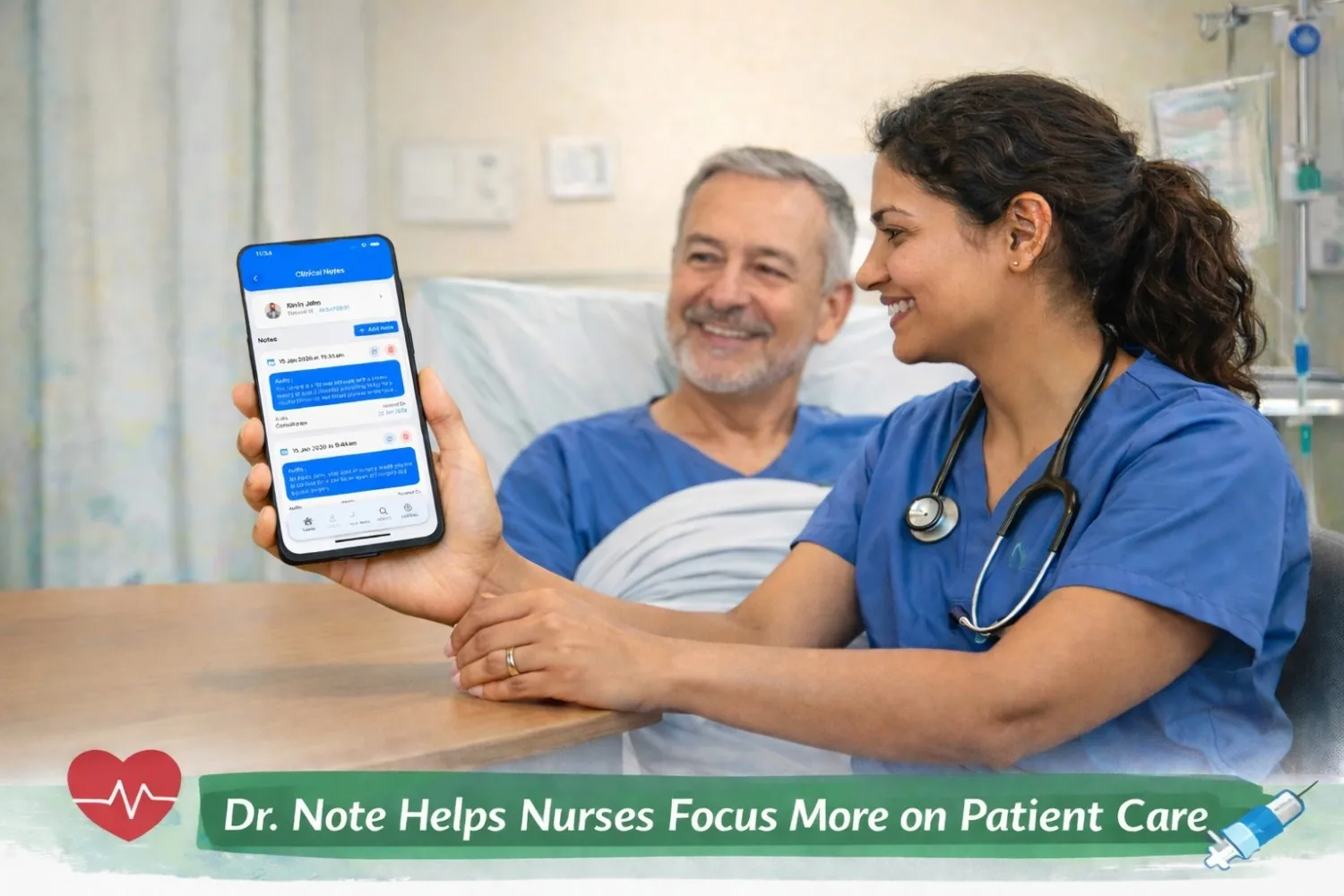
Registered Nurses work where care happens in real time. They monitor vital signs, manage medications, assess wounds, respond to clinical changes, educate families, and document everything accurately. Every shift moves quickly. Every observation matters. Documentation must be fast, structured, and reliable. This is where Dr. Notes fits naturally into nursing workflow.
In a Home Care Setting
Priya, an RN in home healthcare, visits Mr. Kumar, 65, recovering from abdominal surgery.
During assessment she checks:
- Temperature: 98.4°F
- BP: 130/84
- Wound edges intact
- Mild redness around incision
- Pain score: 5/10
After dressing the wound and reinforcing antibiotic instructions, she records:
- Abdominal incision clean.
- Mild erythema present.
- No discharge.
- Pain reduced after analgesic.
- Next review in 48 hours.
It takes less than a minute.
At the next visit, she quickly reviews previous notes arranged chronologically and compares healing progression instantly.
In a Clinic Environment
Rahul, a 52-year-old patient with chronic hypertension, visits weekly.
Today’s observation:
- BP: 150/95
- Reports mild headache
- Missed one medication dose
Note entered:
- BP elevated.
- Headache present.
- Medication compliance discussed.
- Diet reinforcement provided.
Two weeks later:
- BP: 135/85
- No headache
- Medication adherence improved
Because entries are sequential, blood pressure trends are clearly visible without opening multiple screens.
During a Busy Shift
In a rehabilitation ward, an RN manages multiple IV lines and medication rounds.
Instead of typing lengthy documentation at the end of the shift, she records a quick voice note:
- IV site clean.
- No swelling or redness.
- Vitals stable.
- Infusion ongoing without complications.
Voice documentation captures important clinical details immediately, without interrupting patient care.
In Community Nursing Practice
During rural outreach visits where internet connectivity is unstable, an RN records:
- Fasting glucose: 168 mg/dL.
- Foot exam normal.
- Diet counseling reinforced.
- Next review in 1 week.
Even without internet, documentation continues smoothly. Later, glucose trends are easy to review in chronological order.
Try Dr. Notes on Mobile
- Secure On-Device Data
- Instant Voice Notes
- Simple Patient Management


Where Dr. Notes Fits in Nursing Workflow
EMR (Electronic Medical Record) and EHR (Electronic Health Record) systems are powerful tools built for hospital-wide documentation, billing integration, and multi-department coordination.
They are essential in large healthcare institutions.
However, many Registered Nurses working in:
- Home healthcare
- Small clinics
- Rehabilitation centers
- Community outreach
- Independent practice
often need something more streamlined.
EMR/EHR platforms may involve:
- Multiple tabs and navigation layers
- Mandatory structured fields
- Diagnosis-driven templates
- Administrative complexity
For quick nursing documentation, this can sometimes feel time-consuming.
Dr. Notes focuses on:
- Fast clinical note entry
- Clear chronological timelines
- Simple progress tracking
- Voice note flexibility
- Offline access
It is not meant to replace hospital-scale EHR systems, but it serves as a practical and efficient solution for nurses who need speed and clarity in daily documentation.
Why This Matters
Nursing care relies on:
- Continuous monitoring
- Early detection of changes
- Pattern recognition
- Accurate communication
Whether tracking wound healing, blood pressure trends, glucose levels, or medication adherence, structured documentation supports better patient outcomes.
Dr. Notes keeps that structure simple and accessible.
In Simple Terms
Dr. Notes helps Registered Nurses:
- Document faster
- Track patient trends clearly
- Record voice notes during busy shifts
- Continue working without internet
- Focus more on patient care
Behind every stable recovery is organized documentation.
Dr. Notes helps make that process smoother.
Try Dr. Notes on Mobile
- Secure On-Device Data
- Instant Voice Notes
- Simple Patient Management
Comments