It's 8:10 pm on a Wednesday and Priya is still at the clinic. The last patient left at 7:30. The receptionist locked up at 7. Priya is the only physio in her solo outpatient practice, and she's typing SOAP notes for thirteen patients she saw today.
Knee from 9 am. Shoulder from 9:30. The frozen-shoulder lady from 10 who told her about her grandson's exam. Another rotator cuff at 10:30. By the time Priya gets to the 4 pm note, the morning patients have blurred into one composite person. She can't remember if the post-ACL patient's flexion was 105° or 110°. She has to guess, or open his last note and hope she wrote it down then.
She'll be home by nine. She'll eat reheated rice while answering one more WhatsApp from a patient asking about an exercise. Then she'll do it again tomorrow.
What's Actually Happening
This isn't a "Priya is bad at time management" problem. Outpatient physiotherapy documentation has crept into territory it was never designed for.
Every daily note is expected to carry:
- Subjective — what the patient reports today, in their words.
- Objective — measurable findings: ROM in degrees, MMT grades, NPRS pain score, sometimes outcome measures like PSFS or DASH or KOOS for the body region.
- Assessment — clinical reasoning that justifies the plan, in language a payer or auditor would accept.
- Plan — what was done, what changes next session, what was given as home exercise program.
Most APTA, WCPT and HCPC documentation guidance assumes the note is written in or immediately after the session. Insurance pre-auth reviewers want specific functional language ("patient unable to reach overhead cabinet" beats "shoulder pain") and a clear thread showing measurable progress visit-to-visit. Skip the detail and a claim gets denied. Skip the visit count and the auth runs out.
A solo physio sees twelve to fifteen patients a day in 30-minute slots. Three to four minutes between patients isn't enough to finish a full note. So the notes pile up and follow Priya home.
Other Physios Saying the Same Thing
This isn't a niche complaint. Here's a recent thread on the r/physicaltherapy subreddit titled "documentation is eating 2+ hours of my day and I'm honestly thinking about leaving outpatient":
"outpatient ortho, 5 years in. 14-16 patients a day. I like the clinical work. I like my patients. I'm good at this. but the notes are killing me… each note takes me 8-12 minutes. 14 patients times 10 minutes is 140 minutes of typing. over 2 hours. I stay late almost every day."
— @ArcadiaBunny
From the same thread, a comment from another household:
"I wish that when my husband was in outpatient it only took him 2 hours to document!! He used to stay at work for hoursssss after the clinic closed finishing up. He's in home health now and it's even worse."
— @Glittering-Park4500
And a thread from a home-health PT on the same subreddit on home-health documentation:
"therapists are exhausted by the time they finish visits and documentation often gets pushed to the next day. Having something that can draft the clinical narrative based on their notes means we actually get same-day documentation more often."
— @No_Foundation7481
Same pain, two settings. Outpatient clinic. Home visits. Notes that follow the therapist home.
What the Top Comments Recommend
Read through that thread and a pattern shows up. The PTs who leave on time aren't writing less detail — they're shifting when the note gets written. From a senior reply:
"Subjective is done in the first 2 minutes of the visit, objective gets filled in as we go most of the time, assessment is filled in as we go and finalized right after they leave. Most notes are done 5 minutes after the patient is gone."
— @themurhk
In other words: capture during the visit. Don't batch.
The blocker for a lot of solo physios is the tool. If your charting app forces you to navigate three screens, log back in, and tap through rigid diagnosis-driven menus, you can't realistically chart mid-session while you've still got hands on a patient's shoulder.
Where Dr. Notes Fits
Dr. Notes is built for the in-session capture style those top comments describe. Three things matter for this workflow:
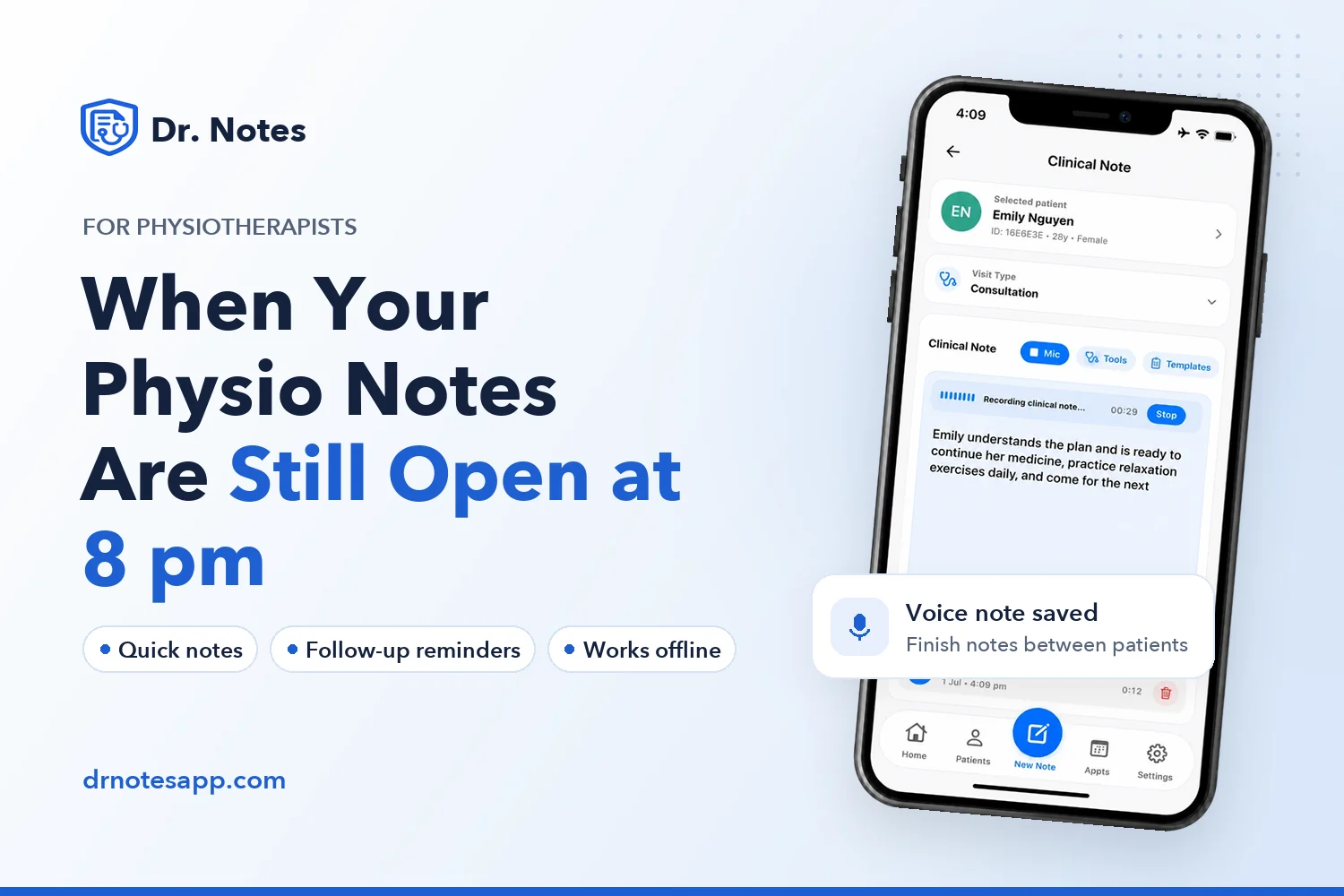
1. Voice notes during the session. Priya can dictate the subjective while the patient is still telling her about their week, the objective while they're on the bike, and the assessment in the thirty seconds after they leave the cubicle. Dr. Notes voice-to-text works on-device, so there's no waiting for a cloud transcription round-trip.
"Right shoulder flexion 140° active, 155° passive. End-range tenderness over greater tuberosity. NPRS 3/10 at rest, 5/10 with reach. Today: scapular setting cues, isometric ER, theraband row 2x10. Home: pendulum daily, scapular setting 3x10. Plan: progress to resisted ER next visit."
Forty seconds spoken, instead of eight minutes typed at 8 pm.
2. Quick visit history. Before each patient walks in, Priya can tap their name and see the last three visits in a chronological list — pain scores, ROM, what was done, what was prescribed for home. She doesn't have to guess whether the flexion was 105° or 110°. It's there.
3. Offline-first. Home visits, basement clinics with patchy Wi-Fi, that one community-centre room with two bars of signal — none of it stops the app. Patient data lives on the device. No cloud sync means nothing hangs while a note is being saved, and nothing leaves the phone unless Priya explicitly exports it.
Combined, this is the documentation pattern @themurhk described: subjective captured live, objective during the session, assessment finalized in the thirty-second gap before the next patient. Notes done by 6 pm. Dinner at a reasonable hour.

Try Dr. Notes on Mobile
- Voice notes, on-device
- Patient history in one tap
- Works offline


A Realistic First Week
Nothing solves a five-year documentation habit in one shift. A realistic first week with Dr. Notes for an outpatient or home-visit physio looks like this:
- Day 1-2. Add five regular patients. Use the voice note feature for subjective at the start of each visit. Notice that you no longer have to mentally rehearse what the patient just said while typing.
- Day 3-4. Dictate the objective measurements (ROM, NPRS, MMT) immediately after taking them. Finalize the assessment in the doorway gap before the next patient.
- Day 5. Compare the time you left the clinic this Friday to last Friday. For most solo physios it's the first week in a long time the notes haven't followed them home.
If the documentation pattern works for the first five patients, the rest of the caseload follows. The reason it works is unglamorous: capture while the visit is fresh, not after.
One Last Thing
Physios don't burn out because they don't love the work. They burn out because the work follows them home. The fix isn't writing less — it's writing at the right time, with a tool that doesn't fight the workflow.
Dr. Notes is on the App Store and Google Play. Try it for a week of real clinic work and see what time you leave on Friday.
Comments
Have a question, or a way you handle this in your own practice? Share it below.