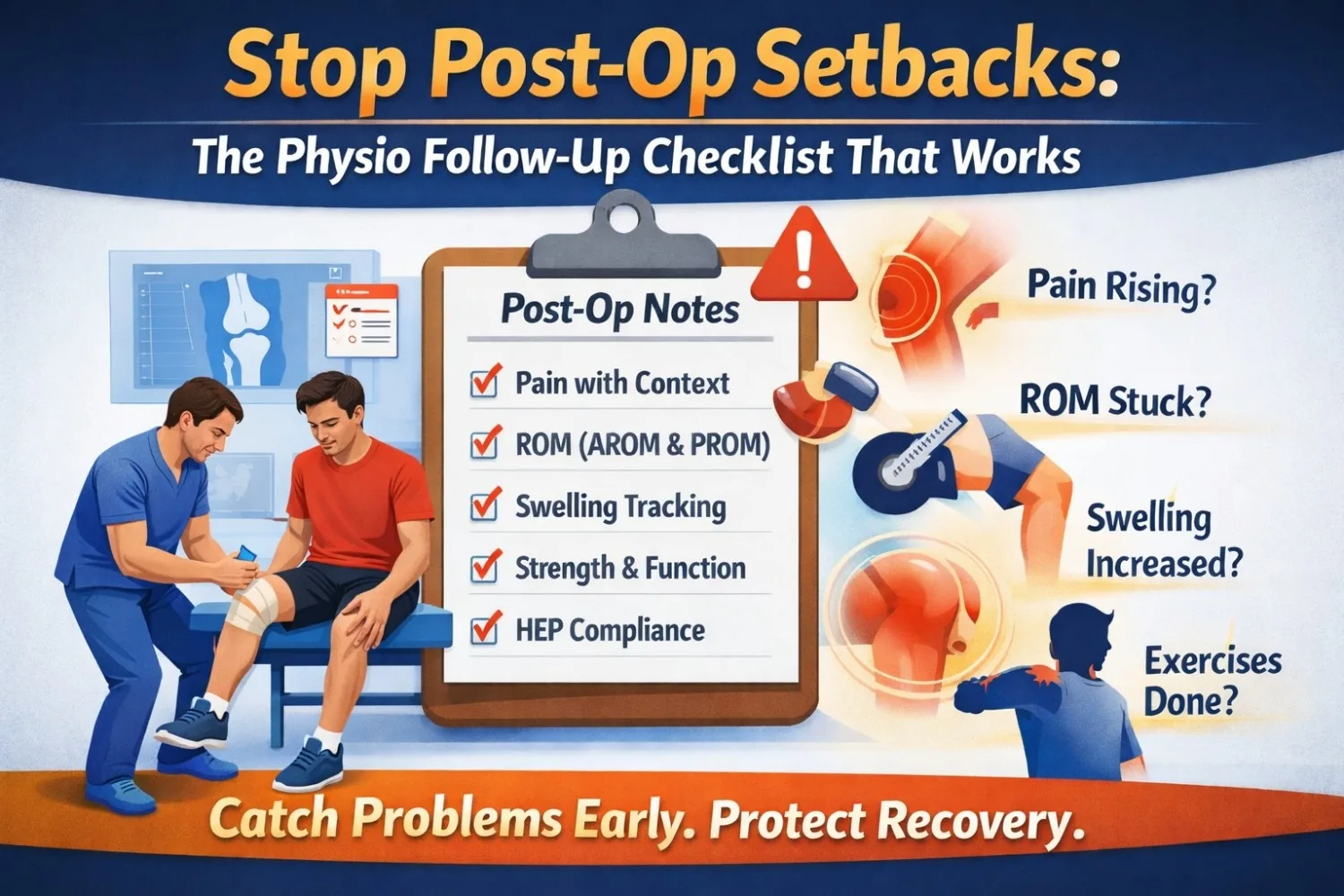
After surgery, the stitches may be closed — but recovery is still vulnerable. In physiotherapy, most setbacks don’t happen because the exercise plan was wrong. They happen because small warning signs were missed. A little extra swelling. A subtle drop in ROM. A patient climbing stairs too early. Poor activation hidden behind, “I’m doing the exercises.”
Post-op rehab rarely fails loudly. It slips quietly. And that’s why structured follow-up documentation matters more than we think.
Why Many Post-Op Rehabs Stall
In busy clinics, follow-up notes often look like this:
- Pain present
- ROM improving
- Continue exercises
It sounds acceptable. But it doesn’t tell you:
- Is pain trending upward or downward?
- Is ROM improving actively or only passively?
- Is swelling limiting progress?
- Is the patient performing exercises correctly — or compensating?
Without structured tracking, patterns remain invisible. And invisible patterns become preventable setbacks.

Try Dr. Notes on Mobile
- Secure On-Device Data
- Instant Voice Notes
- Simple Patient Management


When “Pain Is Okay” Isn’t the Full Story
Patient: 24-year-old, ACL reconstruction, Week 3
He walks in smiling. “Pain is okay, sir.”
But assessment reveals:
- Pain increases during deep flexion
- Mild swelling compared to last visit
- Early stair climbing at home
If you document only “Pain 4/10”, you miss the pattern.
Better documentation includes context:
- Pain 2/10 at rest
- Pain 6/10 beyond 90° flexion
- Worse at night after stair use
- Swelling slightly increased vs previous session
Now you identify overload early. You modify progression. You prevent regression. That’s how structured follow-ups protect recovery.
The ROM Trap: When “Improving” Isn’t Enough
Patient: 62-year-old, Total Knee Replacement, Week 2
She says confidently, “I’m bending better.”
Measurement shows:
- AROM: 70°
- PROM: 82°
- Tight end feel
- Extension lag 8°
If you write only “ROM improving”, you won’t recognize a plateau until stiffness becomes harder to reverse.
Separating active and passive ROM answers critical questions:
- Is weakness limiting motion?
- Is capsular stiffness developing?
- Is swelling restricting range?
Five degrees of progress matters — if you measure it.
When “I Did My Exercises” Isn’t the Whole Story
Patient: 41-year-old, Rotator cuff repair, Week 4
He reports full compliance with home exercises.
But demonstration reveals:
- Upper trapezius dominance
- Poor scapular control
- Limited true external rotation
If you write “HEP done”, compensation remains hidden.
Better documentation:
- External rotation Grade 2+/5
- Upper trap compensation observed
- Scapular control improves with cueing
- Pain 3/10 during activation
Now the barrier is clear. It’s not effort — it’s motor control.
The Physio Follow-Up Checklist That Works
Use this structure at every post-op visit.
1. Pain (With Context)
- Score (0–10)
- Type and location
- Trigger
- Change from previous visit
Trends matter more than single numbers.
2. Swelling / Inflammation
- Girth measurement (if applicable)
- Warmth / redness
- Comparison with last session
Objective data removes guesswork.
3. Range of Motion (AROM + PROM)
- Exact degrees
- End feel
- Pain at end range
- Extension lag
Numbers show progress. Words alone do not.
4. Strength & Muscle Activation
- Muscle grade
- Inhibition (e.g., quad lag)
- Compensation patterns
Quality matters as much as force.
5. Functional Milestones
- Walking distance
- Stair tolerance
- Sit-to-stand reps
- Assistive device use
- Balance tolerance
Function reflects real-life recovery.
6. Wound / Scar Observation
- Healing status
- Scar mobility
- Sensitivity
- Red flags
Early observation prevents complications.
7. Home Exercise Compliance (and Barriers)
- Days completed per week
- Exercises skipped
- Reason (pain, time, fear, confusion)
Most setbacks begin outside the clinic.
8. Patient Confidence
- Fear of movement
- Anxiety about re-injury
- Confidence with loading
Sometimes the body is ready — but the mind is not.
9. Clear Plan for Next Session
Never write “Continue.”
Instead:
- Progress load intentionally
- Introduce specific new exercises
- Reassess girth or ROM
- Modify activity exposure
Clarity prevents random therapy.
A 1-Minute Template You Can Use Daily
Pain:
Swelling/Girth:
ROM (AROM/PROM):
Strength/Activation:
Function:
Scar/Wound:
HEP compliance + barriers:
Confidence level:
Plan next session:
Even in a busy OPD, this structure keeps follow-ups consistent, measurable, and safe.
What This Prevents in Real Practice
- Pain rising + swelling rising → overload detected early
- ROM unchanged for two sessions → stiffness risk identified
- Strength improving but function not improving → fear avoidance revealed
- “Exercises done” but poor form → compensation corrected
Small patterns prevent big delays.
Final Thought
Post-op physiotherapy isn’t just about choosing exercises. It’s about observation, measurement, documentation, and progression. Because in recovery, what isn’t recorded… is what eventually slips.
Try Dr. Notes on Mobile
- Secure On-Device Data
- Instant Voice Notes
- Simple Patient Management
Comments