It's 9:18 a.m. on a Tuesday. Priya runs a two-chair general practice in a high-street unit between a chemist and a tailor. The 9:30 on her column is Mr. Khanna — booked late last night as an emergency. His upper right second molar has been throbbing since Sunday and he couldn't sleep on it.
She pulls up the chart. The tooth is on her list. She remembers it. November exam, four bitewings, distal-occlusal caries on #17, deep into dentine, close enough to the pulp that she'd told him at the chair: "this one is on the clock, let's do it before Christmas." She remembers him nodding. She remembers writing the treatment plan — a composite on #17, a crown on #19 that had a cracked MOD amalgam, and a routine cleaning. Three items.
He had walked to the front desk. The front desk booked the crown for January because that was where the open chair was, and the cleaning for February. The composite on #17 — the one Priya had said was on the clock — never got onto the calendar. The Post-it she had stuck to her monitor on her way to lunch ("book RUL7 filling next") went home in her scrubs pocket on Friday and never came back.
Now the composite is a pulpectomy.
What's Actually Happening
Every dentist who has been in practice for more than a year has a version of this story. The treatment plan and the schedule are two different objects in two different heads. The dentist owns the treatment plan. The front desk owns the schedule. The patient sits in the middle — and at the moment the hand-off happens, the patient is still numb, still anxious, still holding a printout with three line items and four dollar figures.
Inside that hand-off, three things have to survive:
- The clinical priority — which tooth is on the clock, which one can wait, which one can be folded into the hygiene visit. This is the part the dentist said out loud in the operatory and almost never said out loud again.
- The sequence — the crown can't go before the endo, the night guard can't be made before the occlusal equilibration, the SRP has to happen before the perio re-evaluation. Sequence is clinical, but it lives in a chart note the front desk doesn't read.
- The follow-through — if the patient walks out without booking everything, who is on the hook for chasing the rest. By default the answer is "nobody specific," which is the same answer as "nobody."
The ADA's guidance on dental records is clear that the record has to support continuity of care and document the rationale behind the treatment plan. Continuity of care is exactly the thing that breaks when the priority survives in the dentist's head and the schedule survives in the front desk's calendar, and nothing in between connects them. From an audit and malpractice perspective, the gap is uncomfortable too: there is a diagnosed condition in the chart, a recommended treatment that the patient accepted, and then four months of silence — until the patient comes back as an emergency.
This is the part that gets lost in conversations about "case acceptance." Case acceptance is the easy half. The patient said yes. The hard half — and the more expensive half, for the patient more than the practice — is the booked appointment, the second reminder a week before, and the kept appointment. The yes is a starting line. By itself, it does not move teeth.
Other Dentists Saying The Same Thing
This is not just Priya, and it is not new. Roger P. Levin, DDS, founder of Levin Group, wrote in Dental Economics what most working dentists feel by the end of a slow Tuesday:
"There are many treatment plans presented and recommendations made that either never get scheduled, get canceled, or no final decision is made by the patient and the treatment goes undone."
— Roger P. Levin, DDS, "Practice production, prioritized: Completing incomplete treatment," Dental Economics, September 27, 2021
Levin's word for it is "incomplete treatment." He goes further:
"Incomplete treatment is often unnoticed or ignored in the day-to-day pace of a dental practice."
— Roger P. Levin, DDS, Dental Economics, 2021
"Unnoticed or ignored" is a polite way of saying it sits on a Post-it. The clinical reality on the floor is that nobody is blocking time to read every chart looking for what was diagnosed in November and never scheduled. There is always a 10:00 patient and a 10:30 patient and a 4:50 p.m. printer jam.
Dianne Glasscoe Watterson, MBA, who has consulted with general practices for over two decades, framed the same pain in a column in Dental Economics. She was writing in response to a working dentist she calls "Dr. Dave" — a GP with about 1,000 active patients, on two PPOs, with open time on the column and a stack of diagnosed but unscheduled cases. Three months before the article, his business assistant had started tracking it. The number was uncomfortable enough to write in for help. Watterson's reply, on what actually keeps a patient hesitant after they've said yes:
"Patients do not remember what we say nearly as much as how we make them feel."
— Dianne Glasscoe Watterson, MBA, "Diagnosed but not scheduled," Dental Economics, April 19, 2016
That line cuts both ways. The patient does not remember the millimetre of caries close to the pulp. They remember the rush at the front desk, the printout, and the bill. By the time they are home, the priority the dentist felt in the operatory has faded into "I need to call them back at some point."
Samad Syed, MBA, MS, and Ibraiz Quamar, DDS, writing more recently in Dental Economics in January 2026, open their article with a sentence that is the whole problem in one breath:
"They thanked you for your time, seemed to understand, and walked away. Then they failed to return on the scheduled appointment day."
— Samad Syed & Ibraiz Quamar, DDS, "Stop losing patients: 3 treatment planning mistakes you can fix today," Dental Economics, January 29, 2026
Three different voices. Twenty years apart. The same Tuesday morning emergency.
Where The Hand-off Breaks
Look closely at the forty-five seconds between when Mr. Khanna stands up from the chair and when he walks out of the practice. That is the only stretch of time in which the priority Priya felt in the operatory could have been transferred to the schedule.
In that forty-five seconds:
- Priya is escorting him to the front desk while her dental assistant is already turning the chair over for the 10:00 patient who is in the waiting room.
- The front desk is on a phone call with someone trying to reschedule a hygiene visit.
- Mr. Khanna is still numb on the right side and trying not to drool on his shirt.
- The printed treatment plan is in his hand — three teeth, three line items, three figures.
At this point the only person who knows which tooth is "on the clock" is Priya. She is already in the next operatory. The front desk picks the first available slot for the most expensive procedure (the crown), because that is the production number on the daysheet, and books the cleaning for two weeks later because that is what the recall protocol says. The composite — the one the dentist said was urgent — has no slot, because there is no field on the schedule for "filling Priya thinks is urgent." It exists only in the chart note and on the Post-it.
Four months pass. The chart note is buried under twelve other chart notes. The Post-it is gone. Mr. Khanna lives his life and feels fine on that tooth until one Sunday he doesn't, and on Tuesday morning he is the emergency.
Where Dr. Notes Fits
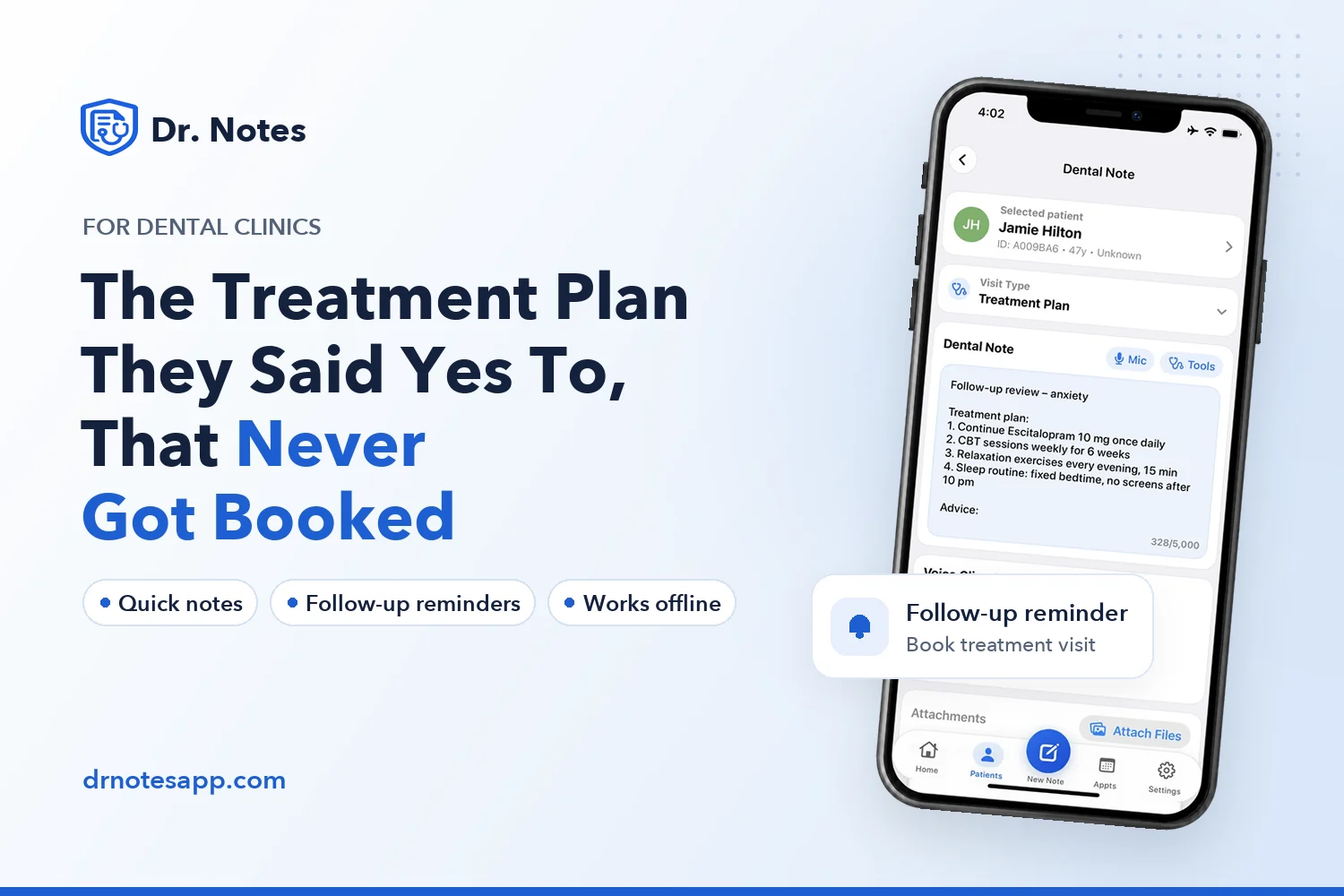
Dr. Notes is not a practice management system. It does not run the front desk schedule. What it does is keep the priority and the follow-through with the clinician who set them — on the same phone that is already in their pocket while they walk from one operatory to the next.
Four pieces of the workflow change:
- The treatment plan is captured in the patient's own card, in the dentist's own voice. Dr. Notes turns voice notes into clean structured text on the device. Walking out of the operatory after the exam, Priya can dictate "three items, RUL7 DO composite first — this one is on the clock — then crown on LRL7, then hygiene; want RUL7 booked within four weeks." That sentence is now in the chart, in the patient's card, in her language — not in a Post-it.
- The reminder lives on the same device that wrote the chart note. Dr. Notes lets the clinician set reminders and manage follow-ups so important patient care steps are never missed. The "book RUL7 within four weeks" is no longer a sticky note that can fall behind the X-ray packet — it is a follow-up entry attached to Mr. Khanna's card with a date, and it will surface on her phone the day she said it should.
- The clinical record and the photograph live in the same place. Dr. Notes attaches images and video to a patient record. The bitewing showing the caries near the pulp, snapped on the phone while it's still on the operatory screen, sits on Mr. Khanna's card next to the dictation. Four weeks later, when Priya glances at the reminder, she sees both — the image and the line she said out loud in the operatory — in two taps. She does not have to rebuild the priority from memory.
- None of it depends on the clinic Wi-Fi. Dr. Notes works fully offline and stores patient data securely on the device. The "this one is on the clock" voice note does not need the practice's internet to be working, the front desk to be free, or the practice management system to be open. It exists the moment Priya says it.
None of this replaces the conversation with the front desk or the production discussion at the morning huddle. It just makes sure the priority does not live only in Priya's head on the walk from op two to op one.

Try Dr. Notes on Mobile
- Voice notes captured chairside
- Follow-up reminders on each patient card
- Bitewings and photos on the same record


A Realistic First Week
Nobody changes how they hand off treatment plans on a Monday morning. A realistic first week with Dr. Notes for a working GP looks like this:
- Day 1. Pick one new patient exam. Immediately after, in the doorway between the operatory and the front desk, dictate the treatment plan into Dr. Notes in the order you want it done. Don't change anything else about how you usually hand off to the desk.
- Day 2. On any patient who accepts more than one tooth's worth of work, set a follow-up reminder for yourself — not for the front desk — for the procedure you flagged as "on the clock." Four weeks is usually a fair window.
- Day 3. Snap a photo of the relevant bitewing or PA straight into the patient card the moment you finish the exam. So when the reminder fires, the image is one tap away and you don't have to log into the practice management software to argue with yourself about whether you were right.
- Day 4. When your first reminder fires, look at the patient's card. If they have not booked the procedure you flagged, send a message to your front desk naming the tooth and the urgency in one line.
- Day 5. Compare. Among the new-patient exams from this week, how many of the procedures you flagged as "on the clock" have actually been booked? That number is your baseline.
If the pattern works for the first five new-patient exams, it works for the rest of the month. The reason it works is unglamorous: the priority leaves the dentist's head while the dentist is still standing in the doorway of the operatory, on the same device that will remind them about it four weeks later.
One Last Thing
The Mr. Khanna emergency is not a story about case acceptance, or about the front desk, or about the patient being unreliable. He said yes in November. He never said no. The pulpectomy is a story about the forty-five seconds between the operatory and the door, in which the only person who knew which tooth was on the clock was already mentally in the next op.
Roger Levin has been calling this "incomplete treatment" for twenty years. Dianne Glasscoe Watterson has been writing about it since at least 2016. Samad Syed and Ibraiz Quamar are still writing about it in 2026. The maths hasn't moved, because the forty-five seconds hasn't moved.
The tool you reach for as you walk from op two to op one — when you can still hear yourself saying "this one is on the clock" out loud — can.
Dr. Notes is on the App Store and Google Play. Try it for one week of new-patient exams and see how many of the "on the clock" teeth actually make it onto the schedule.
Comments
Have a question, or a way you handle this in your own practice? Share it below.