
A patient enters the consultation room and sits down.
Before the patient has explained what brought them there, the psychiatrist has already begun to observe.
Do they appear comfortable or guarded? Are they making eye contact? Is their speech slow, rapid or difficult to interrupt? Do their emotions match what they are describing?
These observations may seem small, but together they help the psychiatrist understand how the patient is experiencing the present moment.
This is the purpose of the Mental Status Examination, commonly known as the MSE.
A good MSE is more than a checklist. It is a respectful clinical description of how a patient appears, behaves, speaks, thinks and responds during a consultation.
In this article, we will follow three fictional patients—Alex Morgan, Rahul Verma and Priya Raman—to understand how the same MSE format can produce very different write-ups for depression, schizophrenia and a manic episode associated with bipolar disorder.
These examples are provided for education only. They should never be copied without adapting them to the individual patient.
What is a Mental Status Examination?
The Mental Status Examination is a structured assessment of the patient’s current mental functioning.
The clinical history describes what has happened over time. The MSE describes what the psychiatrist observes and explores during the present consultation.
For example:
Clinical history
The patient reports feeling low for the past six weeks.
MSE finding
The patient speaks softly, maintains limited eye contact and describes the
current mood as “low and exhausted.” Affect is constricted but reactive.
Both are important, but they provide different types of clinical information.
The MSE contributes to assessment, formulation and treatment planning. However, it does not independently establish a diagnosis.
Two people with the same diagnosis may present very differently. The same patient may also have different MSE findings during an acute episode, recovery and follow-up.
Standard Mental Status Examination Format
A complete MSE may include the following areas.
1. Appearance
Describe what can be observed objectively and respectfully:
- Apparent age
- Clothing
- Grooming and hygiene
- Nutrition
- Posture
- Eye contact
- Distinguishing physical features
Avoid vague or judgemental descriptions.
Instead of writing:
The patient looked strange.
Write:
The patient wore several layers of clothing despite the warm weather and appeared poorly groomed.
2. Behaviour and Rapport
Document how the patient behaved and engaged during the consultation.
Possible observations include:
- Cooperative
- Guarded
- Withdrawn
- Agitated
- Restless
- Hostile
- Overly familiar
- Distracted
- Internally preoccupied
Rapport may be easy, gradual or difficult to establish.
3. Psychomotor Activity
Psychomotor activity describes the relationship between the patient’s mental state and physical movement.
It may be:
- Normal
- Reduced
- Increased
- Agitated
- Restless
- Slowed
Any unusual movement should be described clearly.
4. Speech
Speech can provide important information about mood, thought organisation and level of activation.
Assess:
- Rate
- Volume
- Quantity
- Rhythm
- Tone
- Fluency
- Spontaneity
- Response latency
- Pressure of speech
For example:
Speech was slow, soft and reduced in quantity, with mildly increased response latency.
5. Mood
Mood is primarily the patient’s description of their emotional state.
Where possible, record the patient’s own words:
The patient described the mood as “low and exhausted.”
Using the patient’s words helps preserve their experience in the clinical record.
6. Affect
Affect is the psychiatrist’s observation of the patient’s emotional expression.
Assess:
- Range
- Intensity
- Stability
- Reactivity
- Appropriateness
- Congruence with mood and thought content
Common descriptions include:
- Full range
- Constricted
- Restricted
- Blunted
- Flat
- Labile
- Elevated
- Anxious
- Irritable
Mood and affect should be documented separately.
7. Thought Process
Thought process describes how the patient’s ideas are organised and connected.
Possible findings include:
- Linear and goal-directed
- Circumstantial
- Tangential
- Flight of ideas
- Racing thoughts
- Thought blocking
- Loosening of associations
- Perseveration
- Disorganised thinking
8. Thought Content
Thought content refers to the themes, beliefs and concerns occupying the patient’s mind.
Assess for:
- Hopelessness
- Guilt
- Suicidal thoughts
- Self-harm thoughts
- Thoughts of harming others
- Delusions
- Obsessions
- Grandiose beliefs
- Preoccupations
- Overvalued ideas
Risk-related findings should be documented in detail rather than reduced to “present” or “absent.”
9. Perception
Assess for:
- Hallucinations
- Illusions
- Depersonalisation
- Derealisation
- Other perceptual disturbances
If hallucinations are reported, document their type, content, frequency, associated distress and effect on the patient’s behaviour.
10. Cognition and Orientation
Depending on the clinical situation, assess:
- Level of consciousness
- Orientation to time, place and person
- Attention
- Concentration
- Immediate memory
- Recent memory
- Remote memory
- Language
- Abstract thinking
- Executive functioning
Avoid documenting “cognition normal” unless the relevant areas were assessed.
11. Insight
Insight describes the patient’s awareness and understanding of:
- Their symptoms
- The possibility of illness
- The effect on daily functioning
- The need for treatment
- The consequences of refusing care
Rather than writing only “good” or “poor,” briefly explain the patient’s understanding.
12. Judgement and Impulse Control
Judgement refers to the ability to make safe and appropriate decisions.
Impulse control describes the patient’s ability to manage immediate urges and behaviour.
These findings should be based on information from the consultation, recent behaviour and relevant collateral history.
Consultation One: Depression
Alex Morgan, 34 Years Old
Alex is a schoolteacher who has experienced low mood, poor sleep and reduced interest for approximately six weeks.
During the consultation, Alex sits with a slightly lowered posture and makes limited eye contact. Answers are relevant, but there is a short delay before responding.
“I feel empty and tired,” Alex says quietly. “Even getting out of bed feels difficult.”
Alex describes poor concentration, guilt about reduced performance at work and withdrawal from family activities.
When Dr. Meera asks directly about safety, Alex reports passive thoughts that life may not be worth living. However, Alex denies a current intention or specific suicide plan.
Dr. Meera listens carefully, explores the thoughts further and completes a separate suicide risk assessment.
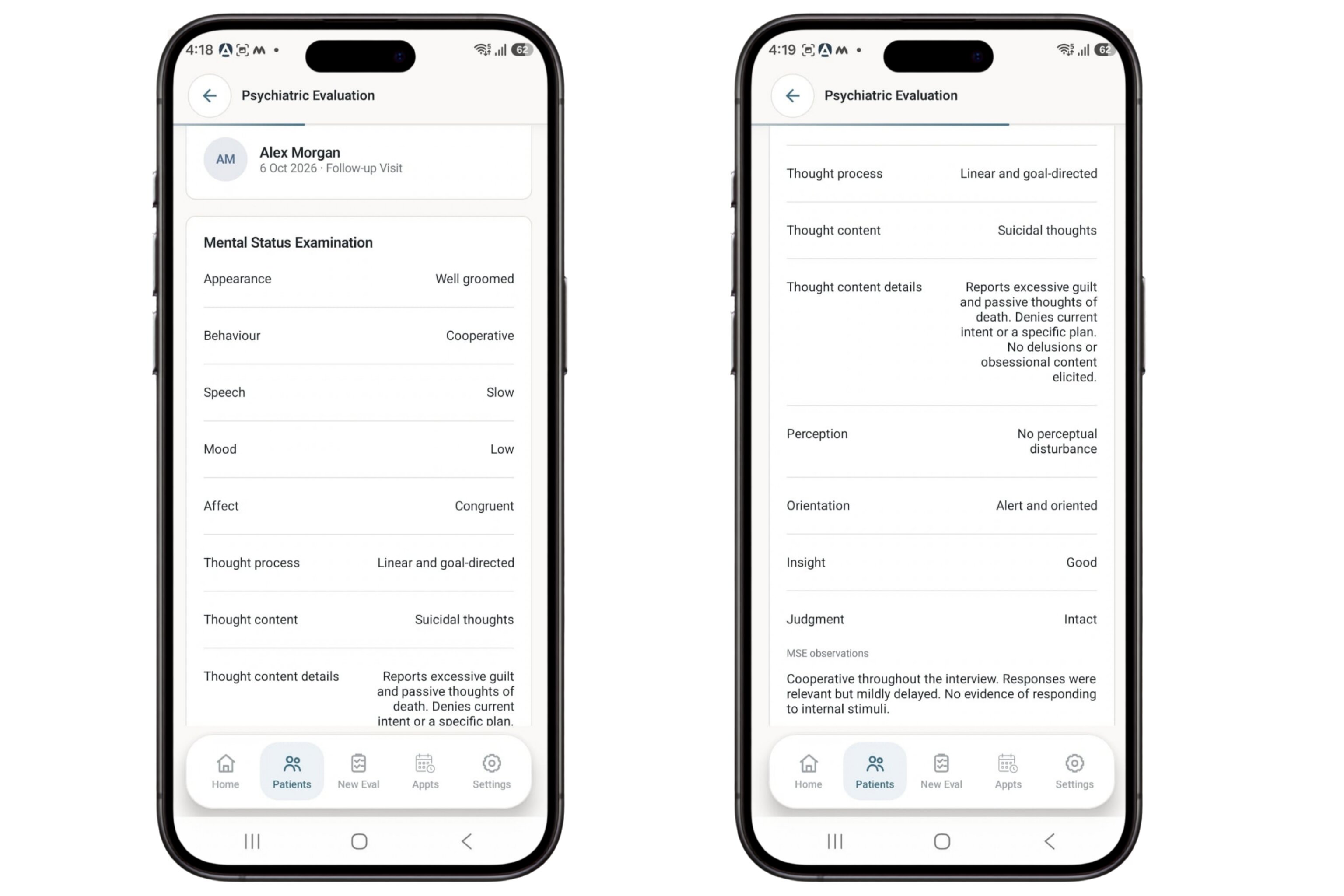
MSE Write-Up Example for Depression
Alex appeared the stated age and was appropriately dressed, with mildly reduced grooming. Alex was cooperative but withdrawn and maintained limited eye contact. Psychomotor activity was reduced. Speech was slow, soft and reduced in quantity, with mildly increased response latency. Alex described the mood as “low and exhausted.” Affect was constricted but reactive and congruent with the reported mood. Thought process was linear and goal-directed. Thought content included hopelessness, excessive guilt and passive thoughts of death. Alex denied current suicidal intent or a specific plan. No delusions or obsessional content were elicited. Alex denied hallucinations and other perceptual disturbances. Alex was alert and oriented to time, place and person. Attention and concentration were mildly reduced. Insight was good, judgement was intact and impulse control was preserved.
Why This Write-Up Works
The note does more than say, “Alex appeared depressed.”
It separates:
- Alex’s own description of the mood
- The psychiatrist’s observation of affect
- The organisation and content of thoughts
- Relevant safety information
- Cognitive findings
- Insight and judgement
The presence of passive thoughts of death should also be connected with a separate, detailed safety assessment covering intent, planning, access to means, previous behaviour, protective factors and the actions taken by the psychiatrist.
Consultation Two: Schizophrenia
Rahul Verma, 27 Years Old
Rahul attends the clinic with his elder sister.
He sits close to the door and looks around the room several times. His answers are brief, and he occasionally pauses in the middle of a sentence.
After being given time to speak, Rahul explains that his neighbours are monitoring him through electronic devices.
He also reports hearing two voices commenting on his activities.
Rahul’s sister describes a gradual change over the past several months. He has become socially withdrawn, stopped attending work and needs reminders to take care of his personal hygiene.
Dr. Meera records each source separately:
- What Rahul reports
- What his sister reports
- What she directly observes
- Her clinical interpretation
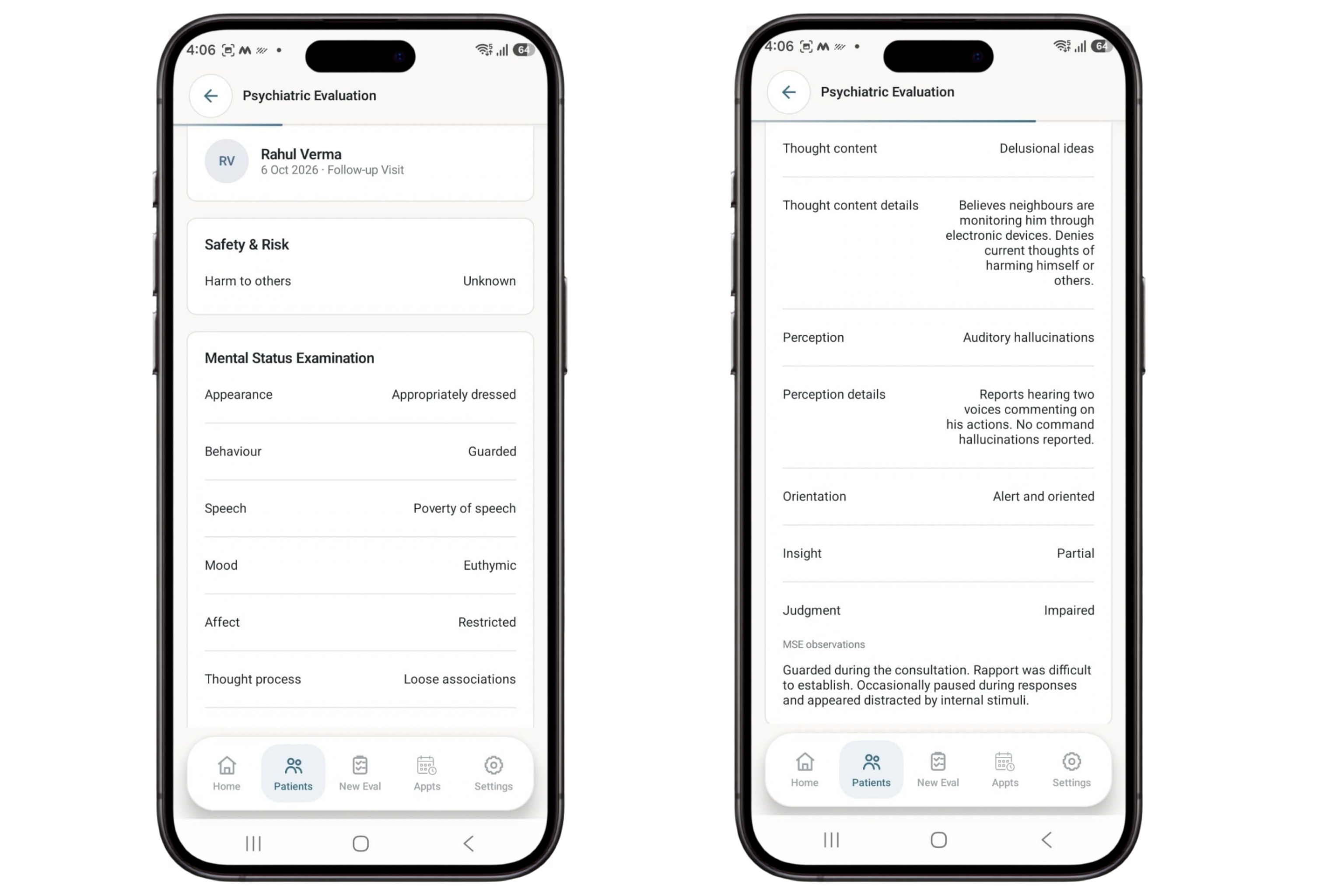
MSE Write-Up Example for Schizophrenia
Rahul appeared his stated age and was appropriately dressed, although grooming was poor. He was guarded, maintained intermittent eye contact and appeared internally preoccupied. Rapport was difficult to establish. Psychomotor activity was mildly reduced. Speech showed poverty of content, with brief answers and occasional delayed responses. Rahul described his mood as “fine” but appeared mildly anxious when discussing his neighbours. Affect was restricted. Thought process demonstrated loosening of associations and occasional thought blocking. Thought content included persecutory beliefs that neighbours were monitoring him through electronic devices. Rahul reported hearing two voices commenting on his actions. He denied command hallucinations and current thoughts of harming himself or others. He was alert and oriented to time, place and person, although attention was impaired. Insight into his experiences was limited, judgement regarding treatment was impaired and impulse control appeared preserved during the interview.
Why This Write-Up Works
The note uses specific and respectful language.
It distinguishes between:
- Observed guardedness
- Beliefs reported by Rahul
- Voices reported by Rahul
- Information provided by his sister
- The psychiatrist’s assessment of insight and judgement
Not every person with schizophrenia has hallucinations, persecutory beliefs, poor grooming or impaired insight.
A patient receiving effective treatment may have organised speech, appropriate behaviour and good awareness of their condition.
The MSE must describe the individual—not repeat a standard description associated with a diagnosis.
Consultation Three: Bipolar Disorder—Manic Episode
Priya Raman, 28 Years Old
Priya arrives with her husband but quickly takes control of the conversation.
She speaks enthusiastically about several new business ideas and explains that she needs only two or three hours of sleep because she has “more energy than everyone else.”
Her speech is rapid and difficult to interrupt. She moves quickly between ideas and describes plans to achieve international business success within a few weeks.
Priya’s husband reports that she has recently made several large purchases without discussing them with the family.
Priya does not believe that her behaviour is unusual and sees no need for treatment.
Dr. Meera remains calm and respectful while assessing Priya’s mood, thinking, recent behaviour, insight, judgement and immediate risks.
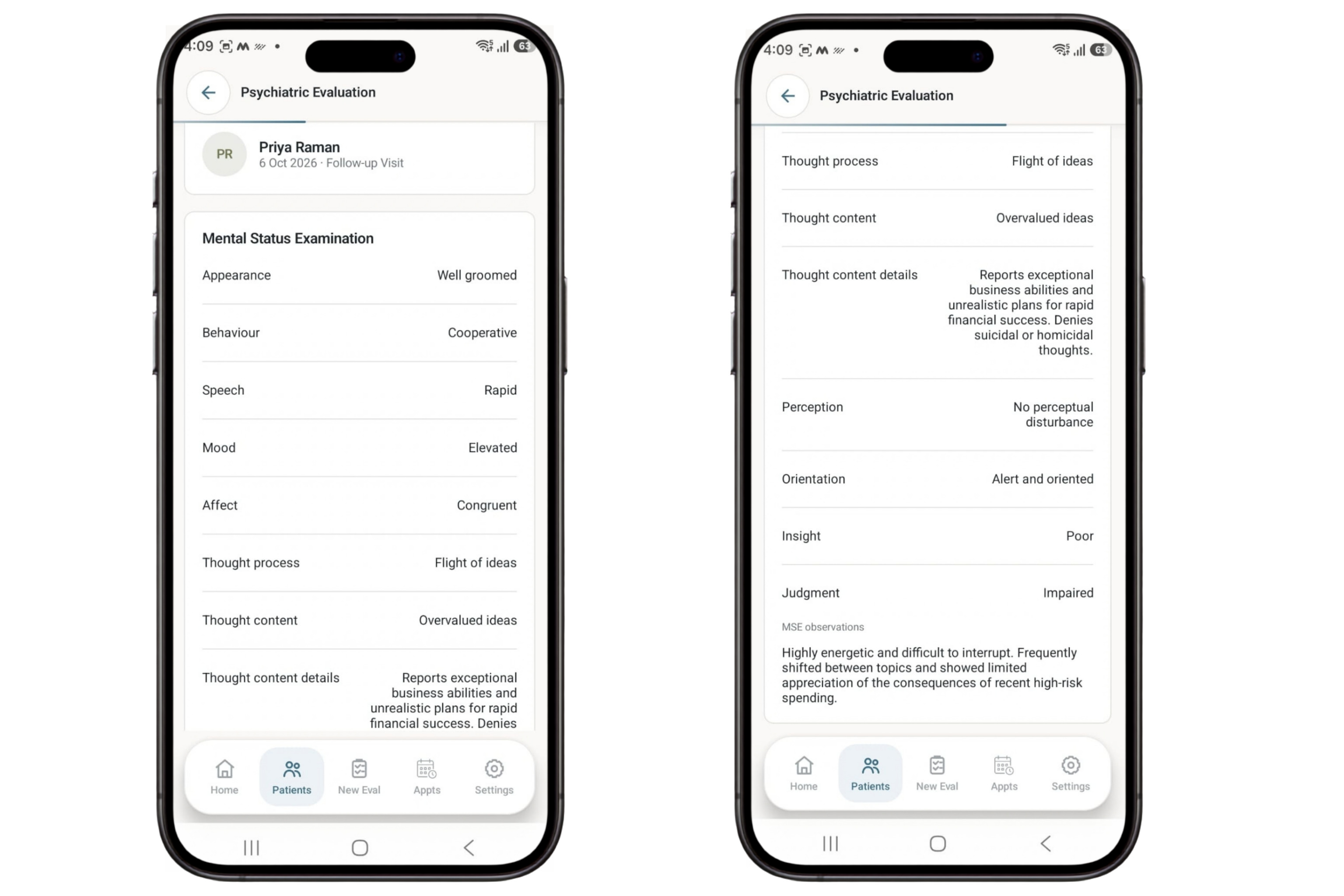
MSE Write-Up Example for a Manic Episode
Priya was well groomed and brightly dressed. She was cooperative but highly energetic, overly familiar and difficult to interrupt. Psychomotor activity was increased. Speech was rapid, loud and pressured. She described her mood as “excellent.” Affect was elevated, expansive and congruent with the reported mood. Thought process demonstrated flight of ideas. Thought content included overvalued and grandiose beliefs about exceptional business abilities and rapid financial success. Priya denied suicidal or homicidal thoughts. No hallucinations or other perceptual disturbances were reported. She was alert and oriented to time, place and person but was easily distracted. Insight was poor, judgement regarding financial and treatment decisions was impaired and impulse control was reduced.
Why This Write-Up Works
The note connects Priya’s observed behaviour with clinically relevant concerns.
It documents:
- Increased energy
- Pressured speech
- Elevated mood
- Flight of ideas
- Grandiose or overvalued ideas
- Distractibility
- Poor insight
- Impaired judgement
- Reduced impulse control
Bipolar disorder may involve depressive, hypomanic, manic or mixed episodes. The MSE will therefore depend on the patient’s current presentation.
There is no single MSE description that applies to every person with bipolar disorder.
Comparing the Three Examples
| MSE Area | Alex: Depression | Rahul: Schizophrenia | Priya: Manic Episode |
|---|---|---|---|
| Behaviour | Cooperative and withdrawn | Guarded and internally preoccupied | Energetic and difficult to interrupt |
| Speech | Slow, soft and reduced | Poverty of speech with delayed responses | Rapid and pressured |
| Mood | Low and exhausted | Reports feeling fine | Elevated or “excellent” |
| Affect | Constricted but reactive | Restricted | Elevated and mood-congruent |
| Thought process | Linear and goal-directed | Loosening and thought blocking | Flight of ideas |
| Thought content | Hopelessness and guilt | Persecutory beliefs | Grandiose or overvalued ideas |
| Perception | No disturbance reported | Auditory hallucinations | No disturbance reported |
| Attention | Mildly reduced | Impaired | Easily distracted |
| Insight | Good | Limited | Poor |
| Judgement | Intact | Impaired regarding treatment | Impaired regarding risk and treatment |
This comparison is useful for learning, but it should not become a shortcut for diagnosis.
A patient with depression may appear restless instead of slowed. A person with schizophrenia may have organised speech and good self-care. A patient experiencing mania may present with irritability rather than an obviously elevated mood.
The MSE must always reflect the individual patient.
Common MSE Documentation Mistakes
Copying the Previous Note
Repeating the same MSE at every visit may hide meaningful improvement or deterioration.
The note should reflect the current consultation.
Using Vague Descriptions
Statements such as “behaviour abnormal” or “thoughts disturbed” do not explain what was observed.
Describe the specific finding.
Mixing History With Present Findings
A hallucination experienced three months earlier belongs in the clinical history unless it is also present during the current assessment.
Treating a Diagnosis as an Observation
Writing “the patient is schizophrenic” is not an MSE finding.
Document the patient’s behaviour, speech, thought process, thought content, perception, insight and judgement.
Using Judgemental Language
Avoid descriptions such as:
- Lazy
- Difficult
- Attention-seeking
- Crazy
- Manipulative
Use objective, respectful and clinically relevant language.
Recording Areas That Were Not Assessed
Do not automatically write “normal” for cognition, perception, insight or judgement if these areas were not explored.
Documenting Risk Without Enough Detail
A statement such as “low suicide risk” may not explain how the conclusion was reached.
Relevant findings, clinical interpretation, protective factors and the safety response should also be documented.
How Dr. Notes for Psychiatrists Supports MSE Documentation
Dr. Notes for Psychiatrists provides a structured Mental Status Examination within its connected psych evaluation workflow.
The psychiatrist can organise findings relating to:
- Appearance
- Behaviour
- Speech
- Mood
- Affect
- Thought process
- Thought content
- Perception
- Cognition
- Orientation
- Insight
- Judgement
- Impulse control
- Additional clinical observations
The completed MSE can then be reviewed alongside:
- Safety and risk findings
- Current symptoms
- Psychiatric history
- Clinical scales
- Clinical formulation
- Assessment and treatment planning
- Follow-up information
This helps keep the patient’s clinical story connected across the consultation and future visits.
Dr. Notes works offline, and patient information is stored on the doctor’s device. The psychiatrist must still protect the device, control access and manage backups and exported records carefully.
The app supports organised documentation. It does not perform the examination, diagnose the patient or replace professional clinical judgement.
Quick MSE Documentation Checklist
Before completing the note, ask:
- Does the MSE reflect the patient’s current presentation?
- Have I separated the patient’s report from my observations?
- Have I identified information provided by a relative or caregiver?
- Is the language objective and respectful?
- Have I documented relevant normal and abnormal findings?
- Are risk-related findings sufficiently detailed?
- Have I avoided assumptions based only on the diagnosis?
- Does the MSE connect logically with the history and treatment plan?
- Could another authorised clinician understand my reasoning?
Final Thoughts
A Mental Status Examination is not simply a collection of clinical labels.
It is a careful record of a human interaction.
It shows how the patient presented, what they experienced, what the psychiatrist observed and how those findings contributed to the next steps in care.
When the MSE is clear, respectful and individualised, it supports safer decisions, better communication and stronger continuity between visits.
Most importantly, it helps the clinical record describe more than a diagnosis.
It helps preserve the person behind it.
Important: All names, patients and clinical situations described in this article are fictional and have been created solely for education and product demonstration. The examples are not diagnostic templates and should be adapted to each patient and consultation. This article does not replace clinical training, professional judgement, supervision or applicable clinical and legal guidance.
Comments
Have a question, or a way you handle this in your own practice? Share it below.