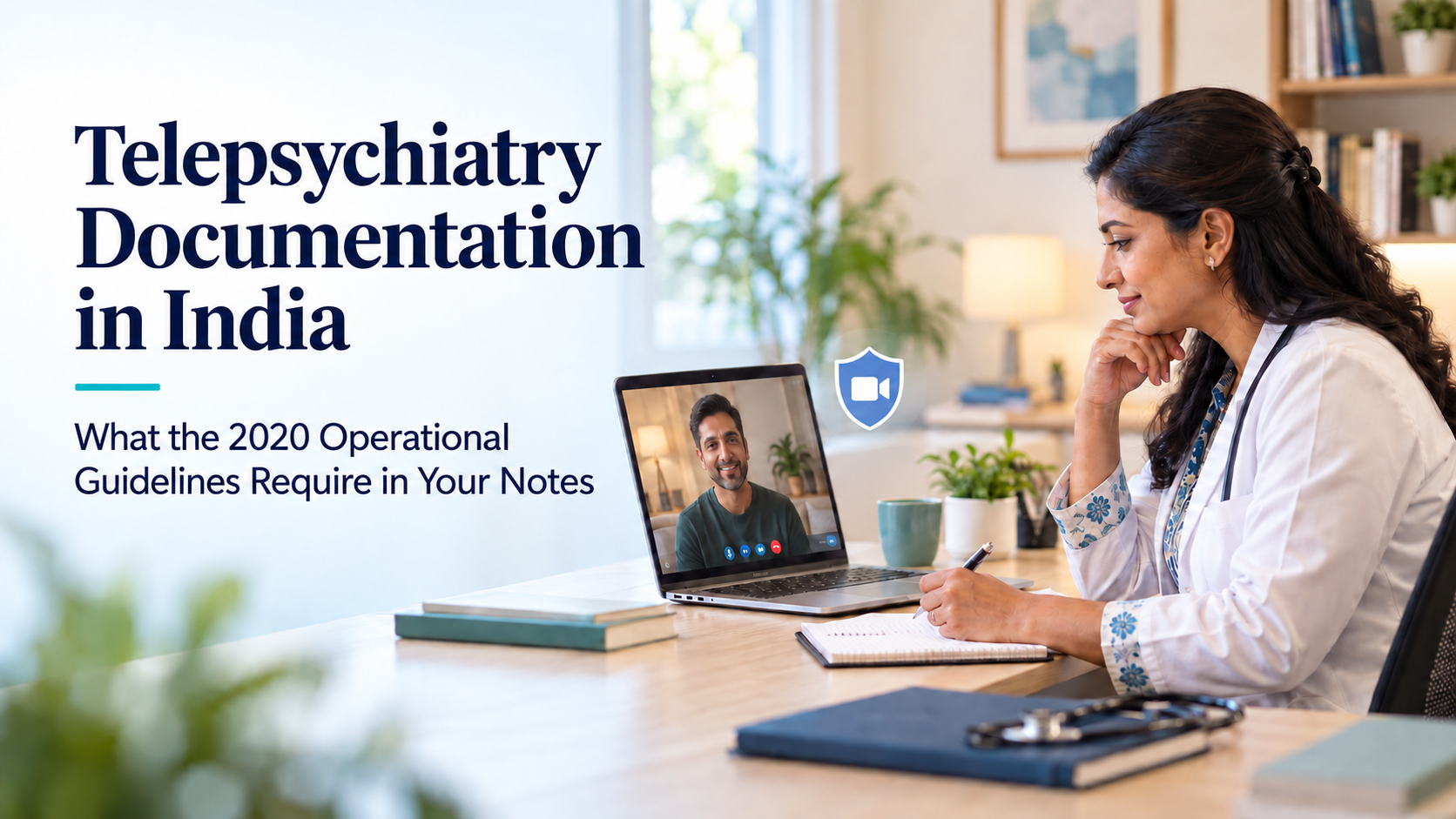
A psychiatrist begins a video consultation with a patient named Alex Morgan.
Alex appears anxious and says he has not slept properly for several nights. As the conversation continues, he quietly mentions feeling that life is no longer worth living.
In a clinic, the psychiatrist can see who accompanied him, involve nearby staff and arrange immediate support. During a video consultation, however, several important questions arise:
- Where is Alex currently located?
- Is he alone?
- Is someone nearby who can support him?
- Does the psychiatrist have his correct telephone number?
- What should happen if the internet connection suddenly fails?
- Which emergency service or hospital can reach him?
- Has Alex agreed to receive psychiatric care through teleconsultation?
- What information must be recorded after the session?
This is where telepsychiatry documentation becomes more than an administrative task.
A good telepsychiatry note must capture the clinical assessment, the circumstances of the remote consultation and the safety plan.
Understanding the Indian telepsychiatry framework
The Telepsychiatry Operational Guidelines–2020 were prepared by the National Institute of Mental Health and Neuro Sciences, the Indian Psychiatric Society and the Telemedicine Society of India.
The guidelines provide practical direction for psychiatrists offering remote mental healthcare in India. They focus mainly on live video consultations, while recognising that telemedicine may also involve audio calls, telephone conversations, text messages and email.
They should be read along with:
- The Telemedicine Practice Guidelines, 2020
- The Mental Healthcare Act, 2017
- The Information Technology Act, 2000
- The Drugs and Cosmetics Act and Rules
- The Narcotic Drugs and Psychotropic Substances Act
- Other laws and professional requirements relevant to the consultation
The operational guidelines support psychiatrists in providing remote care, but they do not remove the need for professional judgement.
A psychiatrist must still decide whether teleconsultation is clinically appropriate—or whether the patient requires an in-person assessment.
Why an ordinary consultation note may not be enough
A traditional psychiatric note usually records the patient’s symptoms, history, Mental Status Examination, diagnosis and treatment plan.
A telepsychiatry note must contain those details, but it should also answer questions created by the distance between the psychiatrist and the patient.
For example:
- How was the patient identified?
- Where was the patient during the consultation?
- Which communication method was used?
- Was the patient able to speak privately?
- Who else was present?
- Was consent obtained?
- Was the connection good enough for an appropriate assessment?
- Was there an emergency plan?
- How was the prescription shared?
These details establish the context in which the psychiatrist assessed the patient and made clinical decisions.
1. Record the consultation details
Begin by documenting the basic details of the remote encounter.
These may include:
- Date and time
- Mode of consultation
- Platform used
- Whether it was a video, audio, telephone, text or email interaction
- Whether the consultation was completed successfully
- Any technical problems that affected the assessment
For example:
Video consultation conducted on 1 October 2026 at 11:00 a.m. The video connection was stable during most of the session. Audio was interrupted briefly, and the consultation continued by telephone for approximately five minutes.
If poor video quality prevented the psychiatrist from properly observing the patient, that limitation should be recorded.
A technical problem is not merely an inconvenience. It may affect the quality and reliability of the clinical assessment.
2. Verify and document the patient’s identity
Before beginning the consultation and issuing a prescription, the psychiatrist should verify the patient’s identity.
Relevant identifying information may include:
- Full name
- Age
- Address
- Telephone number
- Email address
- Registered patient number
- Another appropriate form of identification
The note does not necessarily need to contain every number from an identity document. It should contain enough information to show that the psychiatrist confirmed the identity appropriately.
A simple entry may state:
Patient’s identity verified using name, age, registered telephone number and clinic patient ID.
If a family member, caregiver, interpreter or nominated representative participates, their identity and relationship with the patient should also be confirmed and documented.
3. Record where the patient is located
A patient can join a teleconsultation from home, work, a relative’s house, a hospital or even a parked vehicle.
Knowing the patient’s location becomes critical if the person:
- Expresses suicidal intent
- Threatens violence
- Develops severe agitation
- Appears acutely psychotic
- Is intoxicated
- Experiences a medical emergency
- Suddenly disconnects during a crisis
At the beginning of a clinically sensitive consultation, the psychiatrist may record:
Patient reports being at home in Bengaluru. Current address and contact number confirmed. Patient’s spouse is present in the house but is not in the consultation room.
The required level of detail will depend on the clinical situation. When risk is significant, the psychiatrist should have enough information to arrange local assistance.
4. Document consent for teleconsultation
Consent is an important part of telepsychiatry.
When the patient independently initiates the consultation, consent may generally be implied under the broader telemedicine framework. When the psychiatrist, health worker, caregiver or family member initiates the consultation, explicit consent may be required.
The note should record:
- Who initiated the consultation
- Whether consent was implied or explicit
- How explicit consent was obtained
- Whether the patient agreed to continue through teleconsultation
- Whether the patient had the capacity to provide consent
For example:
The patient initiated the appointment through the clinic. Consent for teleconsultation was implied and confirmed verbally at the beginning of the session.
Or:
The consultation was arranged by the patient’s daughter. The purpose and limitations of telepsychiatry were explained. The patient provided verbal consent to proceed, which was documented in the record.
Consent should not be treated as a single checkbox. The patient should understand the nature of the remote consultation and be free to refuse or request an in-person appointment.
5. Confirm privacy and record who was present
Psychiatric consultations often involve information the patient may not feel comfortable discussing in front of others.
At the beginning of the consultation, the psychiatrist should determine:
- Whether the patient is in a private space
- Whether another person is present
- Who that person is
- Whether the patient agrees to their presence
- Whether the patient feels safe speaking openly
A note may state:
Patient attended the consultation from a private room. No other person was present.
If a relative is present:
Patient’s mother was present with the patient’s permission. The patient confirmed that he felt safe and comfortable discussing his concerns in her presence.
If the psychiatrist suspects coercion or feels that the patient cannot speak freely, the concern should be documented. A private or in-person consultation may then be more appropriate.
6. State whether it is a first consultation or follow-up
The distinction between a first consultation and a follow-up can affect remote prescribing and the way the consultation is conducted.
The note should identify whether the encounter was:
- A first consultation
- A tele-follow-up
- A follow-up after an earlier in-person consultation
- A consultation involving a family member without the patient
- A collaborative consultation involving another healthcare worker
For a follow-up, include relevant information about the previous consultation:
Tele-follow-up for a patient last assessed in person on 15 August 2026. Previous diagnosis, medication and treatment response reviewed.
A family member consulting without the patient should not automatically be treated as a routine psychiatric consultation. The psychiatrist should consider the patient’s authorisation, capacity, advance directive, nominated representative and whether an in-person assessment is necessary.
7. Complete and document the clinical assessment
Telepsychiatry does not reduce the need for a proper psychiatric assessment.
The clinical note should contain the information required to understand the patient’s condition and support the psychiatrist’s decisions.
Depending on the consultation, this may include:
- Presenting concerns
- History of the current illness
- Previous psychiatric history
- Relevant medical history
- Current and previous medications
- Medication response and adverse effects
- Allergies
- Family and personal history
- Alcohol and substance use
- Mental Status Examination
- Functional difficulties
- Working diagnosis
- Differential diagnoses
- Clinical formulation
The psychiatrist should also record the limitations of the remote assessment.
For example:
Full assessment of psychomotor activity was limited because only the patient’s face and upper body were visible.
Or:
Video quality was inadequate for reliable observation of abnormal involuntary movements. An in-person examination was advised.
Recognising a limitation does not weaken the clinical note. It shows that the psychiatrist understood what could and could not be assessed remotely.
8. Give special attention to safety and risk
Telepsychiatry may be appropriate for many patients, but psychiatric emergencies require particular caution.
Where clinically relevant, document:
- Suicidal thoughts
- Intent
- Plan
- Access to means
- Previous suicide attempts
- Self-harm behaviour
- Thoughts of harming others
- Severe agitation
- Psychosis or mania
- Intoxication or withdrawal
- Ability to care for oneself
- Protective factors
- Family or social support
- Immediate intervention required
Returning to Alex’s story, a weak note might say:
Suicidal thoughts present. Advised hospital.
A clearer note would say:
Patient reported passive thoughts that life was not worth living but denied current intent or plan. No immediate access to identified means was reported. His spouse was available at home and agreed, with the patient’s consent, to remain with him. Emergency warning signs were discussed. The patient was advised to attend the nearest emergency department if intent, planning or inability to remain safe developed. Follow-up arranged within 48 hours.
The second note helps another clinician understand what was assessed, why the decision was made and what safety measures were arranged.
9. Create a plan for emergencies and disconnection
Before or during a high-risk teleconsultation, the psychiatrist should consider what will happen if the connection fails.
The record may include:
- Patient’s current telephone number
- Current location
- Emergency contact
- Nearest appropriate hospital
- Local ambulance or emergency service
- Family member available to assist
- Instructions provided to the patient
- Circumstances requiring an in-person review
If the patient requires urgent or emergency care, the psychiatrist should direct the patient towards appropriate in-person services and document the action taken.
For example:
Because of active suicidal intent and access to medication, teleconsultation was not considered sufficient. The patient’s brother was contacted with the patient’s knowledge. Immediate transfer to the nearest emergency department was advised. The receiving facility was informed.
The exact response will depend on the facts, available services and applicable legal duties.
10. Document the prescription carefully
Remote prescribing carries the same professional accountability as prescribing during an in-person consultation.
Before prescribing, the psychiatrist should collect enough relevant information to reach an appropriate clinical conclusion.
The record should include:
- Medication name
- Generic name, where appropriate
- Dose
- Route
- Frequency
- Duration
- Relevant risks and adverse effects discussed
- Monitoring required
- Follow-up instructions
- Method used to send the prescription
If the prescription is sent directly to a pharmacy, the patient’s explicit consent should be obtained and documented.
For example:
A digitally signed prescription was sent to the patient’s registered email address. The patient provided explicit consent for a copy to be sent to the nominated pharmacy.
Psychiatrists should use clinical judgement when including sensitive psychiatric details on a prescription. A prescription may be seen by pharmacists, caregivers or other people involved in obtaining the medicine.
Remote prescribing must also follow the applicable restrictions on different categories of medication. Not every psychiatric medicine is suitable or legally permitted for every type of remote consultation.
11. Maintain the records connected with the consultation
Telepsychiatry creates records beyond the final clinical note.
Relevant material may include:
- Appointment records
- Telephone logs
- Important emails
- Clinically relevant text messages
- Reports and investigations reviewed
- Documents or images provided by the patient
- Prescription records
- Referral information
- Emergency instructions sent to the patient
The Telepsychiatry Operational Guidelines state that psychiatrists should maintain the relevant records and documents used during treatment. Prescription records should be preserved as required for in-person practice.
This does not necessarily mean that every casual message must be copied into the note. However, communication that affects assessment, treatment or safety should be appropriately documented and preserved.
12. Do not confuse documentation with recording
A written clinical note is different from an audio or video recording of the consultation.
If a telepsychiatry session will be recorded, explicit consent should be obtained from everyone being recorded.
The patient should understand:
- Why the recording is being made
- Who can access it
- Where it will be stored
- How it will be protected
- How long it will be retained
- Whether it may be shared
A possible entry is:
The purpose of recording was explained. The patient and participating family member provided explicit consent before recording began.
Covert recording should not take place.
In many routine consultations, a clear and complete written note may be sufficient without storing an audio or video recording.
A practical telepsychiatry note template
A structured telepsychiatry note can follow this order:
Consultation details
- Date and time
- Mode and platform
- Connection quality
- First consultation or follow-up
Identity and location
- Patient identity verified
- Current physical location
- Telephone number confirmed
- Identity of participating family members or caregivers
Consent and privacy
- Who initiated the consultation
- Implied or explicit consent
- Capacity to consent
- People present
- Patient’s agreement to their presence
- Privacy concerns
Clinical assessment
- Presenting concerns
- Relevant history
- Medication and allergy history
- Mental Status Examination
- Working and differential diagnoses
- Limitations of remote assessment
Safety assessment
- Suicide and self-harm risk
- Violence risk
- Psychosis, agitation or intoxication
- Protective factors
- Emergency contact
- Local care options
Treatment plan
- Medication
- Therapy or counselling
- Psychoeducation
- Investigations
- Referral
- Safety plan
- Follow-up period
Prescription
- Medicines prescribed
- Method of transmission
- Consent for pharmacy transmission, where applicable
Clinician details
- Psychiatrist’s name
- Registration number
- Signature or appropriate digital authentication
How Dr. Notes for Psychiatrists can support documentation
A telepsychiatry consultation can move quickly. The psychiatrist may need to listen carefully, assess risk, involve a family member, issue a prescription and arrange follow-up—all while working through a screen.
Dr. Notes for Psychiatrists can help organise the clinical information through:
- Patient profiles
- Previous evaluations
- Appointments and follow-ups
- Safety and risk assessment
- Symptoms and psychiatric history
- Mental Status Examination
- Clinical scales
- Formulation
- Assessment and treatment planning
- Final review
- PDF export
A telepsychiatry-specific workflow could also include:
- Consultation mode
- First consultation or follow-up
- Patient identity verified
- Current patient location
- Consent type
- People present
- Connection quality
- Limitations of remote assessment
- Emergency contact
- Local referral plan
- Prescription-transmission method
- Recording consent, where applicable
The app can help the psychiatrist create an organised record, but it cannot decide whether teleconsultation is clinically appropriate. It also cannot replace the psychiatrist’s professional judgement or legal responsibilities.
The human responsibility behind a remote consultation
A screen may separate the psychiatrist and patient, but the responsibility to listen, assess and protect remains the same.
In some ways, telepsychiatry demands even greater clarity.
The psychiatrist must understand not only what the patient is experiencing, but also where the patient is, who is nearby, whether the conversation is private and what will happen if the situation becomes unsafe.
A strong telepsychiatry note tells the complete story:
Who was consulted, how the consultation took place, what the psychiatrist found, what limitations existed and what plan was created to keep the patient safe.
Good documentation protects continuity of care. It supports professional accountability. Most importantly, it helps ensure that distance does not weaken the quality or humanity of psychiatric care.
Official references
- Telepsychiatry Operational Guidelines–2020
- Telemedicine Practice Guidelines, 2020
- Mental Healthcare Act, 2017
This article provides general educational information and does not constitute medical or legal advice. Psychiatrists should review current guidelines, regulations and applicable laws before establishing a telepsychiatry documentation process.
Comments
Have a question, or a way you handle this in your own practice? Share it below.