Structured Psychiatric Evaluations

Move through safety, symptoms, psychiatric history, mental state, clinical scales, formulation and planning while keeping the previous visit in view.

01 Previous Visit

Know where the patient left off

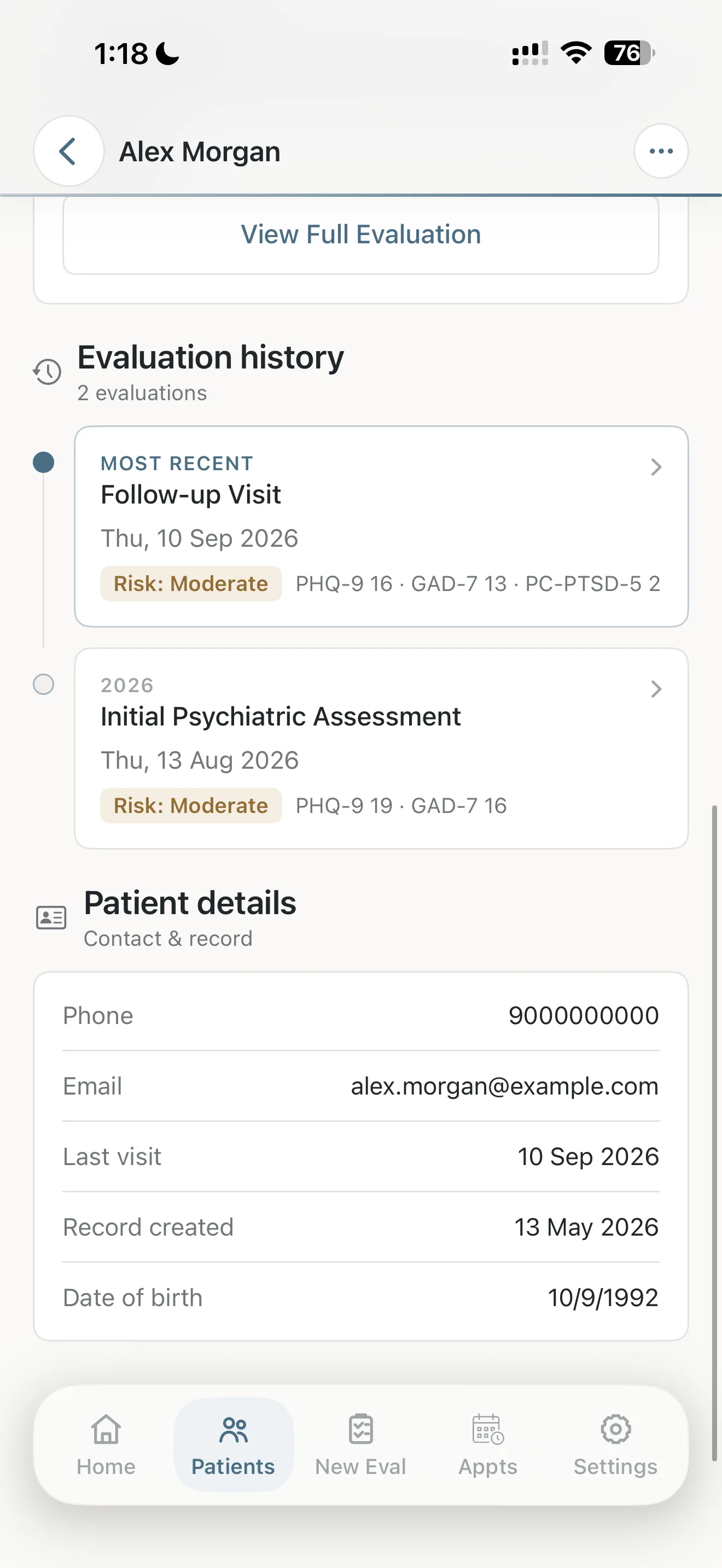
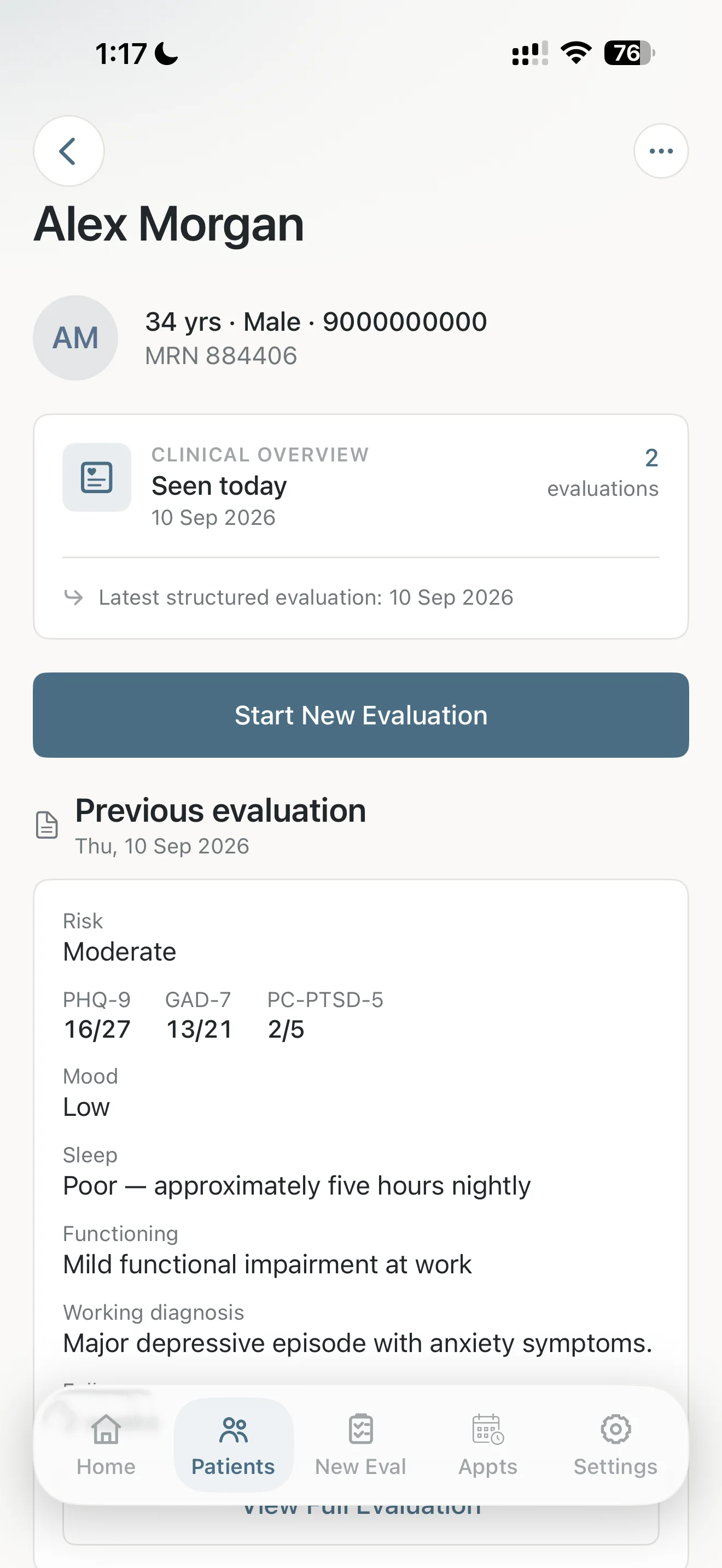
Most follow-ups begin with the same question: what were we watching last time? Dr. Notes answers it before you start, showing previous risk and suicidal thoughts, mood, sleep, functioning, the last set of scores, and the symptoms you were following.

So you walk in with the context, without reopening the whole note and reading it back.

  • Previous risk and suicidal thoughts
  • Latest PHQ-9 and other completed scales
  • Previous mood, sleep and functioning
  • Symptoms followed at the last visit
Since previous visit PHQ-9  17/27  →  16/27
A Dr. Notes psychiatric note showing a “Since previous visit” card with PHQ-9 moving from 17/27 to 16/27, above the patient’s recorded mood, sleep, appetite, energy, concentration and function.

02 Safety

Work through risk without burying it in the note

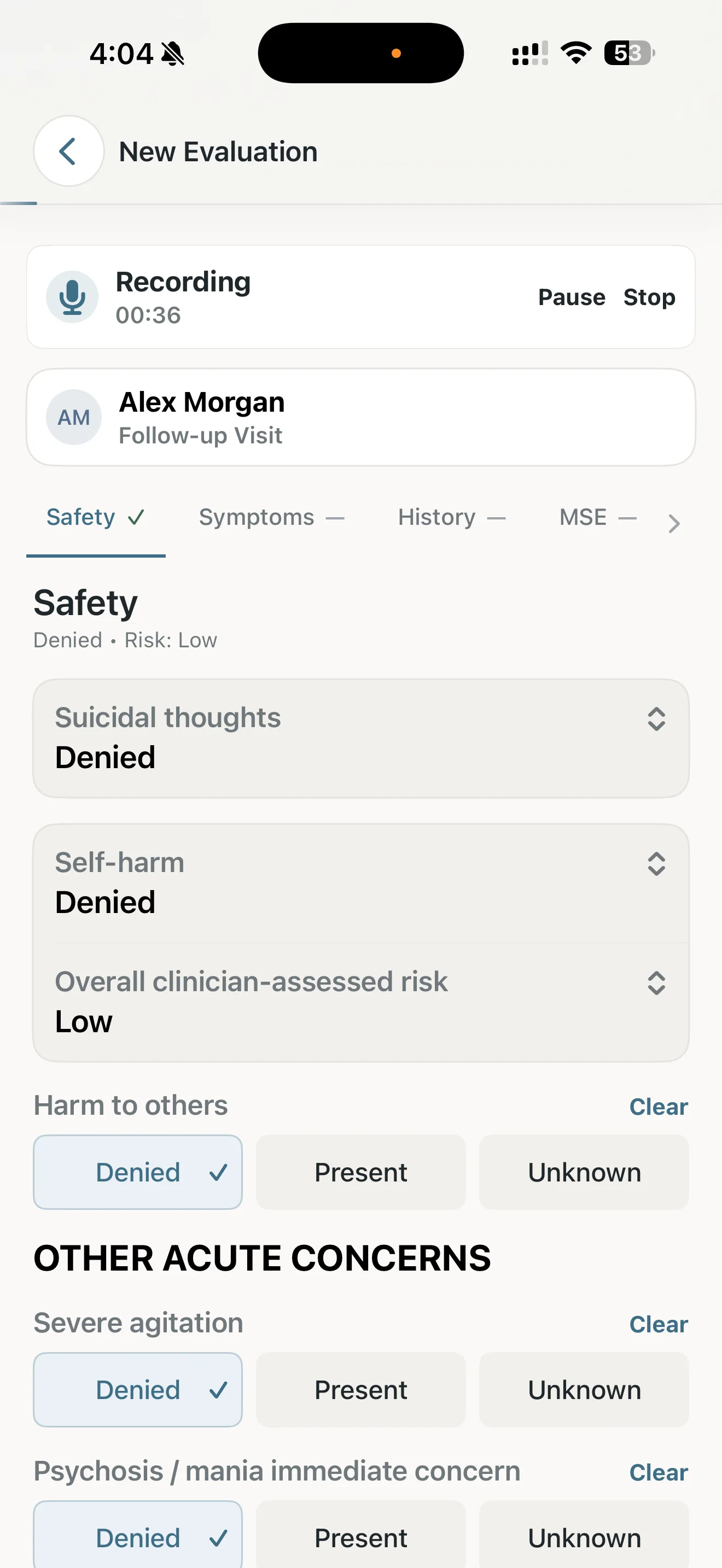
Risk matters too much to end up as a sentence somewhere in the middle of a note, so it gets its own section every time.

Record suicidal thoughts, self-harm, harm to others and your overall risk judgement. If ideation is present, the follow-up questions open on their own, covering intent, plan, access to means and previous attempts, so you are not deciding what to ask under time pressure.

Previous visit

  • PHQ-917 / 27
  • Recorded18 Jul 2026

Today

  • Overall riskModerate
  • Suicidal thoughtsPassive
  • PHQ-916 / 27
  • Additional ideation questions appear only when relevant
  • Acute concerns stay together in the same section
  • Protective factors and safety notes remain in the clinician’s own words
The Safety section of a Dr. Notes psychiatric note, with a Previous Visit button, overall clinician-assessed risk set to Moderate, suicidal thoughts recorded as passive, and the ideation detail questions open below.

03 Symptoms

Record today’s clinical picture quickly

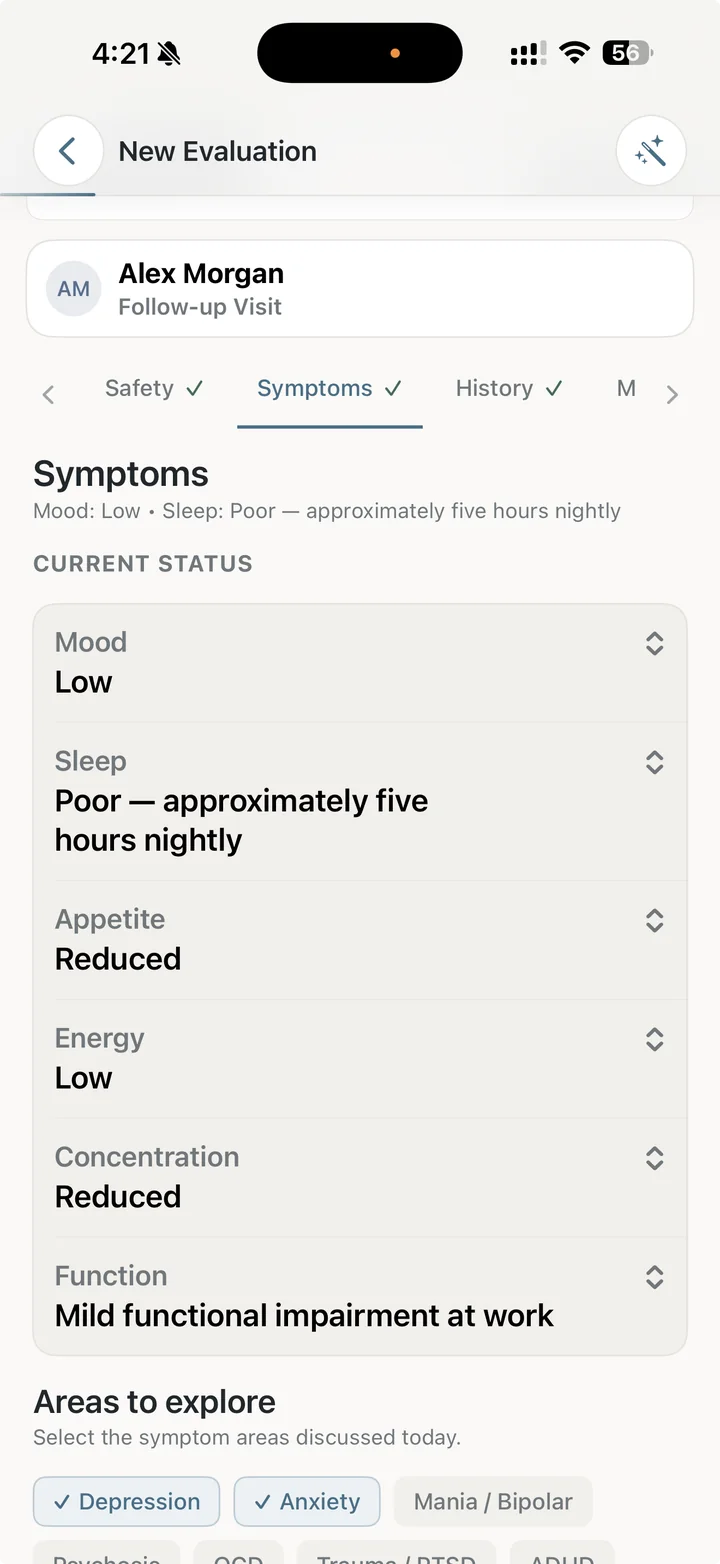
You should not have to retype the same symptom checklist at every visit. Mood, sleep, appetite, energy, concentration and functioning are already there as structured fields, ready to tap through while you talk.

Then flag the areas worth exploring: depression, anxiety, psychosis, trauma, ADHD, substance use, sleep. Write freely where the detail actually matters.

  • Mood, sleep, appetite, energy, concentration and function
  • Select the symptom areas relevant to this visit
  • Add clinical detail only where it is useful
  • Previous status remains available for context
The Symptoms section of a Dr. Notes psychiatric note showing mood, sleep, appetite, energy, concentration and function, with areas to explore such as depression, anxiety, psychosis and sleep selected.

04 History

Keep the important history organised

Psychiatric history has a way of turning into one long paragraph that nobody wants to reread.

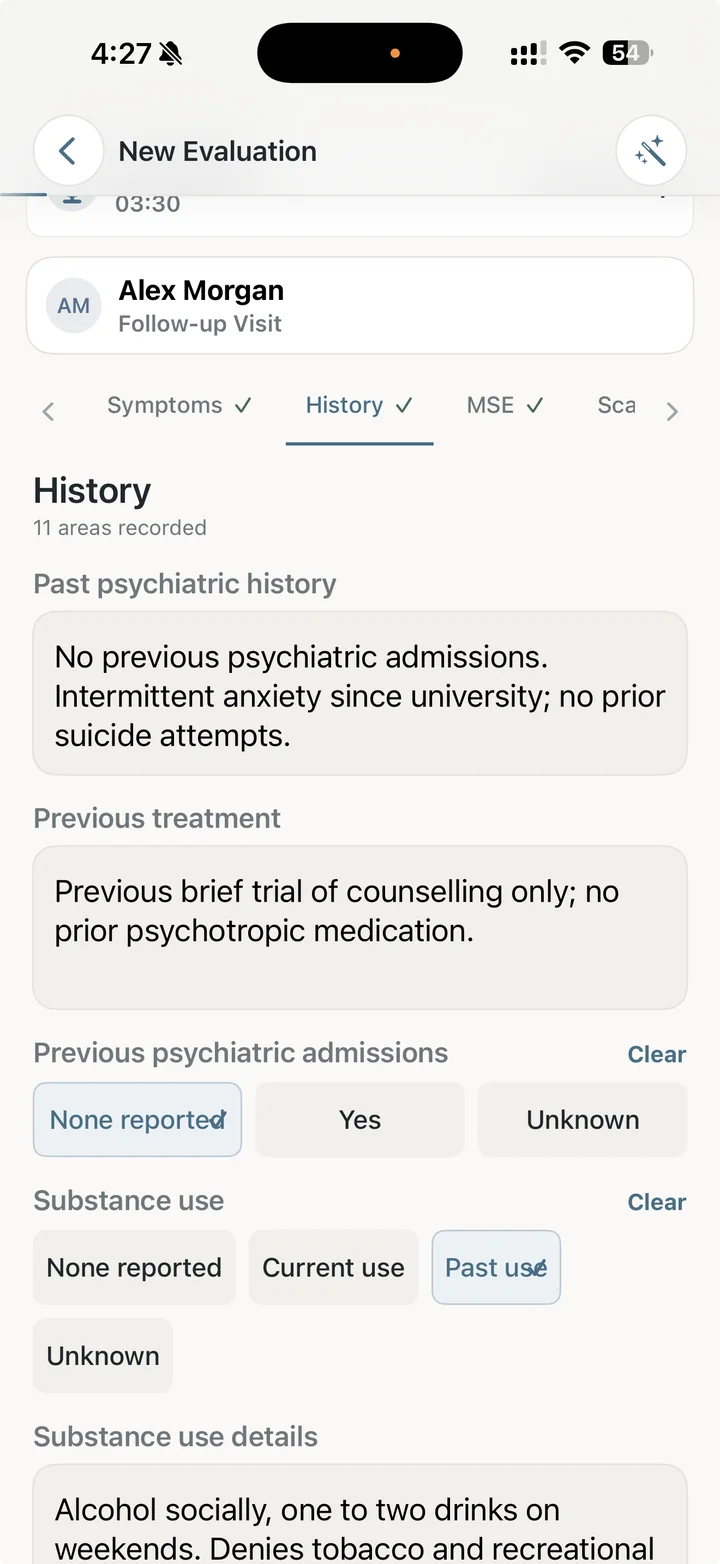
Here it stays in separate fields for past psychiatric history, previous treatment, admissions, substance use, family history, medical background, psychosocial history and trauma, so you can find the one thing you are looking for six months from now. Current medication, adherence, response and side effects sit in the same evaluation.

  • Past psychiatric history and previous treatment
  • Admissions, substance use and family psychiatric history
  • Medical, psychosocial and trauma history
  • Current medication, adherence, response and side effects
The History section of a Dr. Notes psychiatric note, with separate fields for past psychiatric history, previous treatment, admissions, substance use and family psychiatric history.

05 MSE

Complete the Mental Status Examination as you go

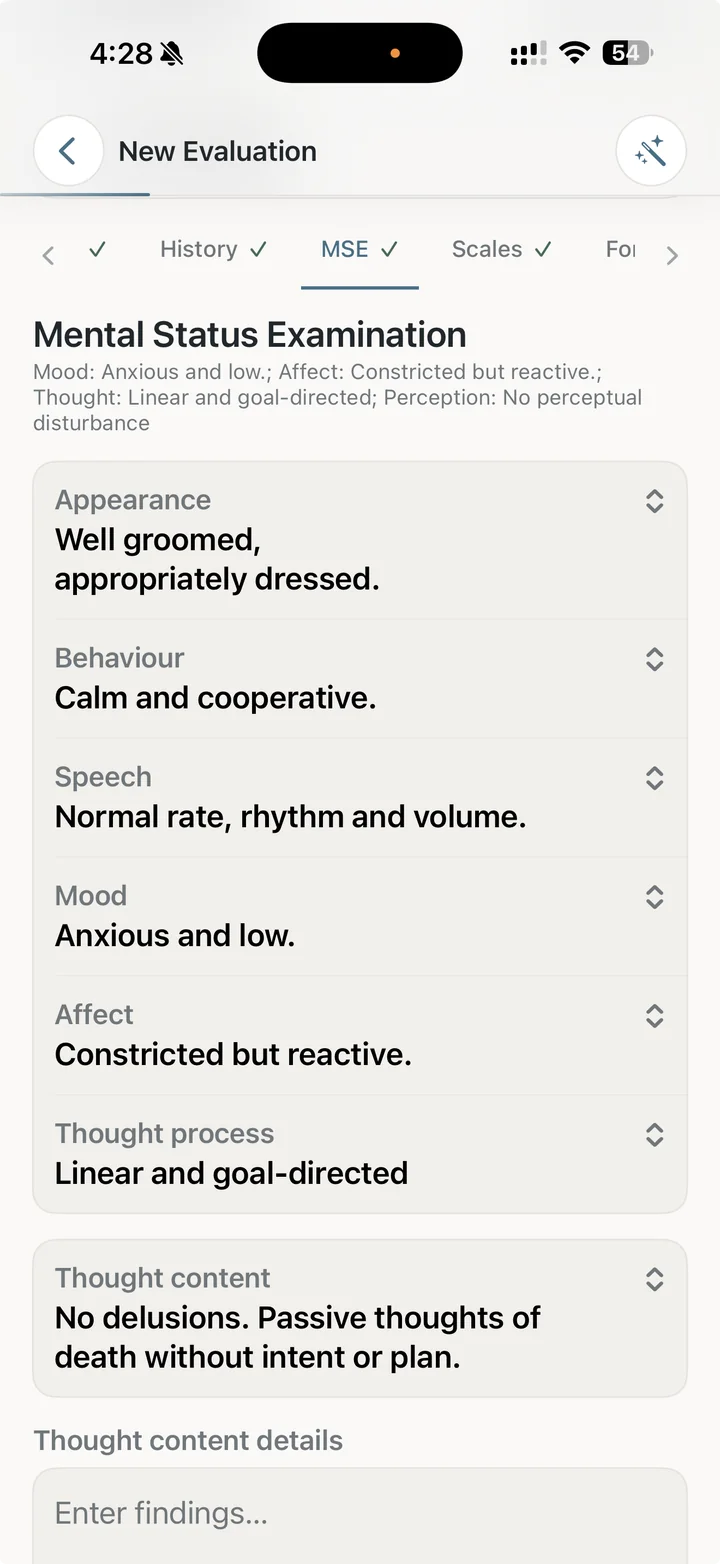
The MSE runs in the order you would examine anyway, so you can fill it in while you are still in the room instead of reconstructing it afterwards.

Appearance, behaviour, speech, mood, affect, thought process, thought content, perception, orientation, insight and judgment are all covered, with eye contact, psychomotor activity, cognition and impulse control there when the case calls for them.

  • Consistent MSE structure from visit to visit
  • Common findings can be selected quickly
  • Custom findings can still be entered
  • Additional observations remain available as free text
The Mental Status Examination section of a Dr. Notes psychiatric note listing appearance, behaviour, speech, mood, affect, thought process, thought content, perception, orientation and insight.

06 Scales

Complete assessments without leaving the evaluation

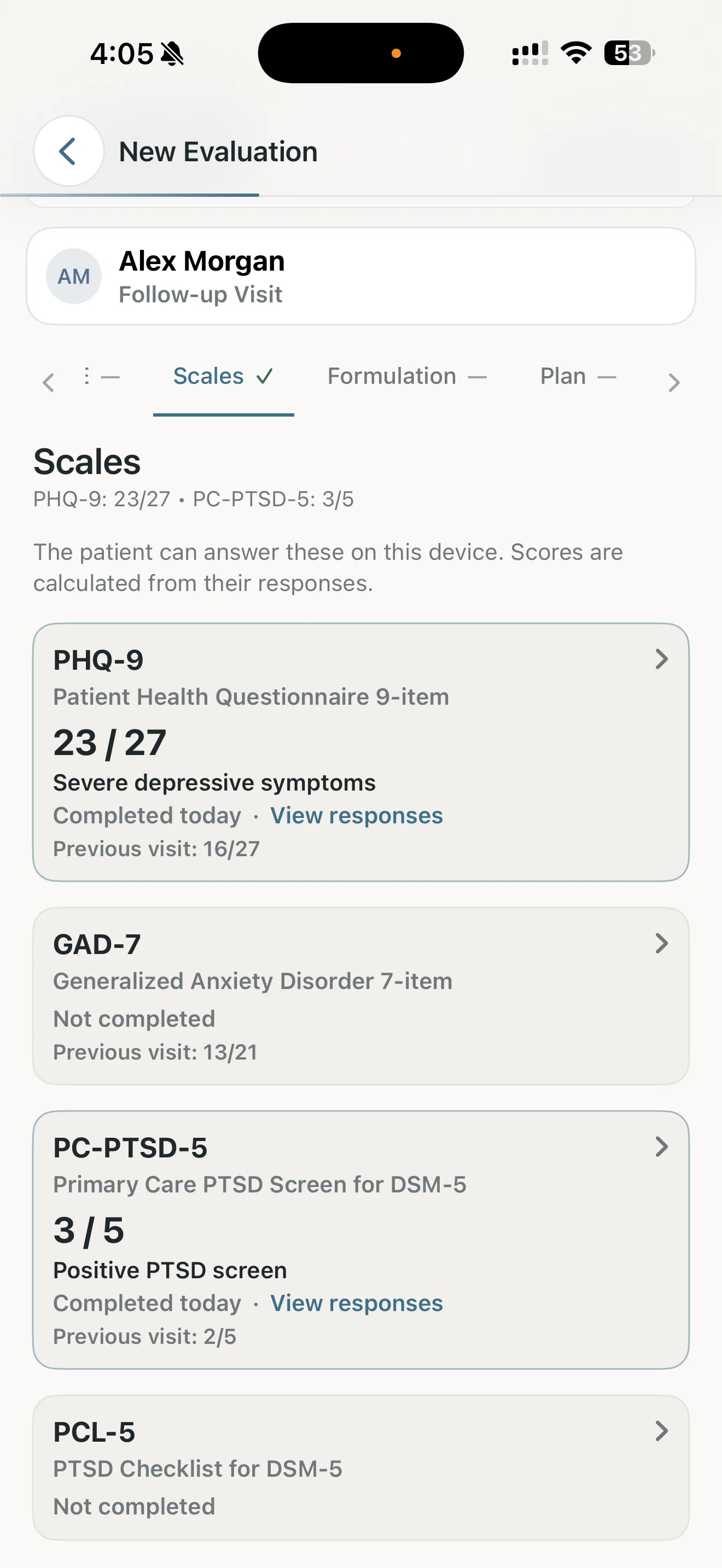
PHQ-9, GAD-7 and PC-PTSD-5 live inside the evaluation, so there is no paper form and nothing to transcribe afterwards.

Hand the phone over and let the patient answer. The score is calculated for you, and the individual answers are kept with the visit, not just the total.

  • PHQ-9 16 / 27
  • GAD-7 13 / 21
  • PC-PTSD-5 5 / 5
  • Responses are scored automatically
  • Individual answers are retained with the evaluation
  • Previous results remain available in the patient’s assessment history
  • Repeated assessments can be compared across visits
The Scales section of a Dr. Notes psychiatric note showing PHQ-9 scored 16 out of 27, GAD-7 scored 13 out of 21 and PC-PTSD-5 scored 5 out of 5, each with a link to view the patient’s responses.

07 Formulation

Add the clinician’s interpretation

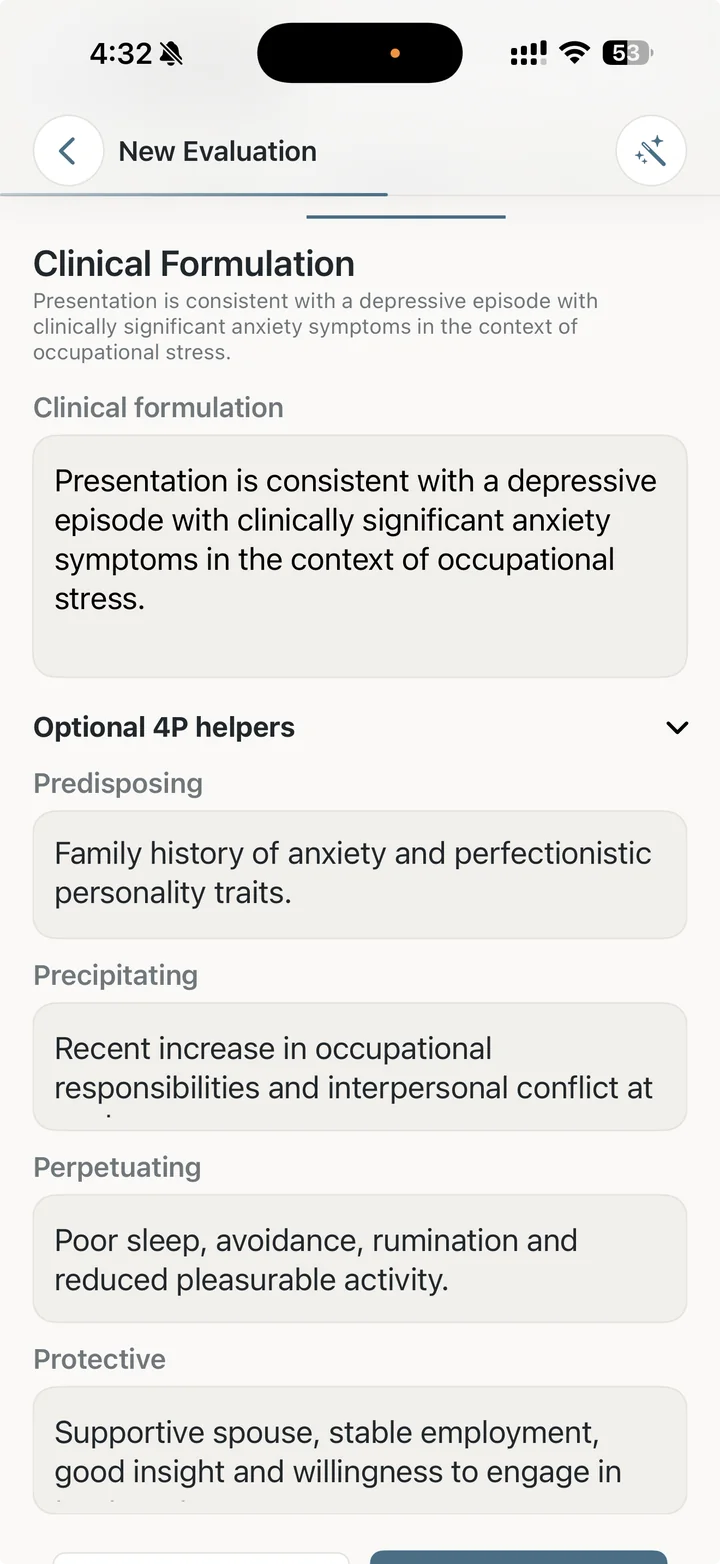
With the history, symptoms, risk, mental state and scales all recorded, this is where you say what you think is going on.

It is deliberately a blank narrative section. Dr. Notes does not diagnose, and it will not generate a formulation from the patient’s answers. That judgement stays yours.

  • Clinical formulation
  • Predisposing factors
  • Precipitating factors
  • Perpetuating factors
  • Protective factors
A Dr. Notes psychiatric evaluation showing the recorded mental status examination and completed scales that the clinical formulation is written from.

08 Plan

Finish the visit with the next steps clearly recorded

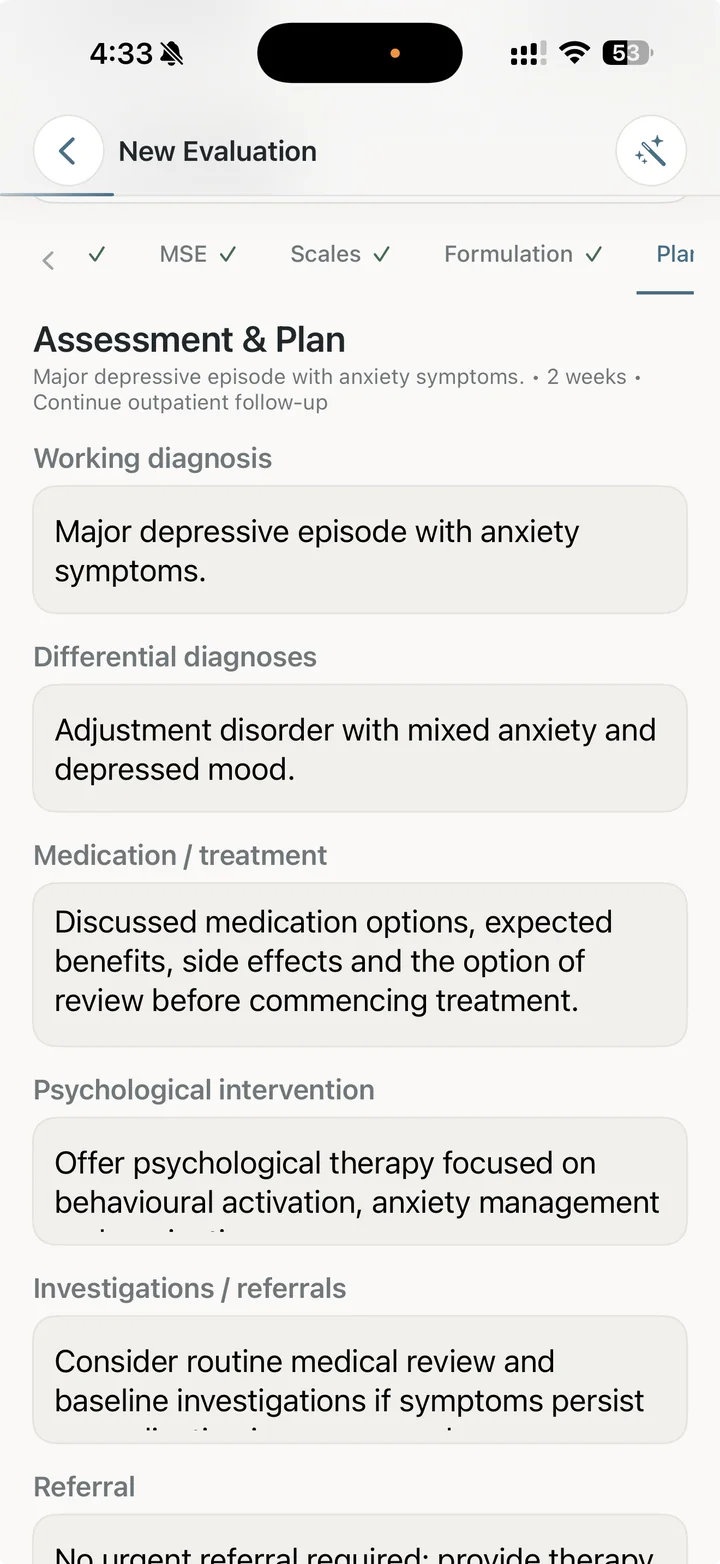
Close the visit with the working diagnosis, your differentials and what happens next.

Medication changes, psychological treatment, investigations, referrals, psychoeducation, the safety plan, follow-up interval and disposition all sit together, so whoever opens this next is not hunting through the note for them.

  • Working diagnosis and differential diagnoses
  • Medication and psychological treatment
  • Investigations and referrals
  • Psychoeducation and safety plan
  • Follow-up interval and disposition
The Assessment and Plan section of a Dr. Notes psychiatric note, with a working diagnosis of major depressive disorder, a differential of generalised anxiety disorder, and the medication and treatment plan.

09 Final Evaluation

Review everything before saving

Before you save, the whole evaluation comes back as one structured read-through.

See something you want to change? Edit takes you straight to that section, and you come back to the same place. Once it is saved it keeps this shape in the patient’s record, still readable months later instead of one long block of text.

  • Safety & Risk
  • Symptoms
  • Mental Status Examination
  • Scales
  • Relevant History
  • Medication & Treatment
  • Formulation
  • Plan & Follow-up
The final evaluation view in Dr. Notes, showing the patient’s PHQ-9, GAD-7 and PC-PTSD-5 scores, a clinician-assessed risk of moderate, and the safety and risk summary with an Edit action.

10 Recording

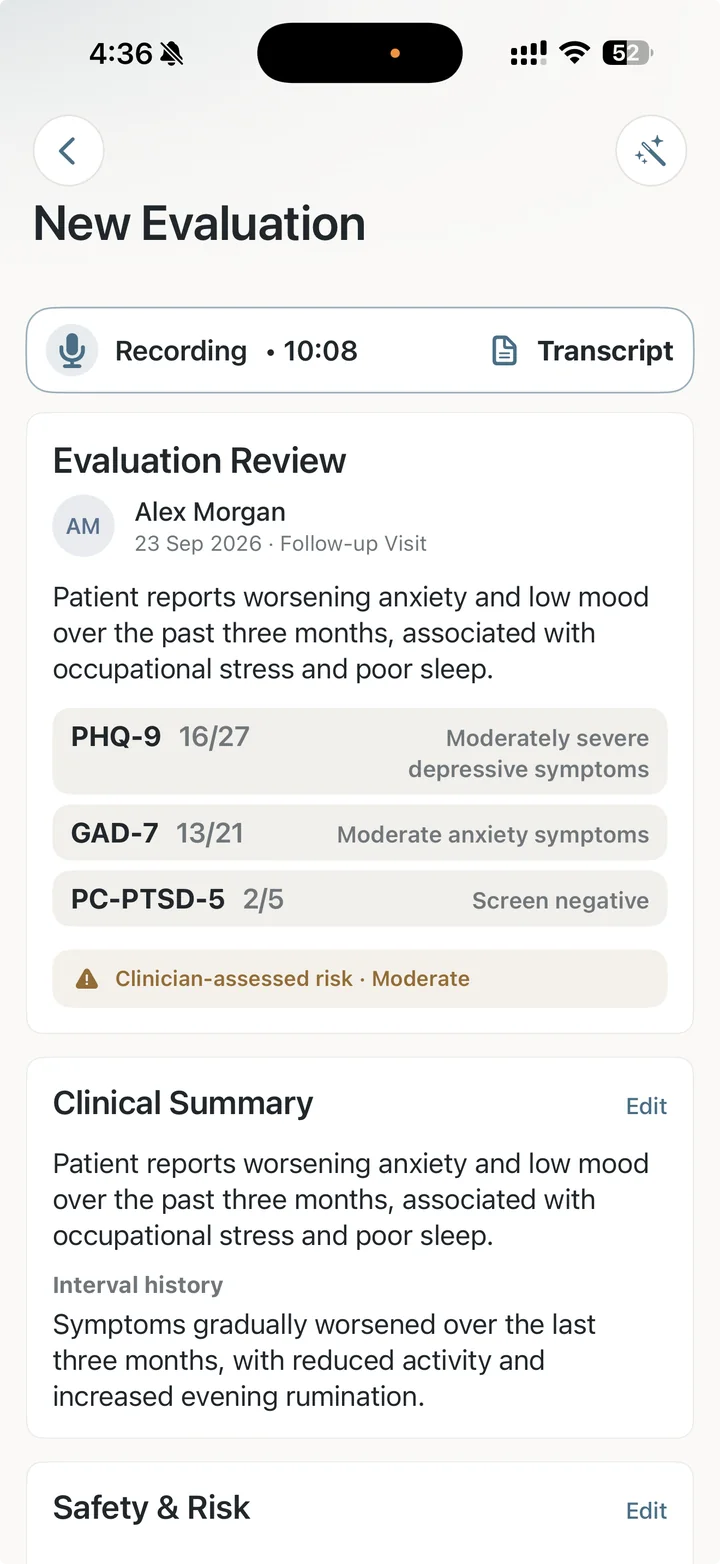
Document during the consultation, or review it afterwards

Some clinicians document as they go. Others would rather stay with the patient and write it up afterwards.

You can complete the evaluation while the consultation records, or record first and come back later with the audio playing, so you can pause, rewind and finish the sections you left. The recording and transcript stay attached to that same visit.

A Dr. Notes psychiatric visit with an active recording showing elapsed time and a Transcript button above the final evaluation summary.
A Dr. Notes psychiatric note showing a “Since previous visit” card with PHQ-9 moving from 17/27 to 16/27, above the patient’s recorded mood, sleep, appetite, energy, concentration and function. The Safety section of a Dr. Notes psychiatric note, with a Previous Visit button, overall clinician-assessed risk set to Moderate, suicidal thoughts recorded as passive, and the ideation detail questions open below. The Symptoms section of a Dr. Notes psychiatric note showing mood, sleep, appetite, energy, concentration and function, with areas to explore such as depression, anxiety, psychosis and sleep selected. The History section of a Dr. Notes psychiatric note, with separate fields for past psychiatric history, previous treatment, admissions, substance use and family psychiatric history. The Mental Status Examination section of a Dr. Notes psychiatric note listing appearance, behaviour, speech, mood, affect, thought process, thought content, perception, orientation and insight. The Scales section of a Dr. Notes psychiatric note showing PHQ-9 scored 16 out of 27, GAD-7 scored 13 out of 21 and PC-PTSD-5 scored 5 out of 5, each with a link to view the patient’s responses. A Dr. Notes psychiatric evaluation showing the recorded mental status examination and completed scales that the clinical formulation is written from. The Assessment and Plan section of a Dr. Notes psychiatric note, with a working diagnosis of major depressive disorder, a differential of generalised anxiety disorder, and the medication and treatment plan. The final evaluation view in Dr. Notes, showing the patient’s PHQ-9, GAD-7 and PC-PTSD-5 scores, a clinician-assessed risk of moderate, and the safety and risk summary with an Edit action. A Dr. Notes psychiatric visit with an active recording showing elapsed time and a Transcript button above the final evaluation summary.

Previous Visit

1 / 10

See what changed. Assess what matters. Leave with a structured psychiatric note.

Dr. Notes is available on both App Store and Google Play.