
When Small Changes Tell a Bigger Story
Progress in mental healthcare does not always arrive as one dramatic breakthrough.
Sometimes, it begins quietly. A patient sleeps through the night, gets out of bed with a little more energy, returns to work or reconnects with someone they care about.
These changes may appear small, but for someone who has been struggling, they can mean everything.
During a follow-up visit, a patient may simply say, “I think I’m feeling a little better.” Those words bring hope, but they also raise important clinical questions. Which symptoms have improved? What challenges remain? Is daily life becoming easier? And is the treatment making a meaningful difference?
This is where the PHQ-9 and GAD-7 can help.
When used alongside careful listening and clinical assessment, these tools give psychiatrists a structured way to measure symptoms of depression and anxiety. A single score provides a snapshot of one moment. Scores recorded across several visits begin to show a pattern of change.
In this guide, we follow Alex Morgan, a fictional 34-year-old outpatient, through three visits. Alex’s PHQ-9 score decreases from 16 to 7, while the GAD-7 score decreases from 13 to 5.
These numbers suggest improvement, but they do not tell the complete story. Their real meaning becomes clearer when they are considered alongside Alex’s sleep, work, relationships, daily functioning, safety and personal experience.
Dr. Notes for Psychiatrists helps bring this information together by connecting clinical scale results with the patient’s psych evaluation, Mental Status Examination, safety assessment and follow-up plan.
The PHQ-9 and GAD-7 support clinical assessment; they do not diagnose patients or replace professional judgement. Their value lies in helping psychiatrists recognise change more clearly while keeping the patient’s voice and experience at the centre of care.
Let’s follow Alex’s journey and see how changes across multiple visits can create a clearer, more connected and more hopeful picture of progress.
What Is the PHQ-9?
PHQ-9 stands for Patient Health Questionnaire-9. It is a nine-item self-report scale used to screen for and measure the severity of depressive symptoms.
Each question asks how often a symptom has affected the patient during the previous two weeks. The response options are:
| Response | Score |
|---|---|
| Not at all | 0 |
| Several days | 1 |
| More than half the days | 2 |
| Nearly every day | 3 |
The nine responses are added together, producing a total score from 0 to 27.
The original validation study found that increasing PHQ-9 scores were associated with greater symptom severity and reduced functioning. A score of 10 or more had 88% sensitivity and 88% specificity for major depression in the study population. However, the result remains a screening and severity measure—not a diagnosis by itself.[1]
PHQ-9 Score Interpretation
| Total Score | Common Severity Description |
|---|---|
| 0–4 | Minimal symptoms |
| 5–9 | Mild symptoms |
| 10–14 | Moderate symptoms |
| 15–19 | Moderately severe symptoms |
| 20–27 | Severe symptoms |
These categories provide a shared language for describing symptom burden. They do not automatically decide the diagnosis, medication, therapy or level of care.
Two patients with the same total score may need very different clinical responses. One may be functioning reasonably well despite distress. Another may be unable to work, sleep or care for themselves. The psychiatrist must understand what sits behind the number.
What Is the GAD-7?
GAD-7 stands for Generalized Anxiety Disorder-7. It is a seven-item self-report scale used to screen for and measure anxiety symptoms.
Like the PHQ-9, it asks the patient to consider the previous two weeks. Each item is scored from 0 to 3, giving a total score from 0 to 21.
The original validation study found that the GAD-7 had good reliability and validity. Higher scores were associated with greater functional impairment. The study identified a useful screening cut-off with 89% sensitivity and 82% specificity in its population.[2]
GAD-7 Score Interpretation
| Total Score | Common Severity Description |
|---|---|
| 0–4 | Minimal symptoms |
| 5–9 | Mild symptoms |
| 10–14 | Moderate symptoms |
| 15–21 | Severe symptoms |
Again, the category is a starting point for discussion. Anxiety symptoms can arise in several psychiatric and medical conditions. Context, duration, impairment, differential diagnosis and comorbidity still need clinical assessment.
The First Visit: Establishing Alex’s Baseline
Alex arrives for an initial consultation after several difficult weeks. They describe low mood, poor sleep, reduced appetite and a growing sense that everyday tasks require too much effort. They also report constant worry about work, finances and disappointing their family.
During the consultation, the psychiatrist completes a full assessment. The PHQ-9 and GAD-7 are used as part of that assessment—not as a replacement for it.
Alex’s baseline scores are:
| Scale | Baseline Score | Common Severity Range |
|---|---|---|
| PHQ-9 | 16 | Moderately severe depressive symptoms |
| GAD-7 | 13 | Moderate anxiety symptoms |
The numbers are useful, but the psychiatrist does not stop there.
They ask:
- Which symptoms are causing the most difficulty?
- How have sleep, appetite, concentration and energy changed?
- Is Alex able to work and manage responsibilities?
- Are there recent stressors or losses?
- Are substances, medications or medical conditions contributing?
- Is there a history of mania, hypomania, psychosis or trauma?
- Are there thoughts of death, self-harm or suicide?
- What support and protective factors are present?
The psychiatrist records the scores together with Alex’s answers, observed mental state, risk findings, formulation and initial plan.
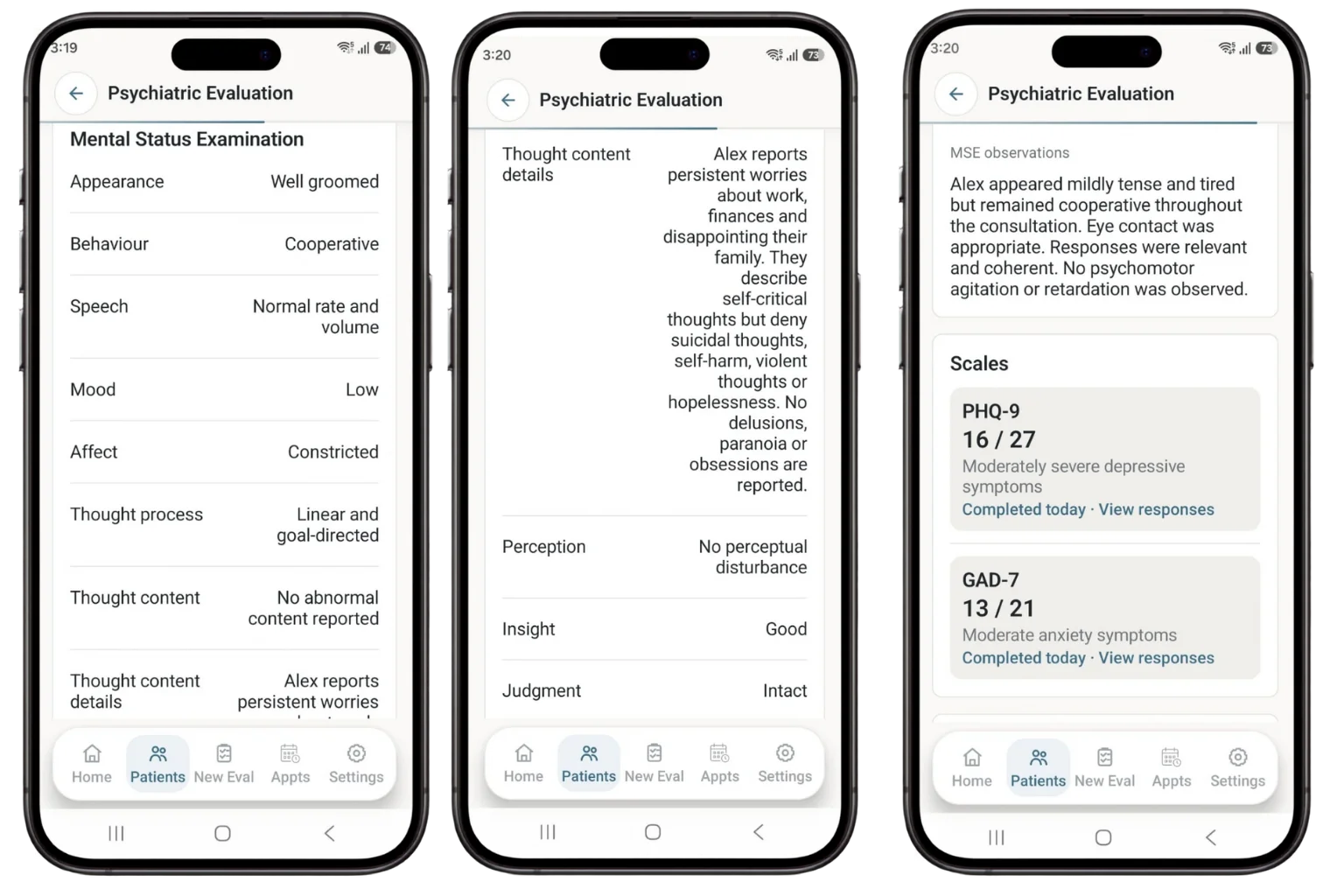
This becomes the baseline. Future scores will be compared with it.
Baseline Documentation
PHQ-9 score: 16, within the moderately severe symptom range. GAD-7 score: 13, within the moderate symptom range. Alex reports that low mood, sleep disturbance, fatigue, excessive worry and reduced concentration are affecting work and daily routines. Scale results were reviewed alongside the clinical interview, Mental Status Examination and safety assessment. The scores support symptom monitoring but do not independently establish the diagnosis.
The Safety Question That Must Not Be Lost in the Total
PHQ-9 item 9 asks about thoughts of being better off dead or of self-harm. A positive response should never be treated as “just one point” inside the total.
The University of Washington AIMS Center advises that clinics should have a clear protocol for responding when a patient screens positive on this item. Further information should be gathered and the level of risk assessed.[3]
The psychiatrist should ask direct, clinically appropriate questions about matters such as:
- The nature and frequency of the thoughts
- Whether there is intent
- Whether a plan has been considered
- Access to possible means
- Previous attempts or self-harm
- Current agitation, intoxication, psychosis or hopelessness
- Reasons for living and other protective factors
- Available family, social and professional support
- The need for a safety plan, urgent review or emergency intervention
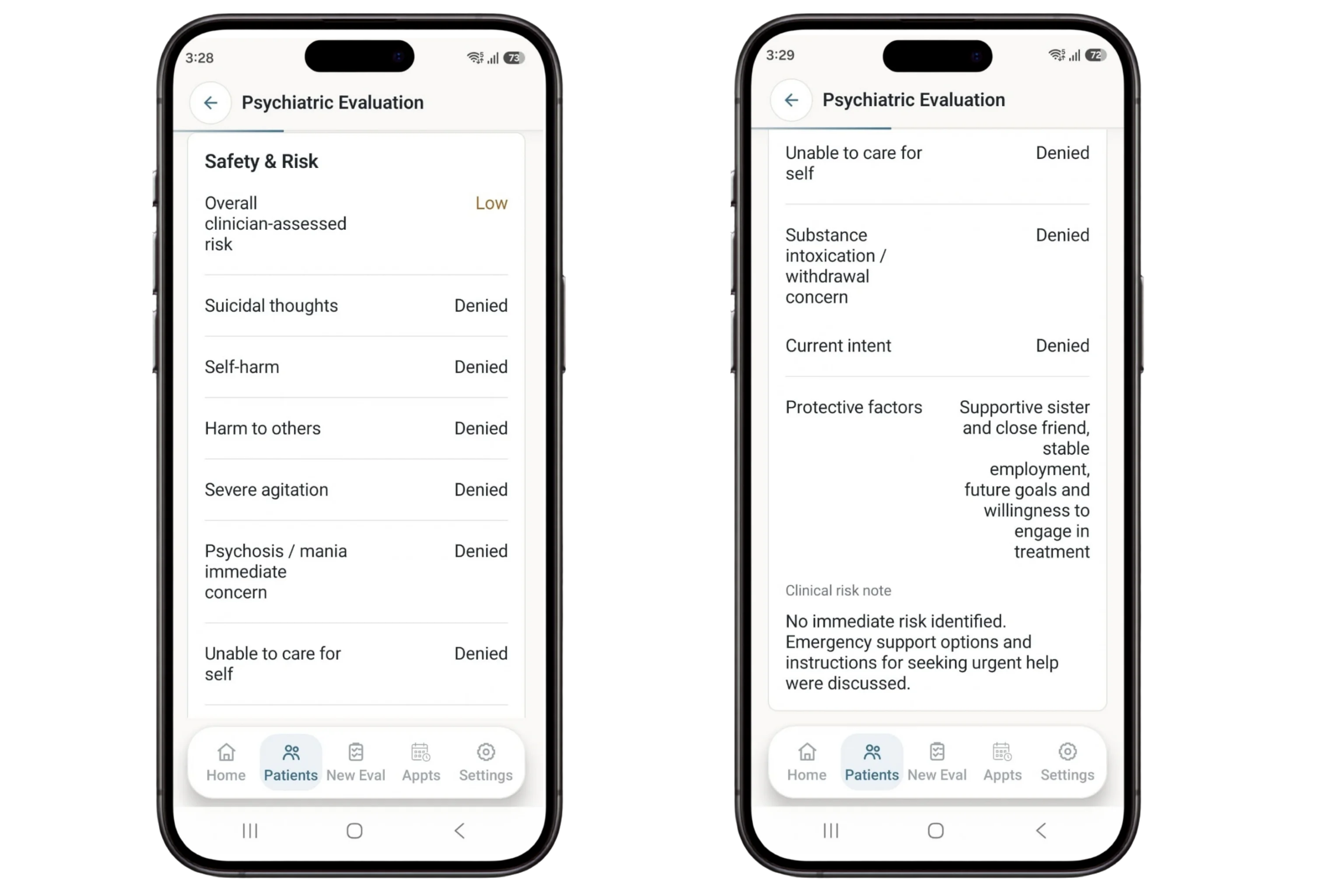
A low PHQ-9 total does not cancel a concerning response to item 9. Equally, item 9 alone is not a complete suicide-risk assessment.
In Alex’s example, suicidal thoughts are recorded as denied at the initial visit and both follow-ups, with the overall risk documented as low. Even so, safety is reviewed and documented separately at every visit rather than being assumed from the total scale score.
The First Follow-Up: Looking Beyond “I’m a Little Better”
Four weeks later, Alex returns.
“I’m still having difficult days,” they say, “but I’m getting out of bed earlier, and I’ve started going to work regularly again.”
The psychiatrist repeats the same scales.
| Scale | Baseline | First Follow-Up | Change |
|---|---|---|---|
| PHQ-9 | 16 | 12 | −4 |
| GAD-7 | 13 | 8 | −5 |
The saved evaluation may also contain other clinically relevant screens. In Alex’s record, a PC-PTSD-5 result is shown for additional context, while the longitudinal comparison in this article remains focused on the PHQ-9 and GAD-7.
At first glance, both scores have fallen. But good follow-up care requires more than writing “improved.”
The psychiatrist examines what changed:
- Anxiety has moved from the moderate to the mild range.
- Depressive symptoms remain in the moderate range.
- Sleep and work attendance have improved.
- Fatigue and self-critical thoughts remain prominent.
- The patient reports following the agreed treatment plan.
- No new adverse effects or immediate safety concerns are identified.
The psychiatrist also checks whether external factors may have influenced the scores. Was the week unusually calm? Did a major stressor resolve? Was the form completed carefully and privately? Has the patient’s understanding of the questions changed?
The score trend supports Alex’s report of improvement, but it also shows that clinically important symptoms remain.
Follow-Up Documentation
Compared with baseline, PHQ-9 decreased from 16 to 12 and GAD-7 decreased from 13 to 8. Alex reports improved sleep, work attendance and control of worry. Low energy and negative self-appraisal remain troublesome. Overall presentation suggests partial symptomatic and functional improvement. Current findings, tolerability, adherence, safety and patient preference were reviewed before continuing the care plan.
The Second Follow-Up: When the Trend Becomes Clearer
At the next visit, Alex appears more engaged. They describe reconnecting with friends, completing work on time and returning to evening walks.
The scores are repeated:
| Scale | Baseline | First Follow-Up | Second Follow-Up |
|---|---|---|---|
| PHQ-9 | 16 | 12 | 7 |
| GAD-7 | 13 | 8 | 5 |

The longitudinal pattern now shows:
- PHQ-9 has fallen by nine points from baseline.
- GAD-7 has fallen by eight points from baseline.
- Depression and anxiety scores are now within the mild symptom ranges.
- The numerical improvement is supported by better sleep, work performance, social activity and observed engagement.
Research on the PHQ-9 has estimated that an individual change of approximately five points may represent a clinically important difference, although the meaning of change must still be judged in context.[4]
The psychiatrist does not assume that a lower score means the work is finished. They review residual symptoms, relapse risks, treatment adherence, the patient’s goals and the follow-up plan.
Why Tracking Is More Useful Than a Single Score
A score taken once provides a snapshot. Repeated scores can create a timeline.
That timeline may help a psychiatrist recognise several patterns.
1. Steady Improvement
Scores fall across visits, and the patient also reports meaningful functional recovery. This supports the conclusion that the overall clinical picture is improving.
2. Little or No Change
Scores remain similar despite treatment. This may prompt a review of diagnosis, adherence, dose, tolerability, psychosocial stressors, substance use, physical health, access to therapy or other barriers.
3. Worsening Symptoms
Scores rise, functioning declines or risk concerns emerge. The patient may need an earlier review, a revised formulation or a different level of support.
4. Scores Improve, but the Patient Does Not Feel Better
The total may fall while the patient continues to struggle with one severe symptom, an unresolved stressor or poor functioning. The item-level responses and clinical interview matter.
5. The Patient Feels Better, but the Score Barely Changes
Improvement may appear first in areas not fully captured by the scale, such as hope, relationships, coping, motivation or confidence. Alternatively, residual symptoms may still need attention.
In each situation, the score should open a conversation rather than end one.
A Practical Follow-Up Workflow
Step 1: Use a Clear Baseline
Record the date, scale version, total score, item responses when relevant, functional impact and the clinical context.
Step 2: Repeat the Same Measure Consistently
Using the same scale makes comparison easier. The timing should suit the clinical purpose and care plan rather than becoming an automatic routine without meaning.
Step 3: Compare Both Totals and Individual Symptoms
A total score may improve while sleep, concentration or suicidal thinking worsens. Review important individual items, not only the final number.
Step 4: Ask What Changed in Daily Life
Explore work, study, relationships, self-care, sleep, appetite, social activity and the patient’s own goals.
Step 5: Check Treatment and Context
Record adherence, response, adverse effects, therapy attendance, recent stressors, substance use and relevant medical changes.
Step 6: Document Safety Separately
Do not bury risk findings inside the scale score. Record the direct assessment, protective factors, safety plan and follow-up arrangements as appropriate.
Step 7: Write the Clinical Interpretation
Avoid documenting only “PHQ-9 = 12.” Explain what the change means when considered with the interview and examination.
Step 8: Connect the Result With the Plan
The note should show how the psychiatrist used the information. The clinical decision might be to continue, adjust, investigate, refer, monitor more closely or arrange an earlier review, depending on the full assessment.
Common Documentation Mistakes
Recording Only the Total
The number alone does not explain the symptoms, functional impact or clinical reasoning.
Treating the Category as a Diagnosis
“Moderate score” does not automatically mean a specific disorder is present. Diagnosis requires clinical assessment and differential consideration.
Ignoring Item-Level Risk
A concerning response to PHQ-9 item 9 requires direct follow-up even when the total score is low.
Comparing Scores Collected Under Very Different Conditions
Language, assistance, setting, timing and the patient’s understanding can affect responses. Document relevant differences.
Assuming Every Numerical Change Is Clinically Meaningful
Small movements can reflect normal variation. Interpret the size and direction of change alongside functioning and the patient’s experience.
Forgetting to Document What Happened Next
The note should connect the findings to the assessment and plan.
How Dr. Notes for Psychiatrists Can Help
Dr. Notes for Psychiatrists is designed to support structured clinical documentation across visits.
Within the app, psychiatrists can record clinical-scale results and connect them with other parts of the patient’s psych evaluation, including:
- Presenting symptoms
- Safety and risk findings
- Psychiatric and medical history
- Mental Status Examination
- Clinical formulation
- Assessment and treatment plan
- Follow-up arrangements
Keeping current and previous information organised can make it easier to understand how the patient has changed since the last consultation. Instead of viewing a PHQ-9 or GAD-7 score in isolation, the psychiatrist can consider it alongside the wider clinical record.
Dr. Notes works offline, and patient information is stored on the doctor’s device. The doctor remains responsible for protecting the device, controlling access, managing exports and backups and following applicable privacy and record-keeping requirements.
The app supports documentation. It does not independently interpret risk, diagnose patients, recommend treatment or replace professional clinical judgement.
Follow-Up Documentation Checklist
Before completing the note, check that it includes:
- Date and reason for assessment
- PHQ-9 total and relevant item responses
- GAD-7 total and relevant item responses
- Previous scores and dates
- Direction and size of score change
- Symptoms that improved, persisted or worsened
- Functional change
- Treatment adherence and adverse effects
- Relevant psychosocial or medical changes
- Direct safety assessment when indicated
- Clinical interpretation
- Agreed plan and follow-up interval
Conclusion
Alex’s first scores showed significant depressive and anxiety symptoms. The later scores did something more valuable: they showed the direction of change.
But the numbers became meaningful only when the psychiatrist connected them with Alex’s sleep, work, relationships, safety, functioning and personal experience.
That is the central value of measurement-based follow-up:
A score shows where the patient is today. A carefully documented series of scores helps show where they are going.
PHQ-9 and GAD-7 can make progress easier to see, but they remain only part of the clinical picture. The patient’s story, the psychiatrist’s assessment and shared decisions about care must remain at the centre.
Learn more about Dr. Notes for Psychiatrists: Dr. Notes for Psychiatrists
Download on the App Store or Google Play .
References
- Kroenke K, Spitzer RL, Williams JBW. The PHQ-9: Validity of a Brief Depression Severity Measure. Journal of General Internal Medicine. 2001;16(9):606–613. PubMed
- Spitzer RL, Kroenke K, Williams JBW, Löwe B. A Brief Measure for Assessing Generalized Anxiety Disorder: The GAD-7. Archives of Internal Medicine. 2006;166(10):1092–1097. PubMed
- University of Washington AIMS Center. PHQ-9 Depression Scale Questionnaire and Suicide Prevention Protocol Resources. AIMS Center
- Löwe B, Unützer J, Callahan CM, Perkins AJ, Kroenke K. Monitoring Depression Treatment Outcomes With the Patient Health Questionnaire-9. Medical Care. 2004;42(12):1194–1201. PubMed
Comments
Have a question, or a way you handle this in your own practice? Share it below.