
Six weeks after his previous consultation, Joel Jackson returns for a psychiatric follow-up. He is still experiencing anxiety, disturbed sleep, reduced appetite and low energy. Relationship difficulties continue to affect him, and his history includes earlier trauma. Although Joel has been prescribed medication, his adherence has been partial, and he reports little improvement with his current treatment.
For Joel, these concerns are not separate entries in a clinical record. They are all part of one continuous experience.
For the psychiatric evaluator, however, Joel’s story contains many clinical details that must be carefully reviewed, understood and connected.
Before beginning the follow-up session, the evaluator needs to know:
- What concerns were identified during the previous consultation?
- What is Joel’s psychiatric and psychosocial history?
- Has he had any previous psychiatric admissions?
- What medication is he currently taking?
- Is he following the treatment as advised?
- Has he experienced any improvement or side effects?
- Were any safety concerns identified previously?
- What treatment and follow-up plan was created?
When this information is scattered across different notes, reviewing it can take valuable consultation time. Relying only on memory may also allow a small but clinically important detail to be overlooked.
The challenge becomes even greater once the consultation begins. The evaluator must remain present with Joel while assessing his current symptoms, daily functioning, treatment response, mental status and safety. At the same time, the clinician must connect today’s findings with what happened during the previous visit.
An Upcoming Dr. Notes Feature for Psychiatric Evaluators
We are developing an upcoming Dr. Notes feature specifically for psychiatric evaluators. The proposed Psychiatric Evaluator workflow is designed to bring patient history, current symptoms, safety findings, mental status observations, clinical scales, medication response and treatment planning into one structured process.
For follow-up consultations, the proposed workflow would allow the evaluator to review the patient’s existing history and previous plan before beginning the new session. The clinician could then focus on what has changed, what remains a concern and what needs to happen next.
This feature is still being developed. Through this blog, we would like to demonstrate the proposed workflow and invite psychiatrists and psychiatric evaluators to share their ideas, suggestions and professional feedback.
Let us follow Joel’s consultation step by step and explore how the proposed Dr. Notes Psychiatric Evaluator could support the follow-up workflow.
Challenges Psychiatric Evaluators Commonly Face
- Important information may be scattered across previous notes.
- Continuous typing can interrupt the natural flow of the clinical interview.
- Small but meaningful changes between visits may be difficult to recognise.
- Safety findings can become separated from the plan created in response.
- Unstructured documentation can make evaluations inconsistent and difficult to review.
The challenge is not a lack of clinical knowledge. It is organising and connecting many pieces of information while remaining present with the patient and producing a record that another clinician can understand later.
The Upcoming Dr. Notes Psychiatric Evaluator
The Dr. Notes Psychiatric Evaluator is being developed to support initial and follow-up psychiatric evaluations. The proposed workflow will bring history, symptoms, safety findings, mental status observations, clinical scales, medication response and treatment planning into one connected process.
For a follow-up consultation, the evaluator will be able to review Joel Jackson’s existing history, previous treatment, medication response, earlier clinical-scale results and previous plan before beginning the new session.
Important distinction: During an initial evaluation, the clinician builds the patient’s history for the first time. During a follow-up evaluation, the clinician begins by reviewing the history and previous plan already available in the record.
Dr. Notes is intended to support documentation and clinical review. It will not diagnose patients or replace professional clinical judgement.
Let us follow Joel Jackson’s consultation step by step and explore how this upcoming feature could support the psychiatric follow-up workflow.
Step 1: Review the Existing Record Before the Follow-Up Begins
When the visit is not the patient’s first session, the evaluator needs context before asking new questions. Repeating the entire history wastes consultation time, while starting without reviewing it can lead to missed changes or duplicated work.
The follow-up workflow would make Joel’s relevant psychiatric, treatment, admission, substance-use, medical, psychosocial and trauma history easier to review. The evaluator could also see his current medication, adherence, response, side effects and earlier plan before beginning the new session.
This gives the evaluator a practical starting point: what happened before, what was recommended and what needs to be reassessed today.
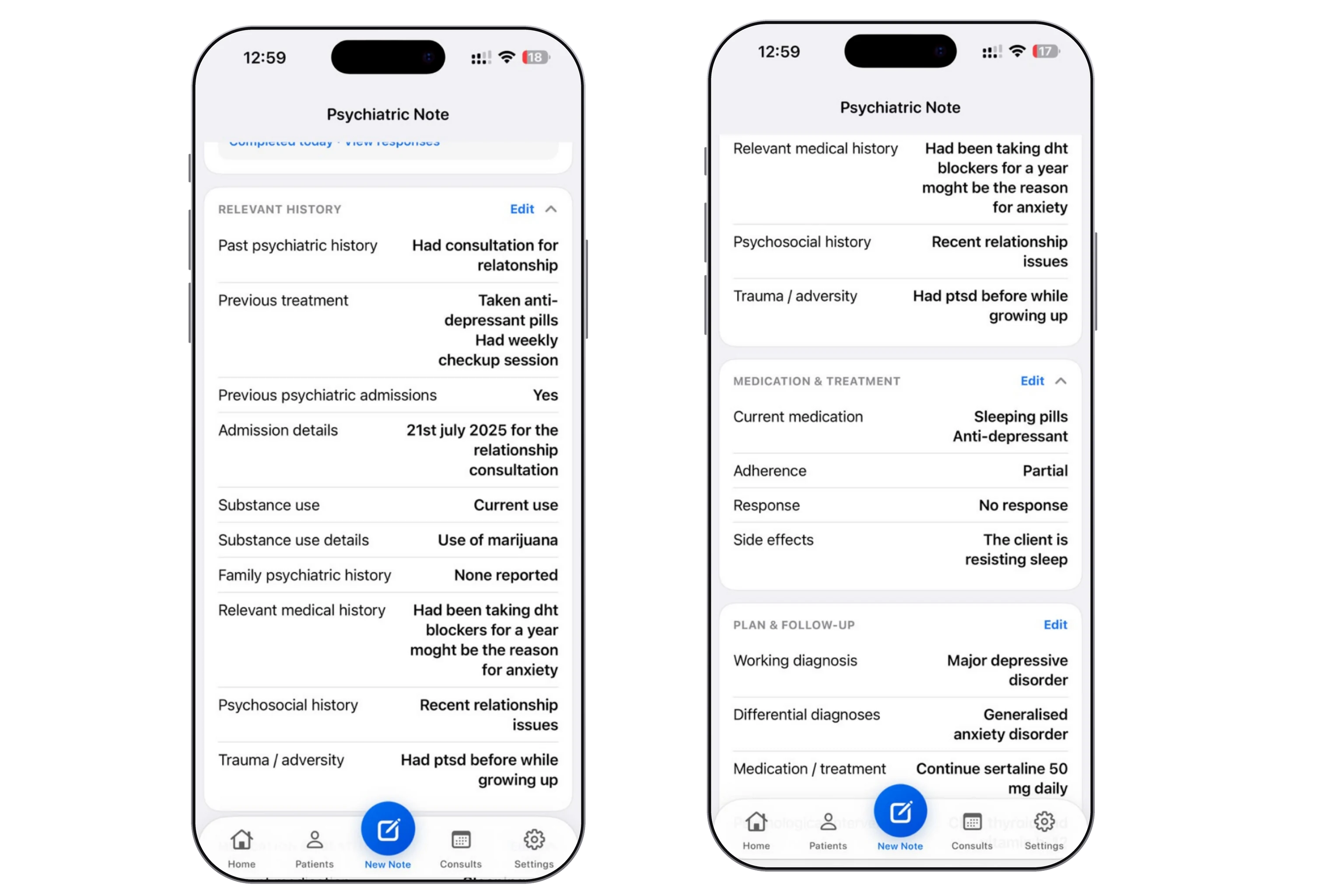
Relevant history from earlier care; Medication, response and previous plan
Step 2: Begin the New Consultation With Context
A follow-up consultation should build on previous care rather than restart the story from the beginning. The evaluator needs to identify what has changed since the last visit while remaining attentive to the patient.
Structured fields would allow the evaluator to confirm existing information and focus on changes in symptoms, risk, treatment response and functioning.
The earlier record remains available as context, while the new consultation adds the latest findings. This could help preserve continuity between visits and reduce repetitive questioning.
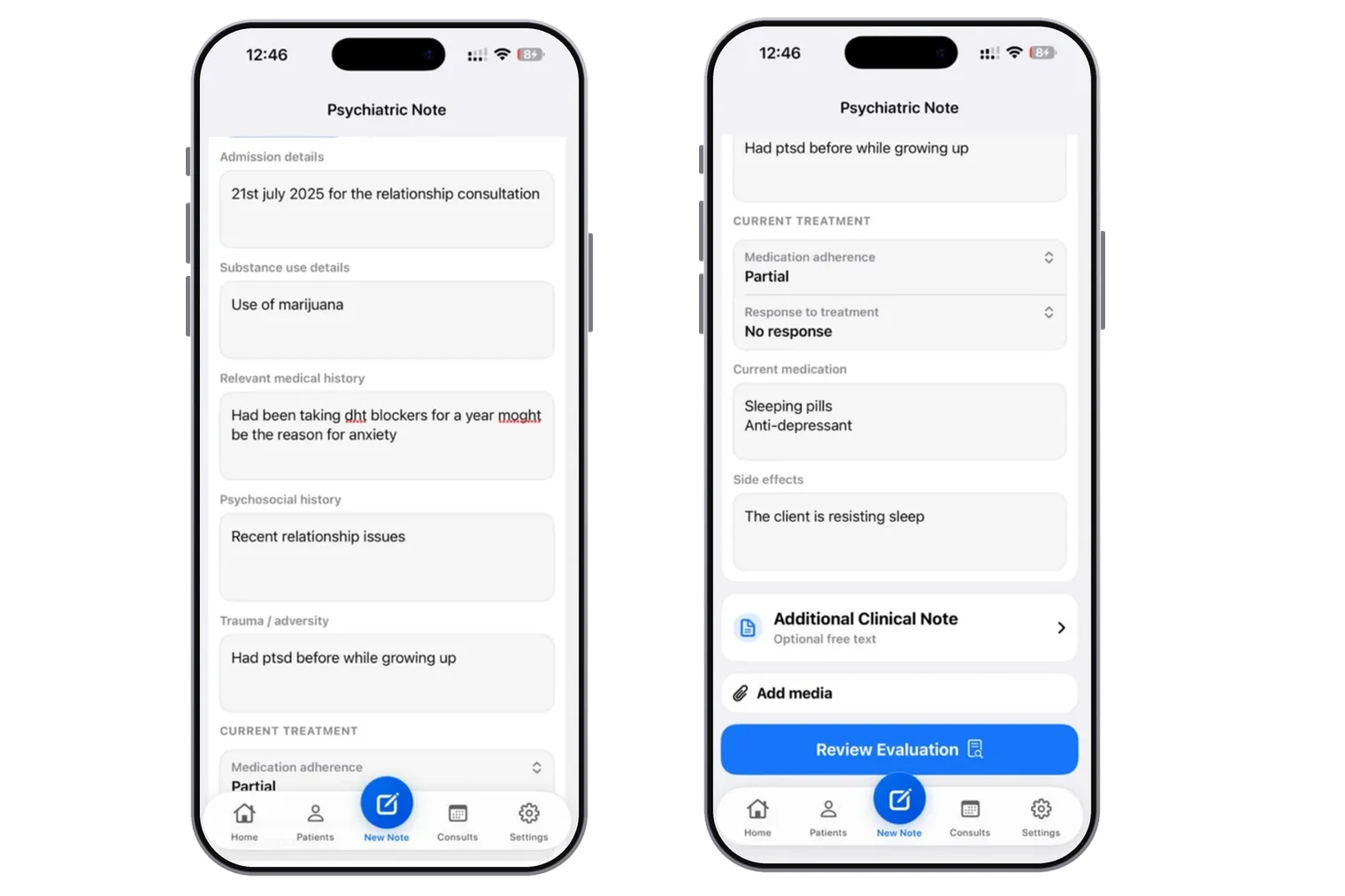
Detailed history available for confirmation; Current treatment reviewed before the session
Step 3: Record the Consultation and Keep the Transcript Available
Psychiatric interviews often contain clinically important details expressed gradually or indirectly. Typing continuously may reduce eye contact, interrupt rapport and divide the evaluator’s attention.
The feature is designed to allow the clinician to record the consultation—with appropriate consent—and keep a transcript available for review.
The transcript would serve as a reference for documentation. It would not replace the evaluator’s interpretation, verification or responsibility for the final clinical record.
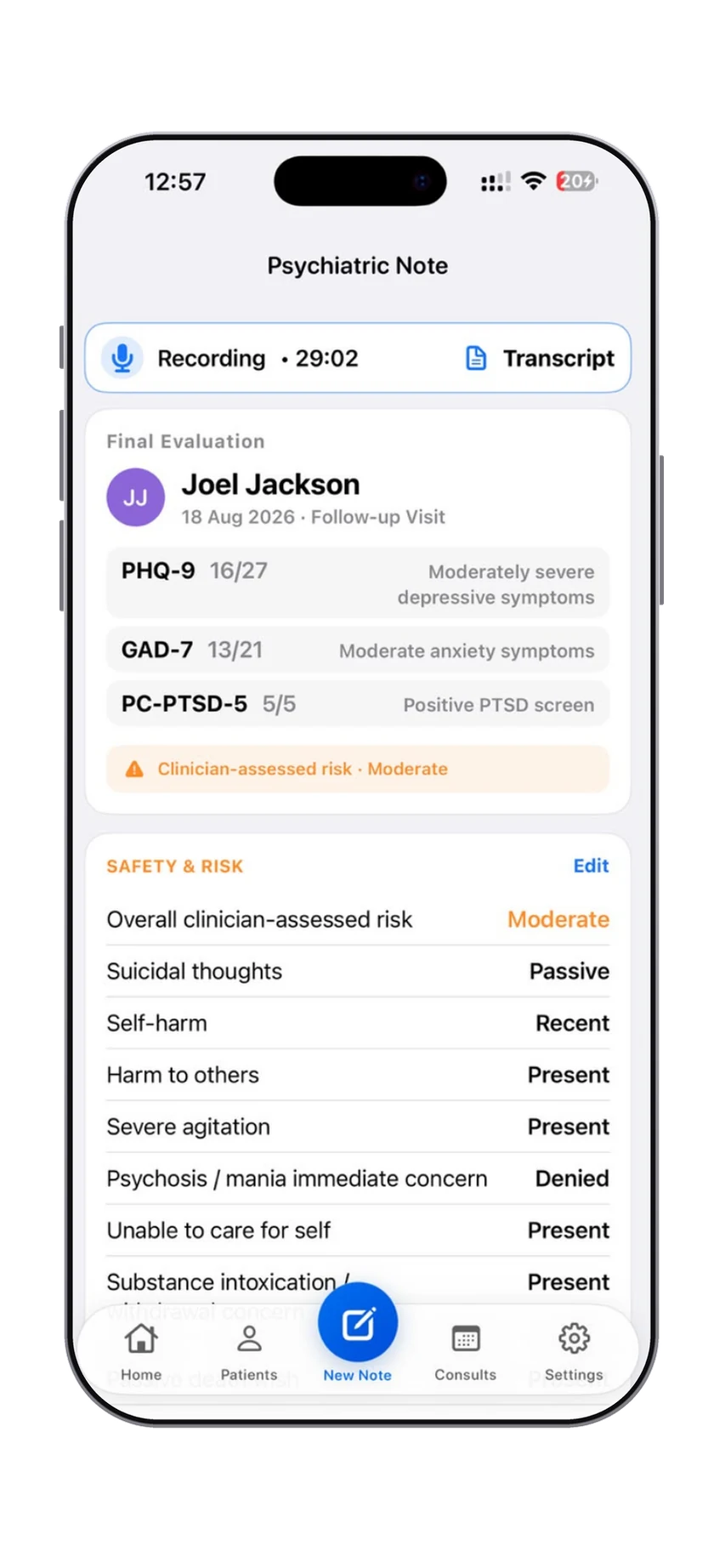
Recording status and transcript access
Step 4: Review the Evaluation Summary and Safety Findings
Safety information may be distributed throughout a long conversation. The evaluator must bring those details together and make a documented clinical judgement.
A proposed evaluation summary would bring Joel’s clinical-scale results and clinician-assessed risk into one view. A dedicated safety section would prompt the evaluator to review suicidal thoughts, self-harm, harm to others, severe agitation, psychosis or mania concerns, ability to care for self, substance-related concerns, intent, plan, access to means, previous attempts and protective factors.
The clinician would still determine the level of risk. The feature is intended to make the supporting information visible and easier to review.
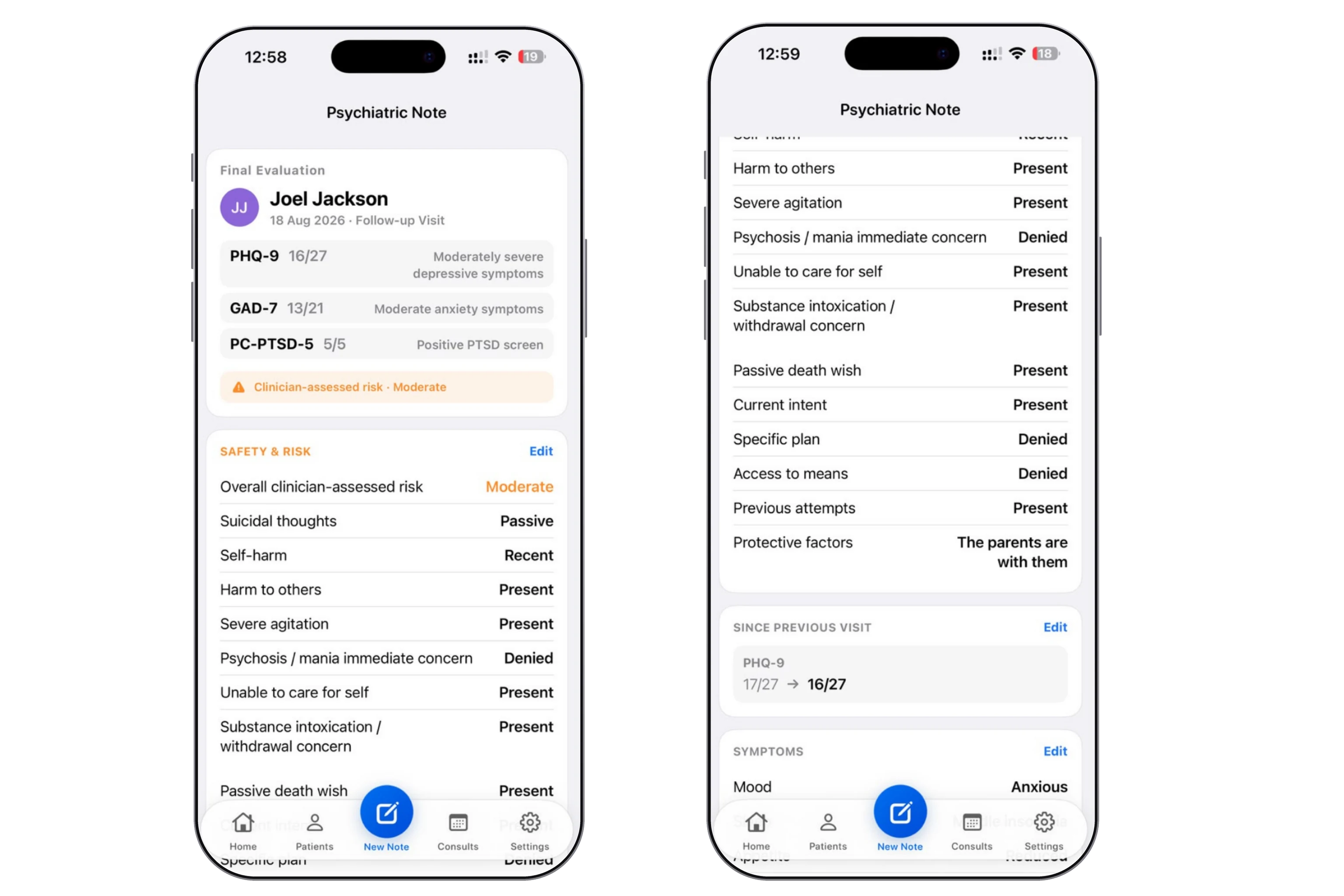
Evaluation summary and clinician-assessed risk; Structured safety review and protective factors
Step 5: Compare the Current Visit With the Previous Visit
Small changes can be clinically meaningful, but they are easy to miss when scores and notes are reviewed separately.
A comparison view would place the previous and current scores together so the evaluator could quickly identify improvement, deterioration or little change.
A score change is only one part of the evaluation. It should be interpreted alongside symptoms, functioning, safety findings and the clinician’s judgement.
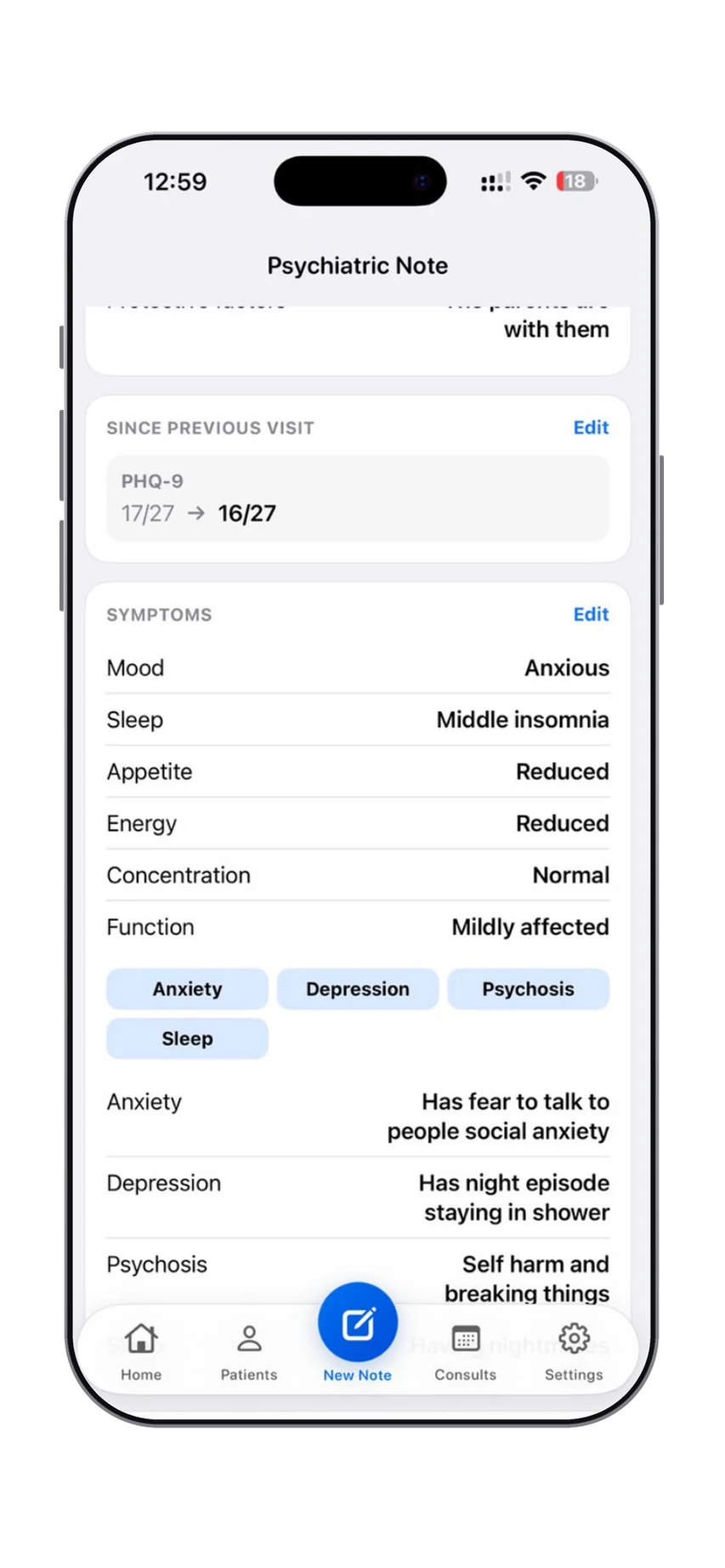
Current and previous PHQ-9 scores compared
Step 6: Document Symptoms and Their Effect on Daily Life
Symptom names alone do not explain how a person is functioning. The evaluator needs both structured findings and the patient’s own description of the experience.
The symptoms section would record Joel’s mood, sleep, appetite, energy, concentration and level of functional impact. Additional fields would allow the evaluator to document specific concerns related to anxiety, depression, psychosis and sleep.
This structure could support consistency without removing the patient’s individual story.
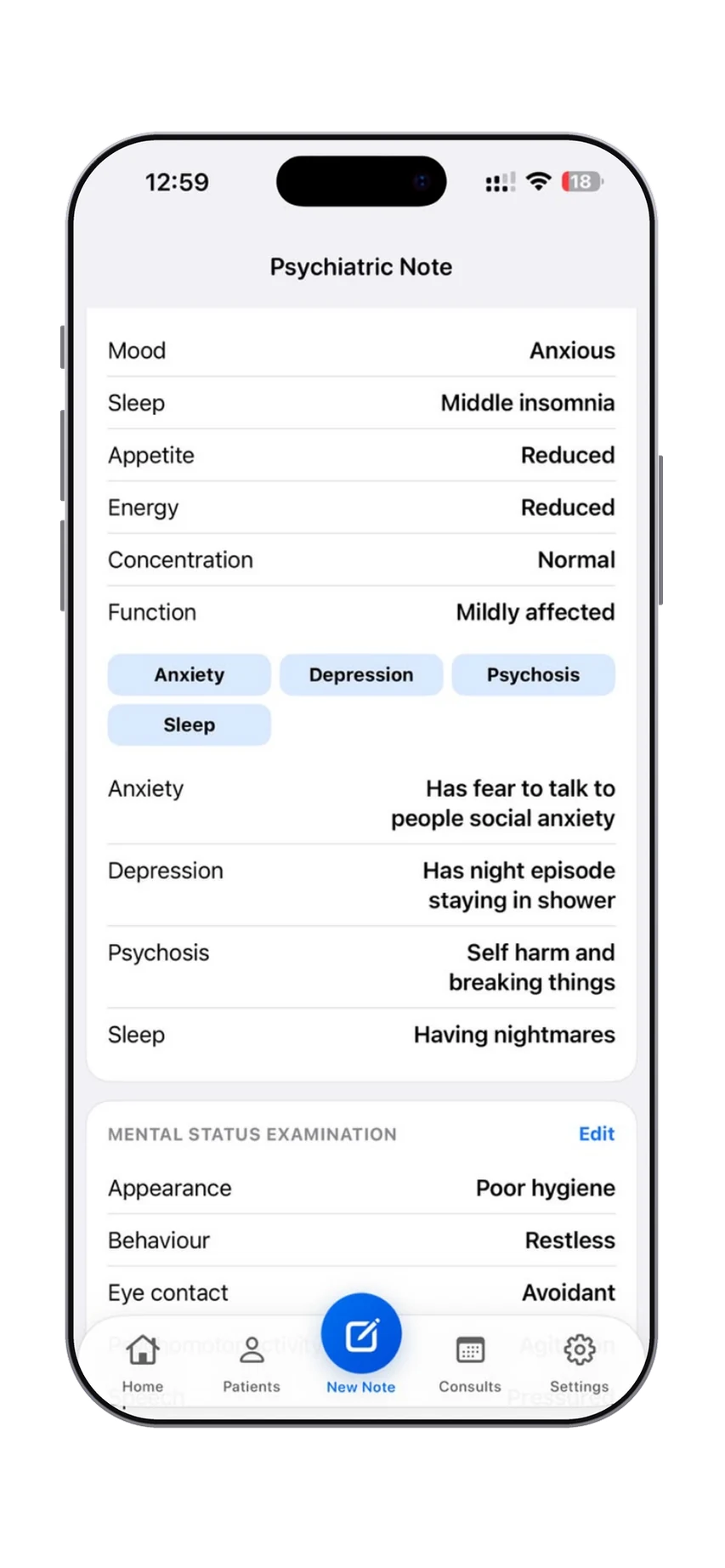
Symptoms, functioning and narrative detail
Step 7: Complete the Mental Status Examination
The mental status examination contains many domains. In a busy consultation, inconsistent documentation can make later review difficult.
The proposed Mental Status Examination workflow would guide the evaluator through appearance, behaviour, eye contact, psychomotor activity, speech, mood, affect, thought process, thought content, perception, cognition, orientation, insight, judgement and impulse control.
The selections would remain clinical observations made by the evaluator; the feature would only organise how they are recorded and reviewed.
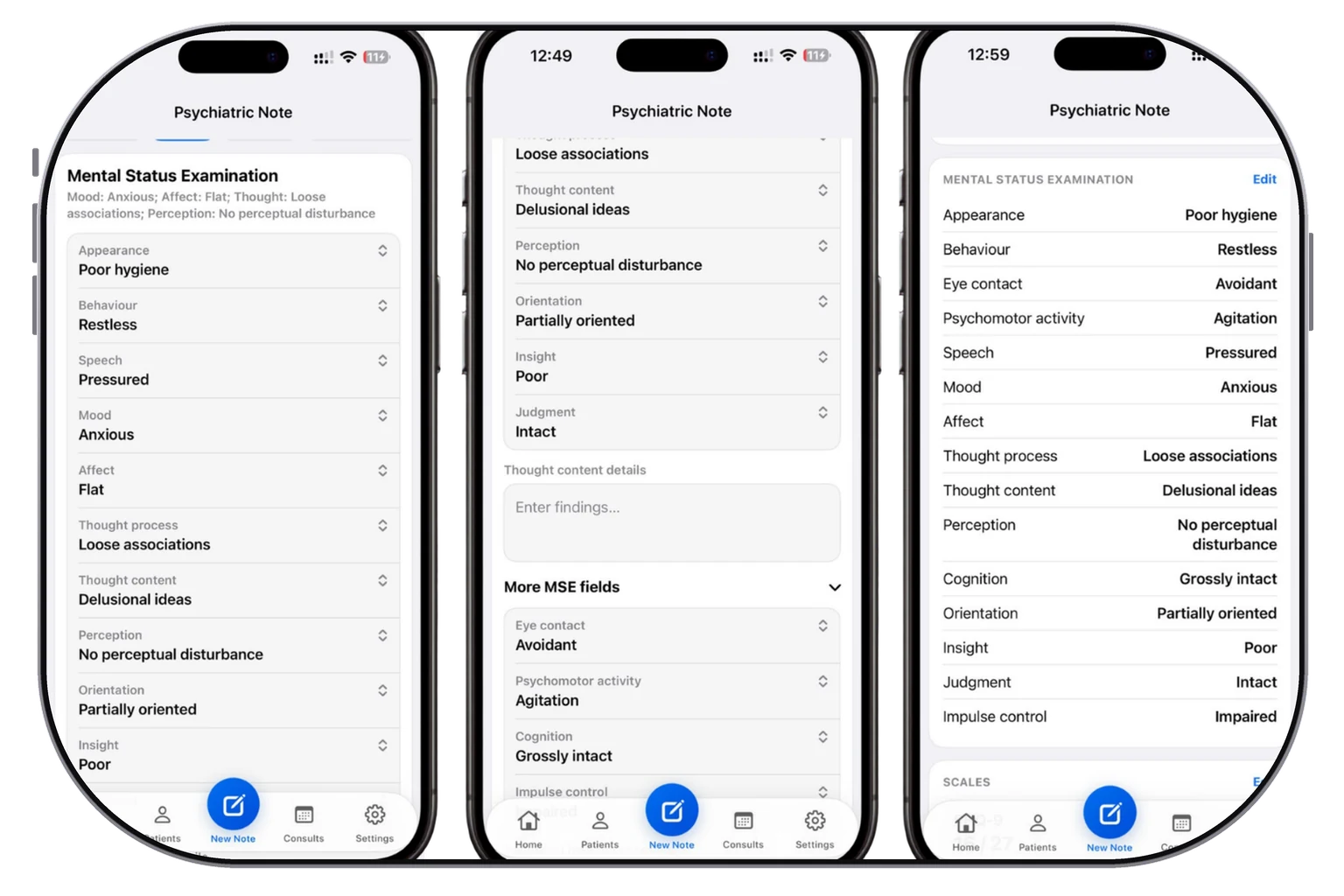
Core Mental Status Examination fields; Additional MSE domains; Completed MSE review
Step 8: Review Standardised Clinical Scales
Standardised scales are useful only when their results remain connected to the wider clinical picture.
The scales section would keep Joel’s PHQ-9, GAD-7 and PC-PTSD-5 results together, show interpretation ranges, retain prior scores when available and provide access to individual responses.
These tools would support assessment but would not provide a diagnosis on their own.
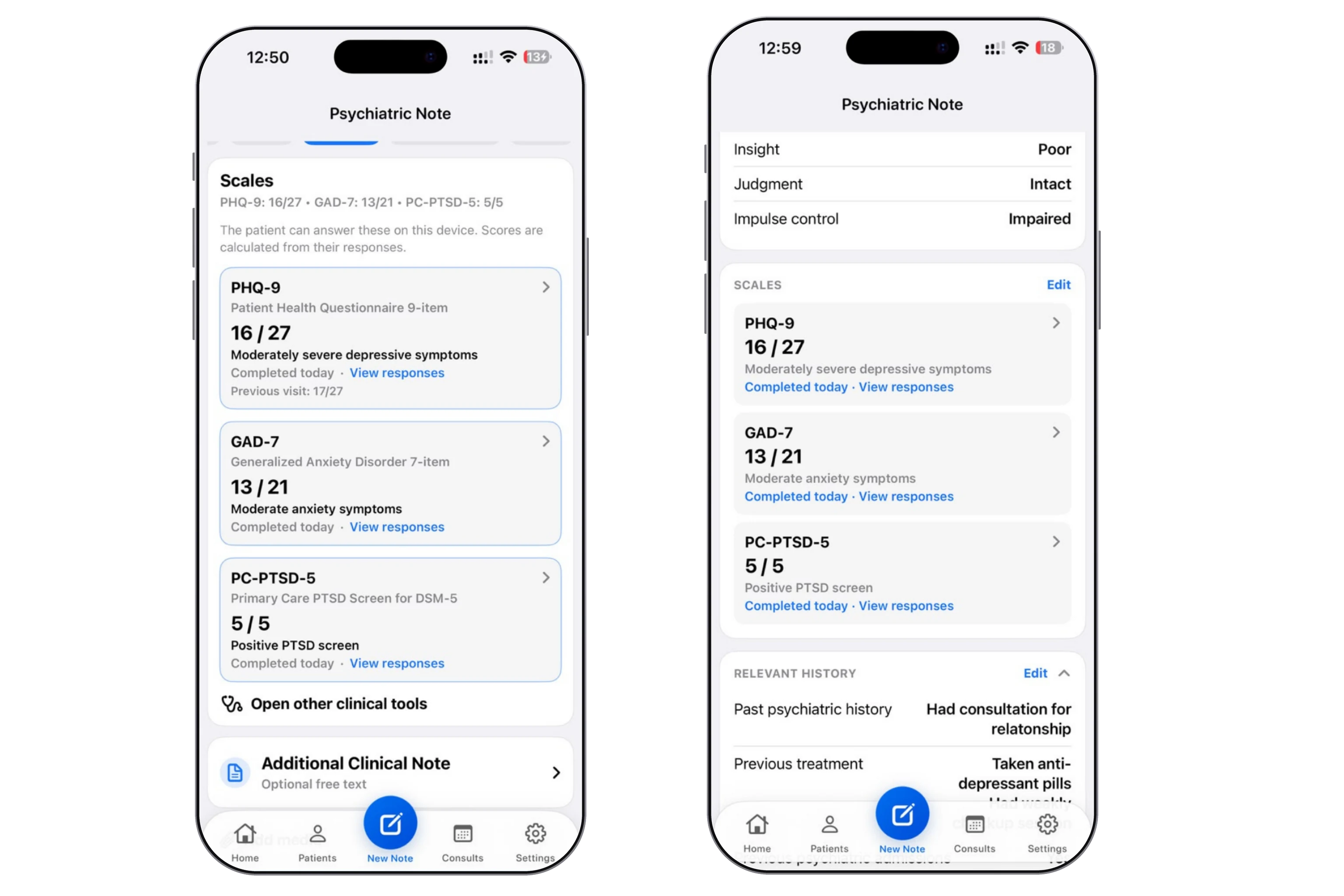
Clinical-scale scores, interpretations and responses; Clinical scales within the evaluation review
Step 9: Build the Assessment and Plan
The final plan must connect the clinician’s findings with diagnosis, treatment, investigations, referrals, safety planning and follow-up.
The assessment-and-plan workflow would bring these decisions into one structured section. The evaluator could document a working diagnosis, differential diagnoses, medication or treatment decisions, psychological interventions, investigations, referrals, psychoeducation, safety planning, follow-up timing and disposition.
The evaluator would remain responsible for ensuring that each decision is clinically appropriate, accurately categorised and clearly documented.
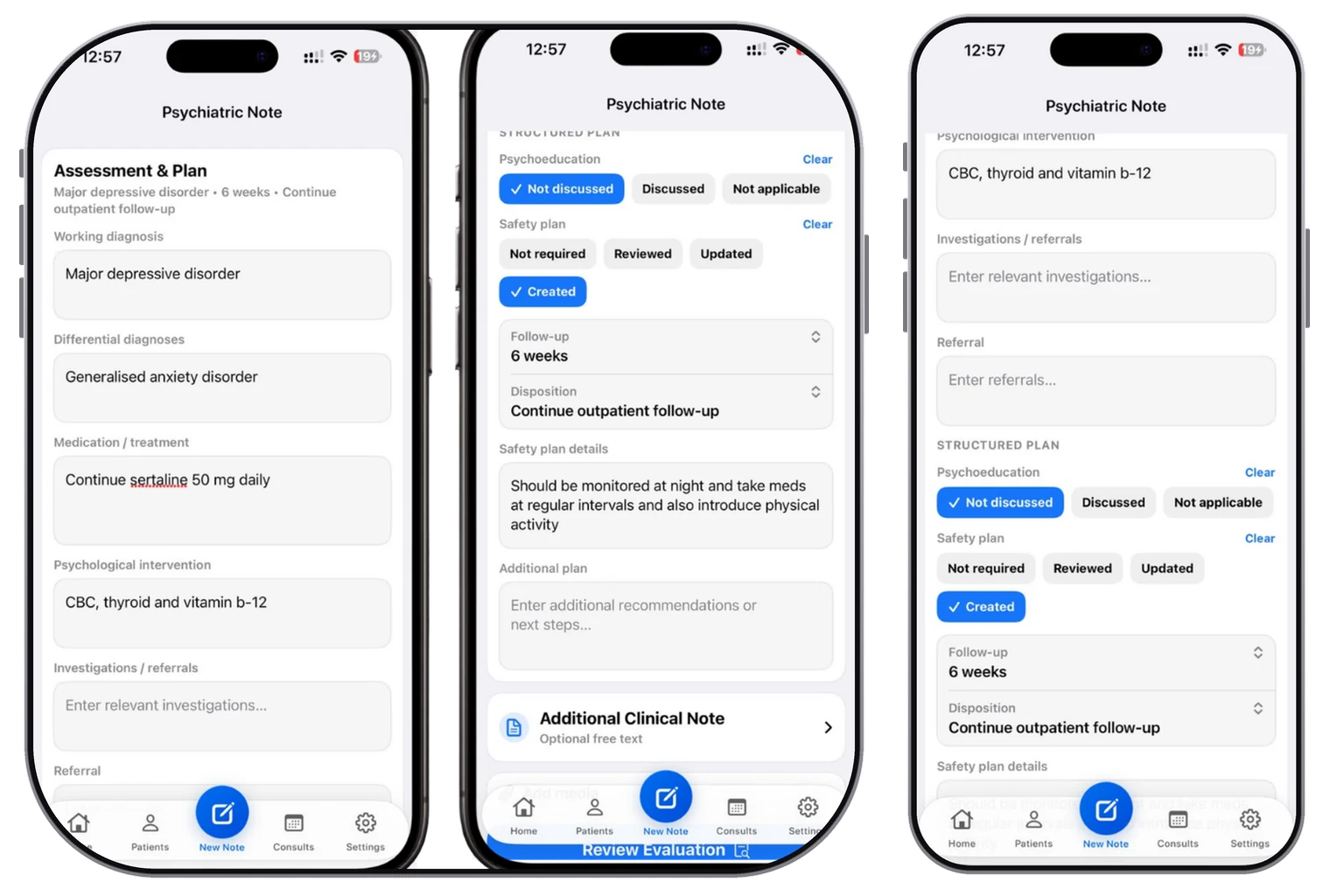
Diagnosis and treatment planning; Structured plan and follow-up fields; Safety-plan details and final recommendations
Step 10: Review the Complete Evaluation Before Creating the Final Note
Errors are easier to correct before a note becomes part of the clinical record. The evaluator needs a final opportunity to confirm that the findings and plan are complete and internally consistent.
A final review would bring the completed history, symptoms, MSE, scales, medication response and plan into a readable summary. Each section could be reopened for editing before the final note is created.
This final review could help identify missing information, unclear wording or contradictions before completion.
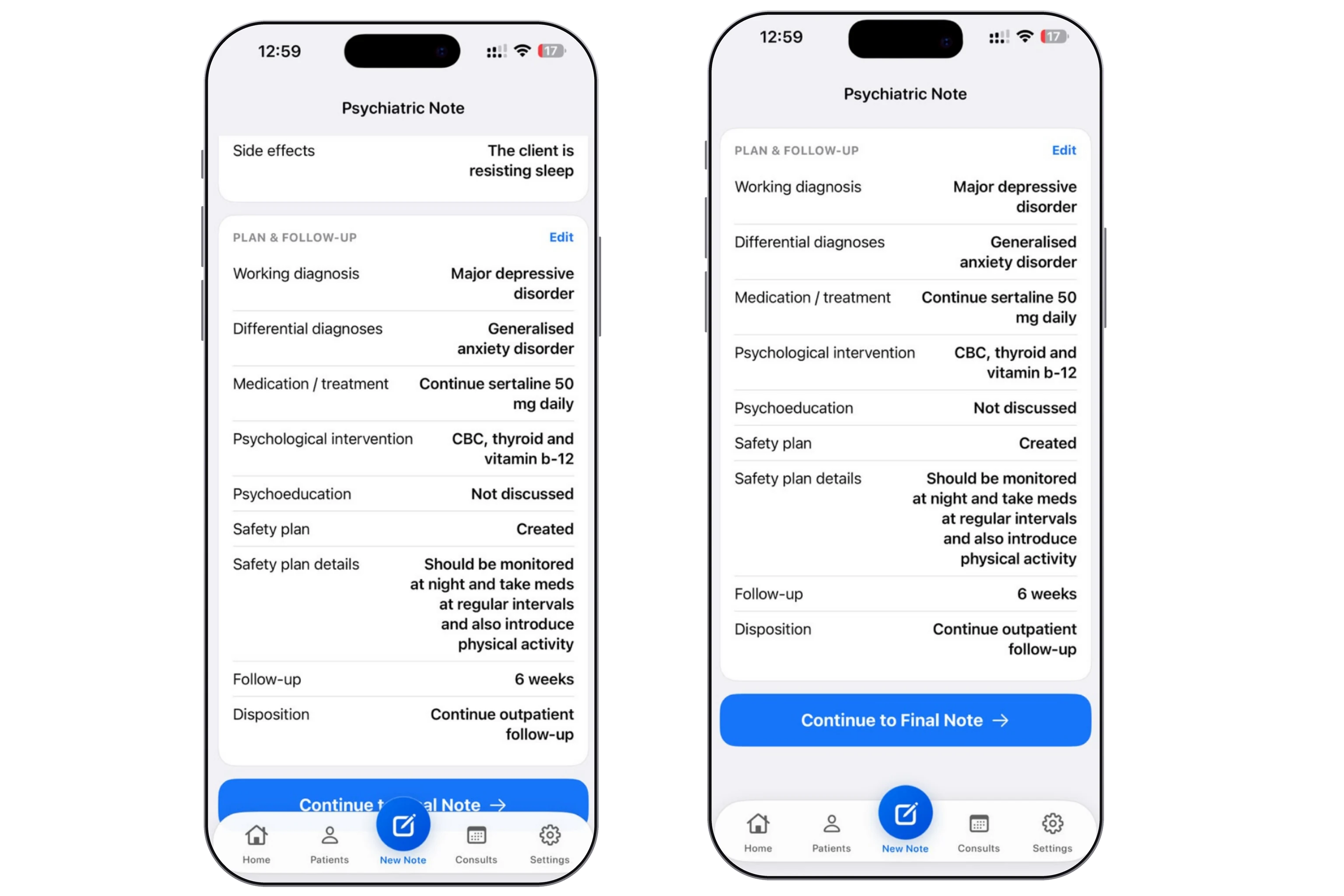
Plan and follow-up review; Continue to the final note
How the Proposed Psychiatric Evaluator Could Help in Everyday Practice
1. Support Continuity Between Visits
The feature is being designed to keep previous history, scores, treatment response and plans connected to the current evaluation.
2. Reduce Repetitive Documentation
The evaluator could review existing information and update what has changed instead of rebuilding the entire record during every follow-up.
3. Keep Safety Visible
Structured risk fields, protective factors and safety planning could remain linked within the same evaluation.
4. Make Clinical Change Easier to Recognise
Previous and current findings could be reviewed together, helping the evaluator identify meaningful trends.
5. Improve Note Consistency
A common structure could make documentation easier to review across clinicians and visits while still allowing narrative detail.
6. Protect the Human Conversation
Recording and transcription, when used with appropriate consent and organisational safeguards, could reduce the need for continuous typing and help the clinician remain more present with the patient.
7. Connect Findings With the Plan
The proposed workflow is intended to bring symptoms, risk, MSE findings, clinical scales, treatment response and follow-up decisions into a connected record.
Supporting Clinicians Without Replacing Clinical Judgement
Psychiatric evaluation requires empathy, professional training, careful interpretation and responsibility. No documentation tool can replace those qualities.
Dr. Notes is being developed to support the work around the clinical decision: gathering information, organising it, making changes easier to see and helping the evaluator create a record that is clearer to review.
For Joel, this could mean that his current symptoms are understood in the context of his history, treatment response, safety concerns and personal circumstances.
For the evaluator, it could provide a clearer path through a complex follow-up—from reviewing what happened previously to documenting what care is needed next.
Dr. Notes Psychiatric Evaluator: structured documentation for complex psychiatric evaluations, with the clinician’s judgement remaining at the centre.
We Would Value Your Feedback
This feature is still being developed, and feedback from psychiatrists and psychiatric evaluators will help us decide what to refine before release.
We would especially like to know:
- Would this workflow be helpful in your clinical practice?
- Does the sequence reflect how you conduct initial and follow-up evaluations?
- Which sections would be most valuable during a consultation?
- Is any important clinical information missing?
- Are there fields or steps that should be removed, simplified or reorganised?
- What additional features would make the tool more useful?
- How could we improve the safety, mental-status and treatment-planning sections?
This is an upcoming feature, not a released clinical capability. The screens shown are part of a proposed workflow and may change based on professional feedback.
Please share your suggestions and comments below. Your feedback can help us build a Psychiatric Evaluator workflow that better reflects the needs of real clinical practice.
Comments
Have a question, or a way you handle this in your own practice? Share it below.