

It's 9:52 a.m. on a Wednesday. Sofia runs a solo general practice above a pharmacy. Her 10:00 is Ms. Verma — a retired schoolteacher she's been seeing for two years. She's in for a crown seat on #14. The crown is on the bench, the bite check is done, the cement is out.
She glances at the chart the way she always does. Under Medical History, in her own handwriting from two years ago: "HTN — Lisinopril 10 mg." Below that are review checkboxes with initials and dates. The latest says "no changes" and is dated fifteen months ago. At the exam in June, Sofia asked Ms. Verma again. She said she was fine, and Sofia recorded the answer.
She seats the crown. The margin isn't right — the distal drops half a millimetre where the temporary had allowed the gingiva to creep. She takes a bur to the crown to relieve it and, doing so, catches the papilla. It's a nick. It happens. Except this one doesn't stop.
Sofia packs gauze. She waits. She packs more gauze. At 10:47 a.m. she asks Ms. Verma if there's anything she's taking that she hasn't told her about. She says, "just the blood thinner the heart doctor put me on earlier this year."
What's Actually Happening
This is not a story about a bad dentist. Sofia asked and recorded the patient's answer. What she didn't have was a moment, between the last full review and today, where the chart caught up with the patient.
The medical history in a solo dental practice is one of the most quietly load-bearing pieces of documentation in the whole chart. The American Dental Association lists apixaban among direct-acting oral anticoagulants and notes that these medicines can be associated with prolonged bleeding. Its guidance on anticoagulant and antiplatelet medications says any suggested change to a medication regimen before dental surgery should be discussed with the patient's physician. The ADA also says a complete, accurate medical and dental history is essential before diagnosing or treating a patient in its medical-history guidance. This scenario is about recognizing and documenting a reported medicine; it does not suggest stopping apixaban or making a treatment decision from the story alone.
The problem isn't that the profession doesn't know this. The problem is the mechanics of how the med history actually gets updated in a two-chair practice on a Wednesday morning:
- Intake form on paper, signed once. Ms. Verma filled it out two years ago with the pen chained to the front desk. Since then, recall reviews have been marked "no changes," but the medication list itself was never rewritten.
- Verbal check at the recall. "Any changes to your health?" A retired schoolteacher on a Tuesday morning may think about her blood pressure after a decade on Lisinopril. She may not think about the twenty-minute conversation with the cardiologist eight months ago that ended with a script for apixaban 5 mg twice daily, because to her that is the heart, not the mouth.
- The visit today is a crown seat, not a full exam. Nothing is scheduled to bleed. The plan is a five-minute appointment. The med history conversation that would have happened at a comprehensive exam doesn't happen.
- An undocumented verbal check is hard to reconstruct. If the chart doesn't include the date, question and answer, it may be difficult later to show exactly what was reviewed with the patient.
Since her last full medical-history review, Ms. Verma had a cardiology visit and a new prescription. At the June recall, the change went unmentioned. Her mouth was unchanged. Her medication history was not. The chart didn't know.
This Is Not A Rare Story
MedPro Group, one of the larger dental malpractice insurers in the US, publishes case summaries of closed claims. In "Failure to Assess Medical History Leads to Legal Action", they walk through a claim involving a 67-year-old man on Coumadin who came in for an extraction of tooth #14. The dentist's entire recorded medical history for the extraction visit was:
"Coumadin and HBP."
— Chart entry, MedPro Group closed claim, medprodental.com
The patient bled overnight. His son drove to the house that evening after being unable to reach him by phone. The write-up is worth quoting in full because it names the exact texture of the moment every solo dentist has been half a step away from:
"The patient's son… was unable to reach his father that evening, so he drove to his father's house, to find him conscious but lying on the floor with blood seeping out of his mouth."
— MedPro Group case narrative, medprodental.com
MedPro's second published case, "How Ignoring a Patient's Medical History Can Lead to a Lawsuit", tells a shorter version of the same story with a different mechanism: a newly retired patient who had disclosed a history of infective endocarditis on the intake form, which was on the chart but was not reviewed before subgingival scaling. She was hospitalised days later, required a PICC line, and settled pre-suit. MedPro's practice-wide recommendation reads like it was written for a Wednesday morning:
"All practitioners involved in patient care should regularly, before treatment starts, review patients' medical histories, verbally clarify and discuss with patients their positive responses."
— MedPro Group Dental risk management, medprodental.com
What Working Clinicians Are Saying
Samantha Via, RDH, writing in Today's RDH, "The Safest Dental Appointment Begins with an Updated Medical History", opens with the sentence every dental hygienist has heard at the front desk:
"Why do I need to fill out another medical form when everything is still the same?"
— Samantha Via, RDH, Today's RDH
Via's answer, the one that has to live somewhere the clinician can act on it, is straightforward:
"Medical status can change in just one day, so it is our responsibility to use good judgment… Failing to update medical history is one of the top reasons dentists are sued."
— Samantha Via, RDH, Today's RDH
Carol Tekavec, CDA, RDH, writing in Dentistry IQ, "Medical History: An Office's Responsibility", put the frame in one line that the whole profession has been quoting for a while now:
"The patient's chart does not just prevent malpractice; it is a blueprint for care and treatment."
— Carol Tekavec, CDA, RDH, Dentistry IQ
Three voices, one story: the intake form on day one is not the medical history. The medical history is the running, time-stamped record of what the patient's body is doing between visits — including the parts the patient forgets to mention because they belong to the heart doctor, not the dentist.
Why The Update Loses
Every solo dentist knows the med history has to be reviewed at every visit. What breaks down is the mechanics of doing it:
- The paper form lives at the front desk, not in the operatory. By the time Sofia is chairside, the form is a photocopy of a photocopy in a manila folder two rooms away. Whatever the patient wrote on it two years ago is a memory of what she wrote at forty-nine years old.
- The verbal check gets shorthanded. "Any changes?" is not a medical history — it's a question that lets a tired patient say "no" without thinking about the apixaban. It also does not survive as a chart entry unless the dentist writes it down in the same breath.
- The recall interval is longer than a prescription cycle. Between one six-month recall and the next, a patient over sixty can start an SSRI, a DOAC, a bisphosphonate, an immunomodulator, or begin chemotherapy — medicines and treatments that may affect bleeding, healing, infection risk or anaesthetic planning.
- Nobody is going to type the update between ops. If updating the chart means walking to the front desk, sitting at the terminal, opening the patient, finding the medical history tab, and typing in the new drug and dose — while the next patient is already numbing — the update does not happen. The dentist tells themselves they will do it tonight. Tonight there are seven other charts.
The people who wrote the ADA guidance and the MedPro closed claims aren't wrong. They are describing a standard of care that presumes the clinician has a tool that lives at the chair, not two rooms away.
Where Dr. Notes Fits
Dr. Notes won't make Ms. Verma volunteer the apixaban. It gives Sofia a place to record what the patient reports and keep the visit note, medication and allergy records, dental history and follow-up reminders connected to the patient.
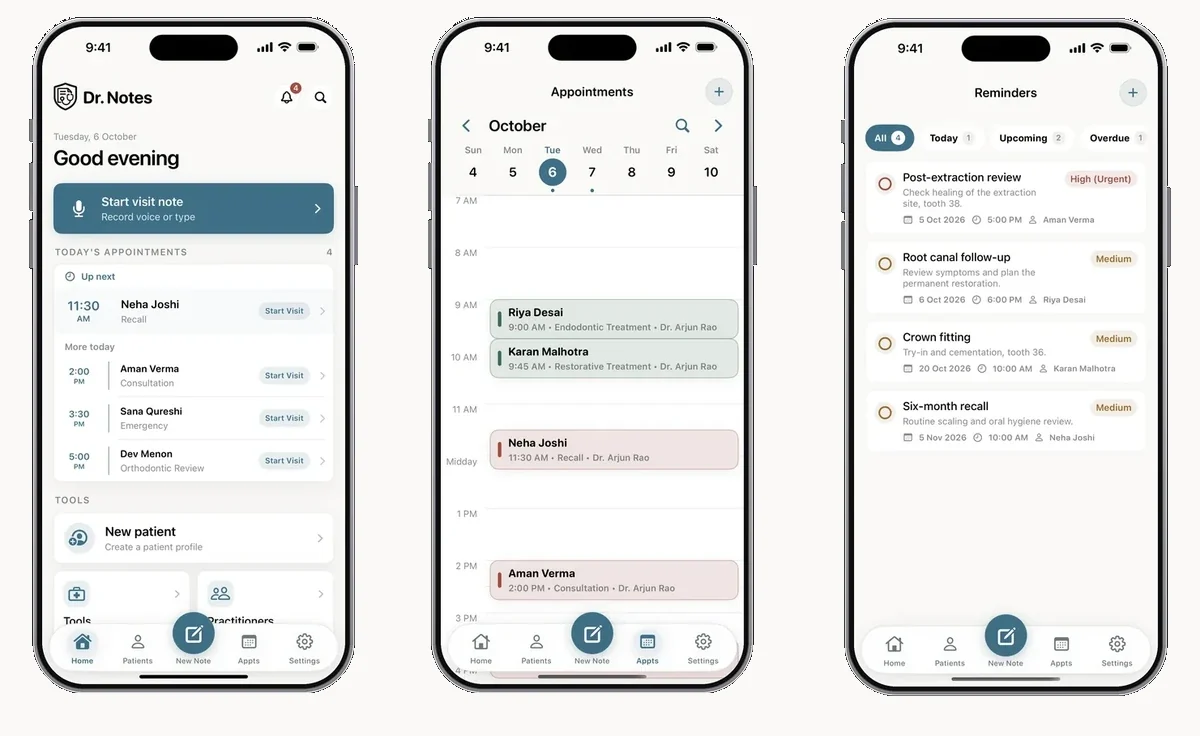
- Record what the patient reports. Sofia can create a voice note or type a visit note at the chair, recording that Ms. Verma reports starting apixaban in January 2026. She can then verify the details with the patient and update the medication record separately. Voice capture records the conversation; it does not verify or reconcile a medication list.
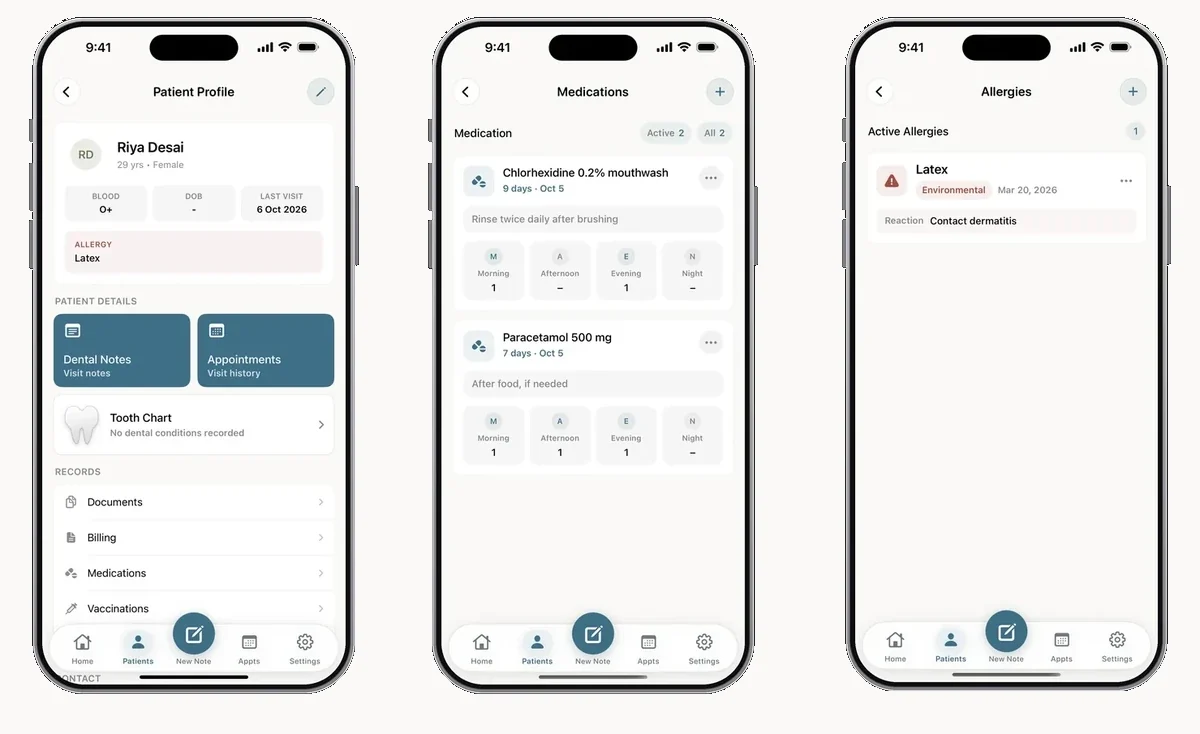
- Visit history sits on the patient's profile. From Ms. Verma's profile, Sofia can open the medication and allergy records, dental notes, documents, appointment history and tooth chart. They are accessible from the patient's record when she prepares for the crown seat.
- Attach the intake form and the cardiologist's letter. Dr. Notes lets you add images and short files to a note. Sofia can attach a photo of the intake form or a cardiologist's letter so it stays with the visit documentation.
- It works offline, at the chair. The operatory Wi-Fi doesn't matter. Dr. Notes is local on the device, so the visit can be documented in the room, not "later, when the network is back".
- Recall reminders are tied to the patient. Sofia can set a patient-specific recall reminder and add a note to prompt a fresh medication, diagnosis and hospitalisation check at the next visit.
Other dental tools from Dr. Notes: Use the Tooth Chart to map tooth-specific findings, or the Dental Local Anaesthetic Maximum Dose Calculator for a local anaesthetic dose calculation. The calculator does not reconcile medications or assess anticoagulant-related bleeding risk.
None of this changes what the dentist has to ask. It changes whether the answer survives in a form the same dentist can reach eight months later, on a Wednesday morning, with a crown in hand and the papilla starting to weep.
The Wednesday-Morning Version
Twelve months from now, Ms. Verma is back for another recall. Sofia opens the patient on her phone. The medication list on the profile reads: "Lisinopril 10 mg qd — HTN; apixaban 5 mg BID — paroxysmal AF, Dr. Iyer, cardiology, since January 2026 (patient report)." The entry is dated. Sofia's visit note records what she confirmed with the patient.
Sofia asks Ms. Verma if anything has changed since last time. She says no. Sofia asks specifically about the apixaban — is she still taking it, at the same dose, from the same prescriber. Ms. Verma says yes. She adds one line to the chart: "apixaban continues, confirmed with patient today, 5 mg BID."
Nothing dramatic happens. That's the point. The dramatic thing already happened, twelve months ago, when the papilla wouldn't stop bleeding at 10:47 a.m. and Sofia realised the chart had drifted from the patient. This time the chart hasn't drifted.
One Last Thing
Sofia's near-miss with Ms. Verma is not a story about negligence. She asked. She ticked the box. She had a signed paper form. What she needed was a record she could update in the room: a visit note for what the patient reported and a medication entry updated after verification.
MedPro Group has been publishing this same case, with different names, for two decades. Samantha Via and Carol Tekavec have been writing about it in the trade press for almost as long. The ADA guidance has not moved. What has moved is the tool the dentist reaches for when the patient says "the heart doctor put me on something earlier this year" — and whether that tool is on the desk two rooms away, or in the hand that just placed the crown.
Dr. Notes is on the App Store and Google Play. Try it for a week of recalls and see how the medication list on your third-favourite patient looks by Friday.
Comments
Have a question, or a way you handle this in your own practice? Share it below.