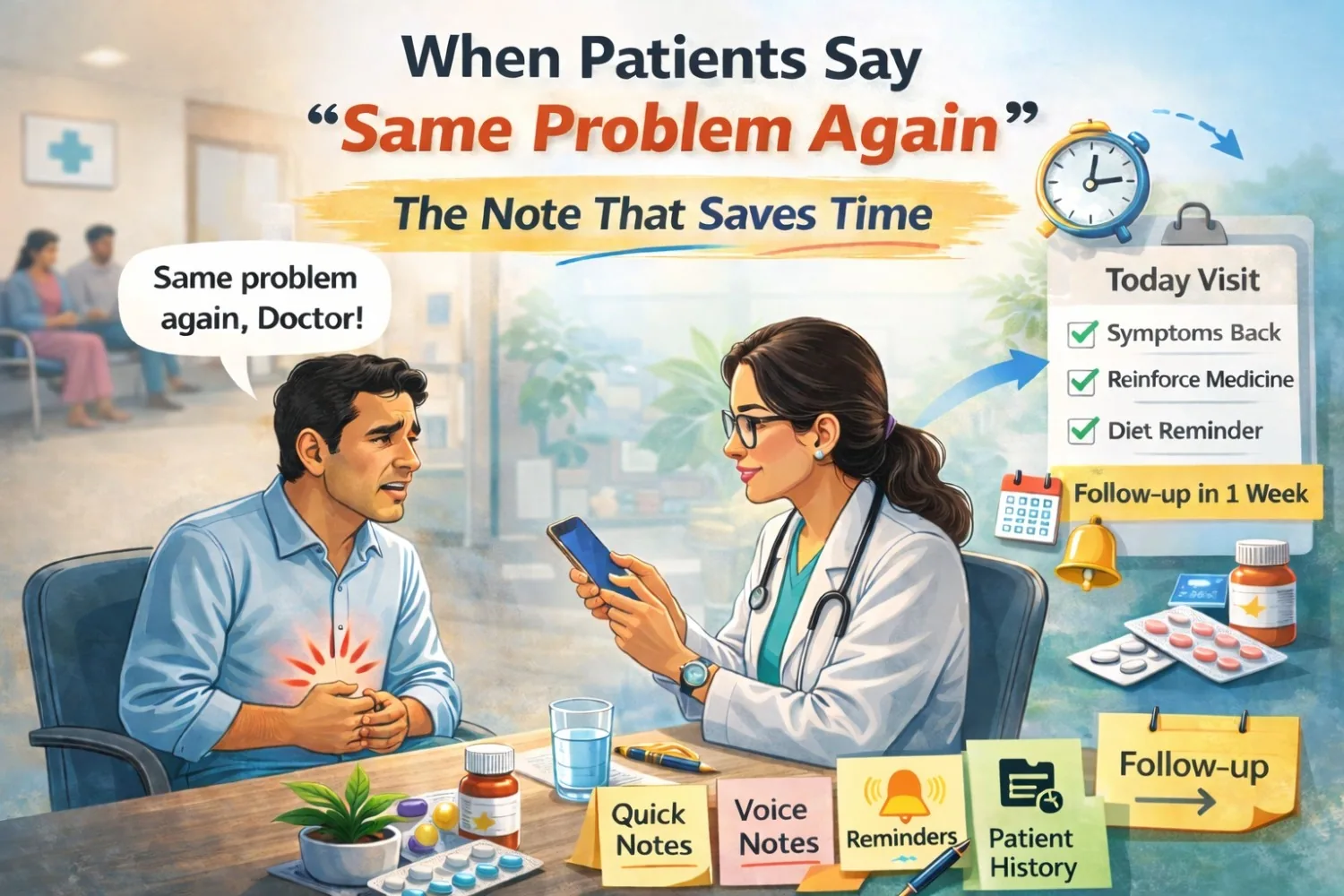
You’re in the middle of a busy clinic day. The waiting area is full. You’ve already seen 25 patients.
Then someone walks in and says: “Doctor… same problem again.”
That one line can slow everything down. Not because the case is hard. But because your brain has to search.
- What happened last time?
- Which medicine worked?
- What did we warn them about?
- Was there a red flag?
- Did we plan a follow-up?
If the internet is slow, or the EMR takes too many clicks, or the old paper file is missing… you end up doing the same work again. And that’s where one simple, clear note saves real time.

Try Dr. Notes on Mobile
- Secure On-Device Data
- Instant Voice Notes
- Simple Patient Management


A Typical “Same Problem Again” Visit
Dr. Meera runs a small clinic. On a Monday evening, Ramesh (38) comes in and says: “Same stomach burning again, doctor.” Dr. Meera remembers seeing him a few weeks ago—but not the full details. She opens Dr. Notes on her iPhone.
In the patient timeline, she sees the last visit note immediately:
Last visit (3 weeks ago):
- Burning pain after tea/spicy food
- More at night
- No vomiting, no black stools
- Started PPI + antacid
- Avoid late dinner, reduce tea
- Review in 2 weeks if not better
In seconds, Dr. Meera knows the story.
So instead of asking everything from zero, she asks the right next questions:
- “Did you reduce late dinner?”
- “Any weight loss or vomiting?”
- “Pain waking you at night still?”
Ramesh admits he stopped the medicine after 5 days because he felt better. He continued late-night meals. Now the visit becomes quick and focused. Dr. Meera updates the plan and adds one line:
Today: symptoms returned after stopping meds early; reinforce course + lifestyle; follow-up if persists.
Ramesh leaves happy because the doctor “remembered everything.” Dr. Meera saves time because she didn’t restart the entire history.
Why “Same Problem Again” Wastes Time
When notes are not easy to access, follow-ups become slow because we must:
- Repeat the same questions
- Re-check old prescriptions
- Guess what worked
- Miss small details that matter
- Spend extra minutes per patient
Even 2–3 minutes extra on each repeat case becomes a lot in a full day. And the biggest issue is mental load. The day is already busy. You don’t want your brain to be a storage system.
The Note That Saves Time Is Not a Long Note
It’s a short note with the right points.
For repeat problems, a good note usually includes:
- Main complaint (in patient’s words if needed)
- Key findings / key negatives (no red flags)
- What you did (treatment plan)
- What worked / what didn’t
- Follow-up instruction (when to return)
That’s it. Not a full essay. Just the pieces that make the next visit faster.
How Dr. Notes Helps in This Moment
Dr. Notes is designed for exactly these real clinic situations:
1) Clear Timeline
Every visit stays in order, so when the patient returns, you can review the last note in seconds.
2) Fast Entry
You can write / record quick notes without opening multiple screens.
Open → write / record → save.
3) Voice Notes When You’re Tired
After the consult, you can record a short voice note like:
“Recurrent acidity. Stopped meds early. Restart PPI 2 weeks. Diet advice reinforced.”
That’s often faster than typing.
4) Works Without Internet
Follow-ups don’t wait for network. Your notes are available even during poor connectivity.
5) On-Device Storage
Notes stay on your device, giving you more control and reliability in daily practice.
A Simple “Repeat Visit” Note Format
Here’s a quick format that works in real life:
Repeat complaint: ___
Since last visit: better/worse + why (stopped meds / trigger / missed dose)
Red flags: none / mention if present
Plan: medicine + advice
Follow-up: when
Example (10–20 seconds):
“Same knee pain again. Stopped exercises. No swelling/red flag. Restart rehab + NSAID gel. Review in 7 days.”
That note is small—but it saves minutes later.
The Real Win: Patients Feel Remembered
When you can quickly recall the last plan, patients feel:
- “Doctor is listening.”
- “Doctor remembers my case.”
- “This clinic is organized.”
That trust matters. And for you, it reduces stress. You don’t carry old cases in your head all day.
Final Thoughts
Patients will always return with repeat problems. That’s normal. But repeating the full history every time is not necessary—if your notes are clear and easy to access.
The right note doesn’t just store information. It gives you back time, calm, and confidence during a busy day.
Try Dr. Notes on Mobile
- Secure On-Device Data
- Instant Voice Notes
- Simple Patient Management
Comments