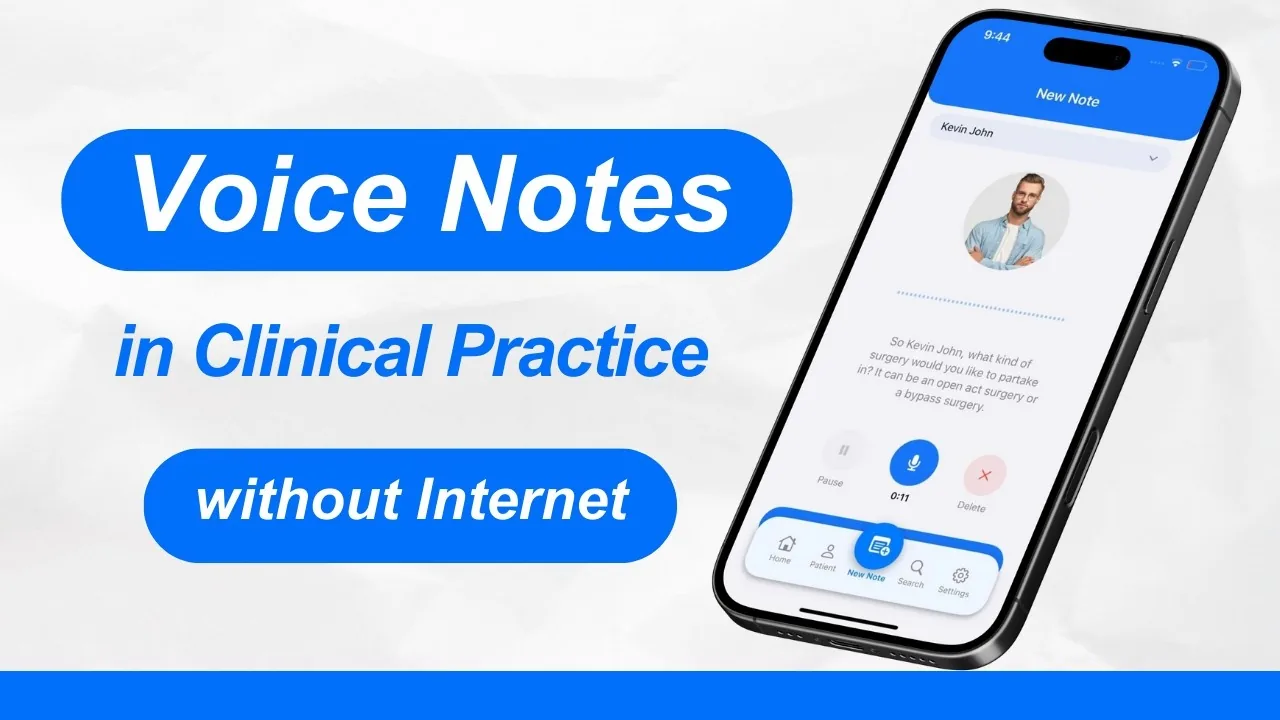
Clinical documentation is essential, but in real-world practice, internet access is not always reliable. Busy clinics, rounds, emergencies, and semi-urban or rural settings often operate with unstable or no connectivity. Yet patient care and documentation must continue without interruption.
This is where voice notes that work without internet become a practical and powerful tool in clinical practice.
The Reality of Documentation in Everyday Clinics
Doctors and healthcare professionals are expected to:
- Capture patient complaints and observations accurately
- Remember subtle symptom details across visits
- Document care during rounds and follow-ups
- Continue working during network issues or outages
Internet-dependent documentation systems often fail in these situations, forcing clinicians to rely on memory or paper notes—both of which increase the risk of errors.
Why Voice Notes Work Better Than Typing
Clinicians naturally think and observe in narratives, not forms. Voice notes allow doctors to record their thoughts, findings, and decisions as they happen, without breaking focus or slowing down the consultation.
Voice notes help by:
- Saving time compared to typing
- Preserving clinical context and nuance
- Reducing mental load and reliance on memory
- Allowing better patient interaction
This is especially valuable in practices such as homeopathy, Ayurveda, mental health, physiotherapy, and nursing care, where symptom descriptions matter more than checkboxes.
Why Offline Capability Is Essential
Many digital tools assume constant internet availability. In reality:
- Networks may be slow or unstable
- Connectivity can drop during peak clinic hours
- Rounds and emergencies may occur away from workstations
Offline voice notes ensure documentation continues without interruption. Clinicians can record observations anytime and review them later—without depending on connectivity.
Healthcare cannot pause for internet access.
Try Dr. Notes on Mobile
- Secure On-Device Data
- Instant Voice Notes
- Simple Patient Management


Real-World Use Cases for Offline Voice Notes
During consultations: Doctors can record immediate observations after seeing the patient.
During rounds: Voice notes allow quick documentation while moving between patients.
In emergencies: When typing is impractical, voice recording ensures critical details are captured.
Across follow-ups: Recorded notes help clinicians recall reasoning, symptom progression, and treatment decisions clearly.
Voice Notes in Practice with Dr. Notes
Dr. Notes is designed as an offline-first clinical notes app, built for real-world clinical environments.
With Dr. Notes, clinicians can:
- Record voice notes instantly
- Store patient data securely on the device
- Access patient records without internet
- Use the app on iPhone and iPad
- Maintain continuity of care across multiple visits
By combining offline access, secure data storage, and voice recording, Dr. Notes supports faster, more reliable documentation without disrupting clinical flow or compromising patient confidentiality.
Best Practices for Using Offline Voice Notes
- Record notes immediately after consultations
- Speak clearly and concisely
- Ensure notes are stored securely within the app
- Include key symptoms, observations, and treatment plans
- Use voice notes alongside structured patient records
- Maintain a consistent documentation habit
Voice notes are most effective when used as part of a secure, organized, and consistent clinical workflow.
Final Thoughts
Voice notes are not about replacing clinical documentation—they are about making documentation realistic.
In real-world clinical practice, tools must adapt to time pressure, connectivity issues, and patient-centered care. Voice notes that work without internet help clinicians document accurately, work efficiently, and focus on what matters most—the patient.
Try Dr. Notes on Mobile
- Secure On-Device Data
- Instant Voice Notes
- Simple Patient Management
Comments